


Exchange Migration Manager
EdbMails is an automated solution designed for secure and reliable Exchange migration. It enables mailbox migration from Exchange Server versions such as 2019, 2016, 2013, 2010, and 2007. The software supports migration to both Microsoft 365 and on-premises Exchange servers with zero downtime. In addition to mailboxes, it also migrates Public folders, Archive mailboxes, Calendars, Contacts, Journals, and Tasks while maintaining complete data integrity.
EdbMails is built to simplify concurrent mailbox migration, improving the consistency, performance, and overall speed of the migration process.
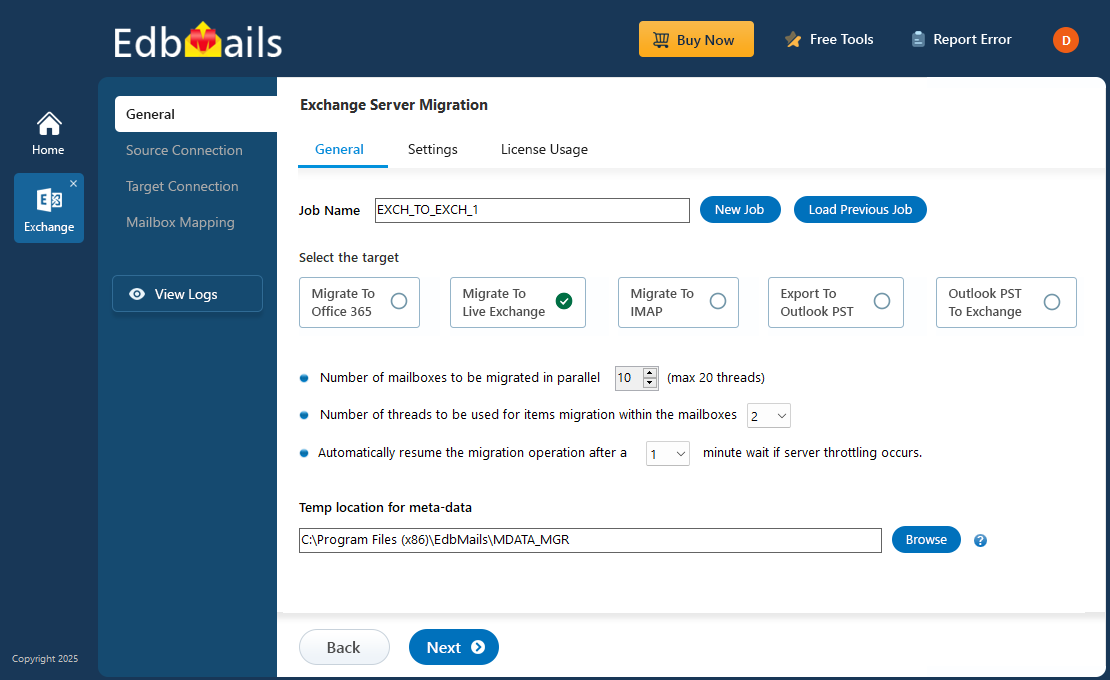
With a wide range of advanced capabilities such as incremental migration, automatic throttling handling, automatic mailbox mapping, and customized target folder mapping, EdbMails stands out as a reliable Exchange Server migration manager designed for smooth and efficient mailbox migration.
How can EdbMails Exchange Migration Tool benefit?
Many Exchange Server experts, including Microsoft MVPs, rely on EdbMails for its array of benefits that simplify the Exchange migration process, making it easy to meet your organization's specific needs.
Exchange Migration with High Performance and Speed
EdbMails Exchange migration manager facilitates concurrent mailbox migrations, boosting the efficiency of your Exchange migration. This feature expedites the migration process by allowing multiple mailboxes to be migrated simultaneously. By default, it supports up to 10 concurrent mailbox migrations, and you have the flexibility to increase it to a maximum of 20, further enhancing performance and speed.
Zero Impact on End-Users during Exchange Migration:
EdbMails Exchange migration tool ensures data integrity and keeps the migration operation hidden from end-users. Your work remains uninterrupted as the migration runs seamlessly in the background, allowing for uninterrupted productivity. Throughout the migration process, data remains unblocked.
Efficient Exchange Migration Monitoring System:
While performing the Exchange migration process, the software continuously monitors progress and automatically generates a comprehensive live log report. This log report provides users with valuable information regarding the ongoing migration.
No Involvement of Third Parties in Migration Operation:
EdbMails software is installed within your environment, eliminating the need for third-party tools or cloud services. This ensures that your data remains secure on your servers and is directly transferred to the target servers. As a result, there's no requirement to share your login credentials with any third parties or additional services.
Preservation of Data Integrity during Migration:
EdbMails Exchange Migrator doesn't alter or remove data on the source server. It solely migrates your items to the target location, ensuring that your data remains entirely unaffected throughout the migration process.
Supported Exchange migration types by EdbMails
Cross-forest Migration
- Migrate from / to Exchange 2007/ 2010/ 2013 /2016 /2019.
Intra-forest Migration
- Exchange 2007 to Exchange 2010/2013
- Exchange 2010 to Exchange 2013/2016
- Exchange 2013 to Exchange 2016/201
- Exchange 2016 to Exchange 2019
Hybrid Migration
- On-premises Exchange to Office 365 & Hosted Exchange
- Hosted Exchange to Hosted Exchange, Office 365 & On-Premises Exchange
- Office 365 to On-Premises Exchange, Office 365 & Hosted Exchange
Simple Steps to perform Exchange migration using EdbMails
Step 1: Install and Launch EdbMails
- Download and install EdbMails Exchange Migration tool on a Windows system.
- Launch the EdbMails application on your computer.
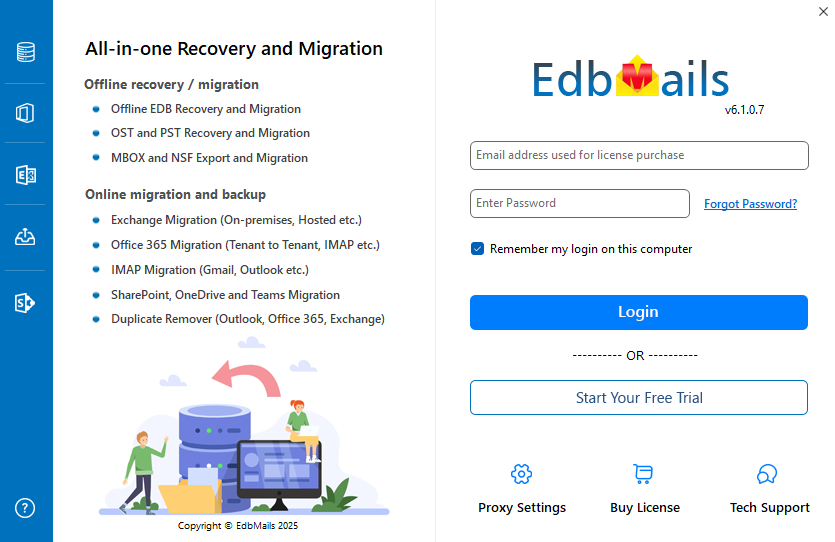
- Enter your registered email ID and password and click ‘Login’. If you are a new user, select ‘Start Your Free Trial’ to continue with the trial version.Note: The trial edition includes all main features and allows migration of up to 30 items per folder. For unlimited migration, purchase an Exchange Migration license from the official EdbMails website.
Click here to view Exchange Migration pricing details.
After purchasing the license, close the application and open it again. Then log in with the same email ID and password used during the purchase to activate your license successfully.
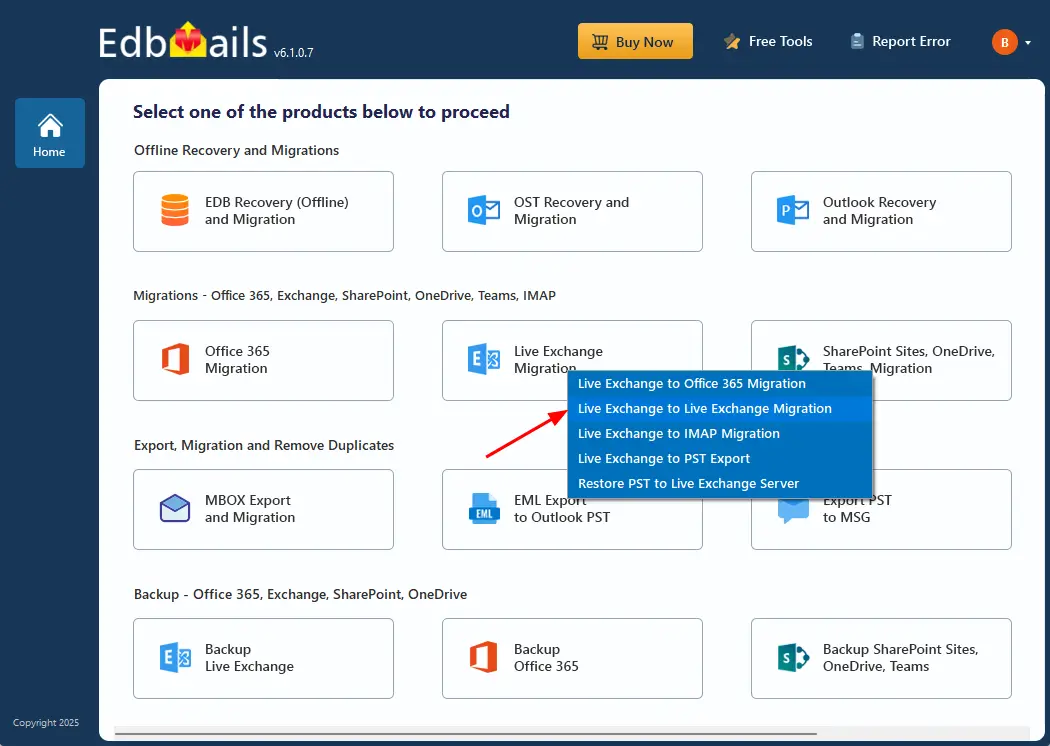
- Choose ‘Live Exchange Migration’ → ‘Live Exchange to Live Exchange Migration’.
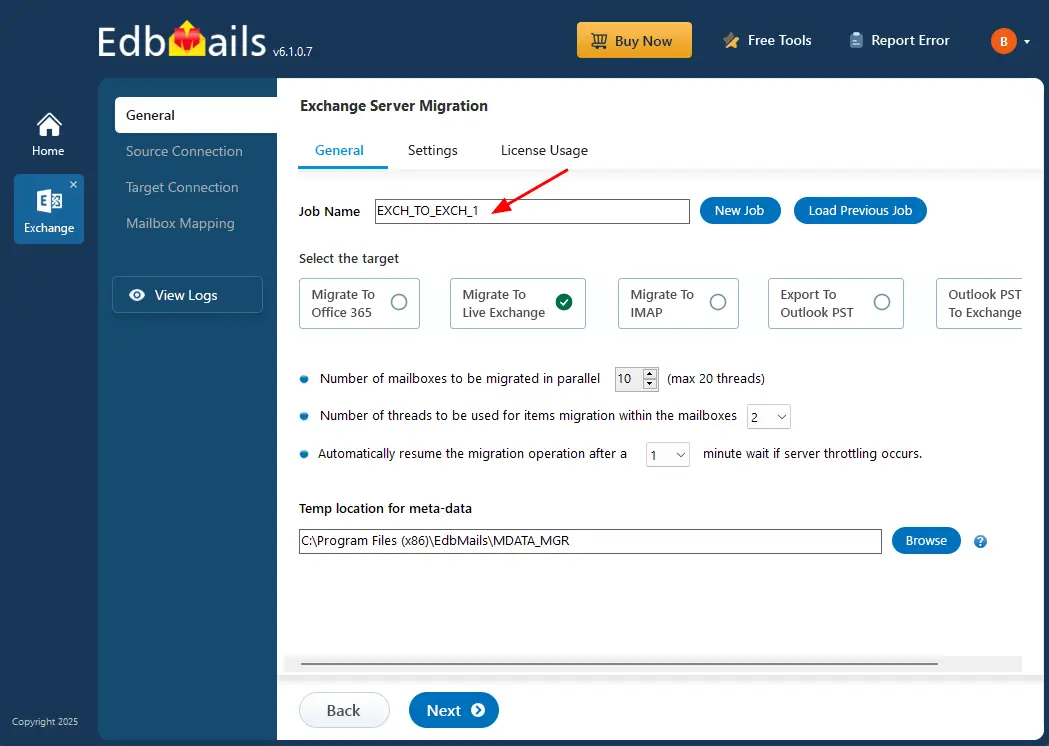
- To set a custom name for the job, click the ‘New Job’ button and enter the name you prefer. If you don’t want to change it, you can continue with the default job name already provided.
Step 2: Connect to source Exchange server
- Click ‘Add New Connection’ to set up the source Exchange connection or select a saved one.
- Choose the appropriate connection method and enter the server details to log in.
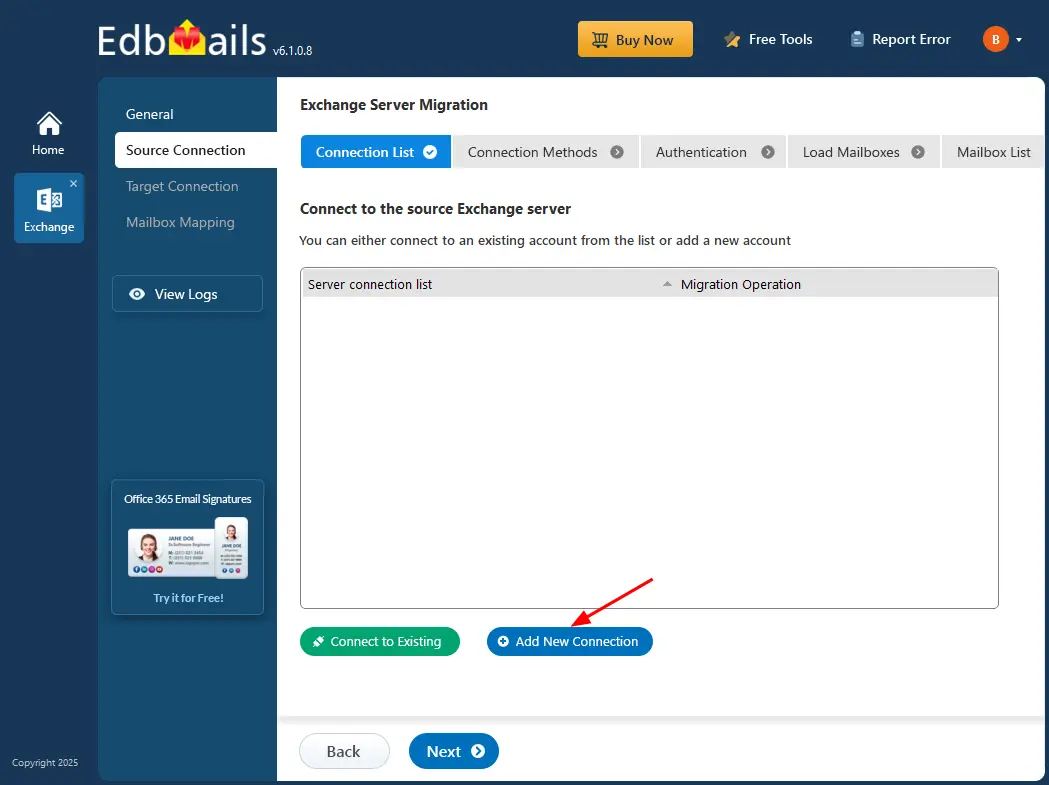
- Load mailboxes automatically or via CSV if more than 100 are present.
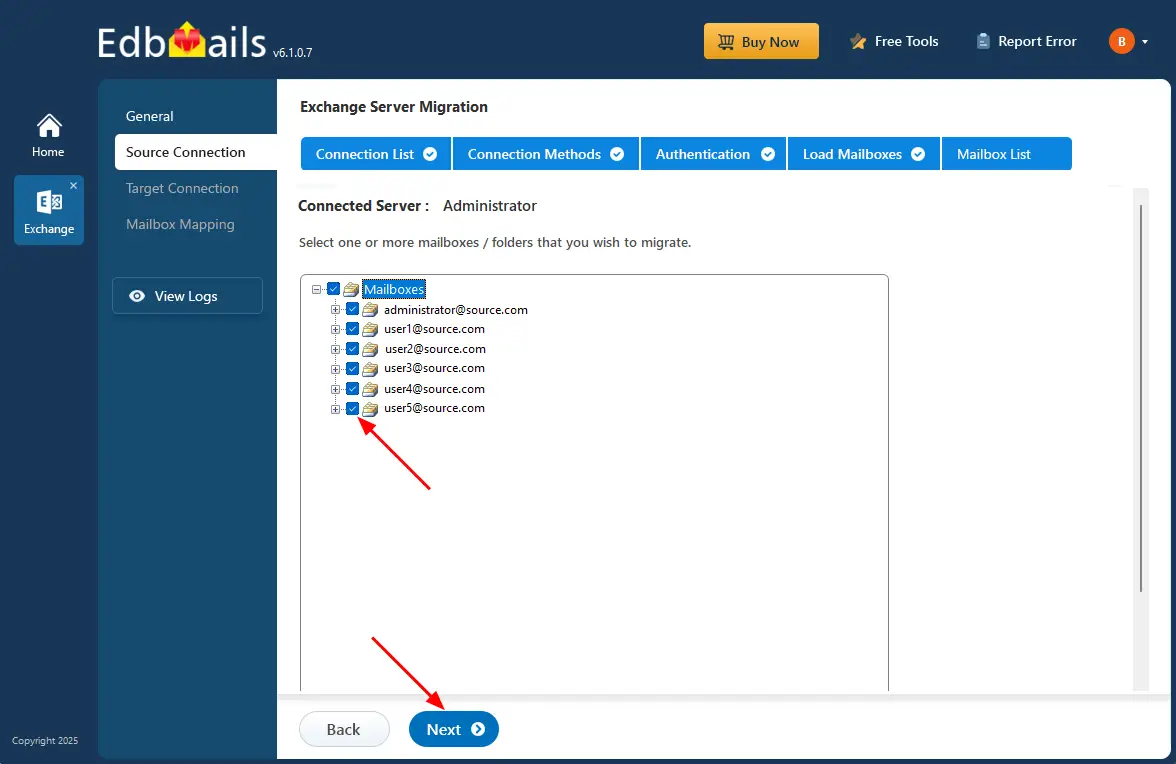
Step 3: Select mailboxes for migration
- Choose the mailboxes or folders you want to migrate.
- Click ‘Next’ to proceed.
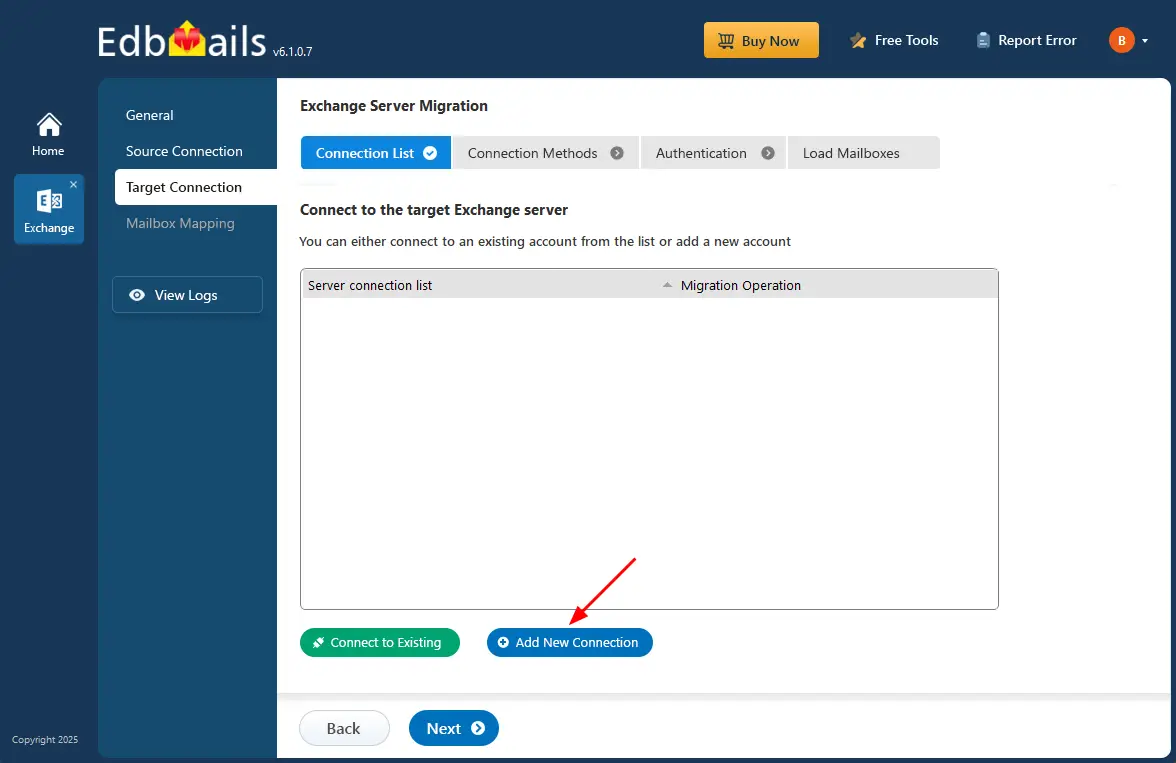
Step 4: Connect to target Exchange server
- Click ‘Add New Connection’ or select an existing target Exchange connection.
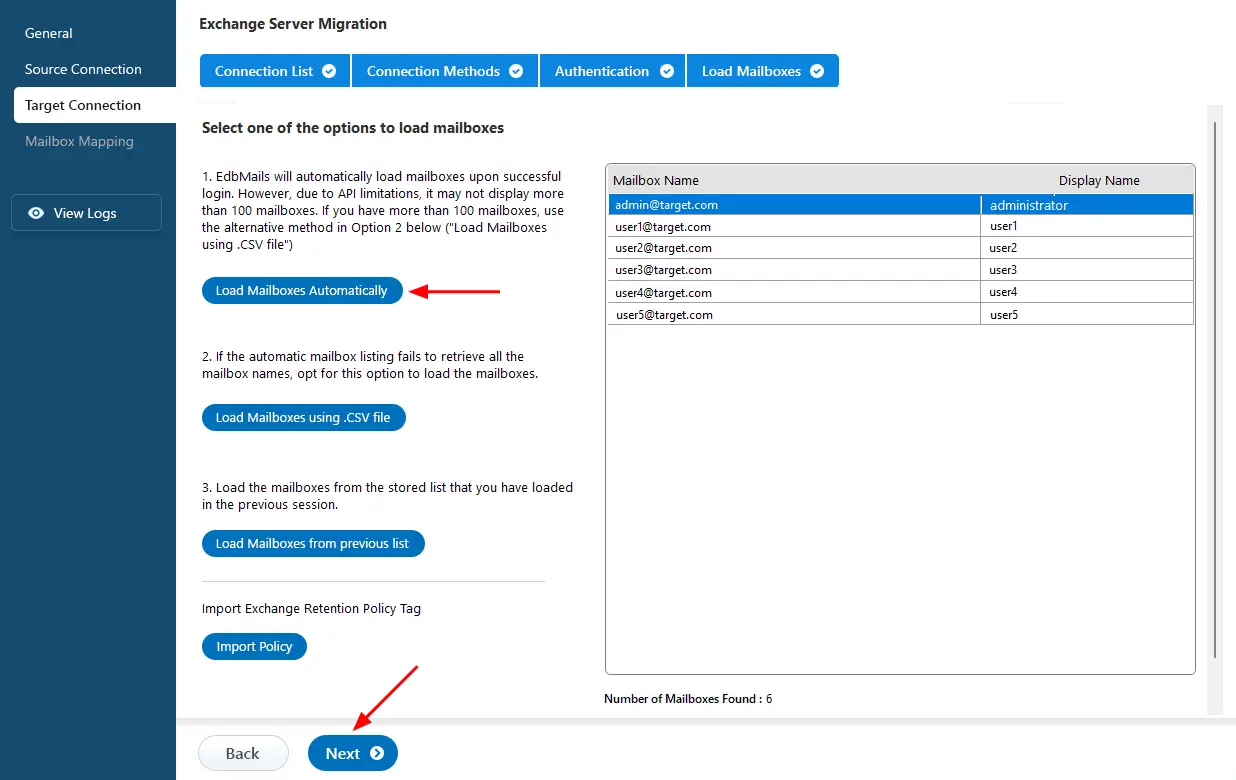
- After successful authentication, select one of the following options to load the mailboxes:
i) Load Mailboxes Automatically: After signing in, EdbMails automatically loads and displays the available mailboxes, making the configuration process simple. Due to Microsoft API limitations, only up to 100 mailboxes may be displayed. If your environment has more than 100 mailboxes, use the alternative option below.
ii) Load Mailboxes using CSV file: If the automatic option does not display all mailbox names, choose ‘Load Mailboxes using .CSV file’ to load the required mailboxes.
iii) Load Mailboxes from previous list: This option allows you to quickly access the mailbox list that was saved and imported during your previous session.
- Select ‘Load Mailboxes Automatically’ and click ‘Next’ to proceed.
- Click ‘Add New Connection’ or select an existing target Exchange connection.
Step 5: Map source and target mailboxes
- Choose a mapping option or let EdbMails map mailboxes automatically.
- If EdbMails is installed on the target server, enable automatic mailbox creation.
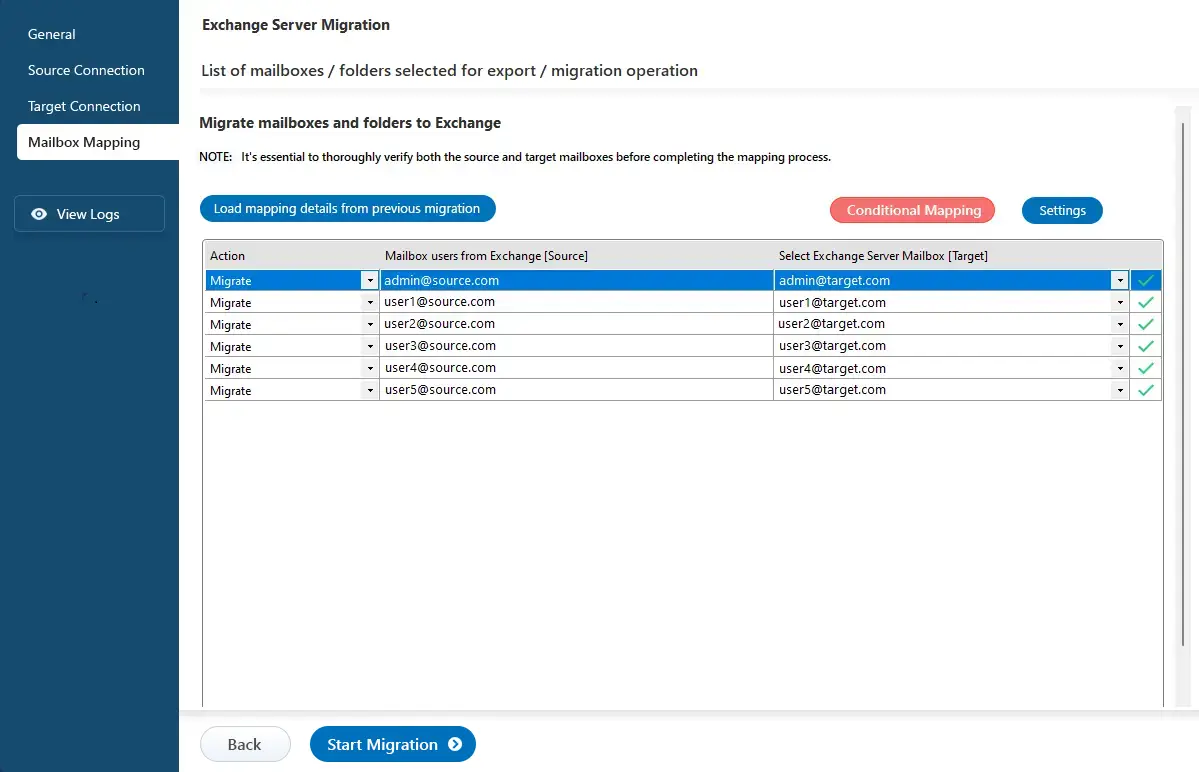
Step 6: Start Exchange to Exchange migration
- Click ‘Start Migration’ to begin the process. Monitor progress in real time.
- Once complete, click ‘View Logs’ for detailed migration reports.
- Log in to the target Exchange server to verify migrated items.
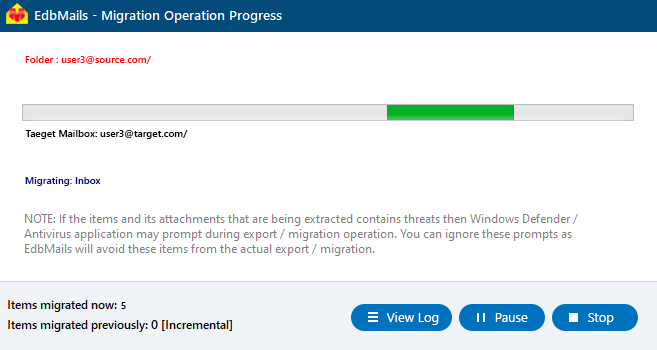
Key Features for Managing Exchange Migration Successfully
EdbMails is the best Exchange migration software, providing a range of essential features for your Exchange migration needs. With support for parallel mailbox migrations, different migration types, and an easy-to-use interface, EdbMails ensures a smooth and secure migration. Explore the key features that set EdbMails apart and make it the ideal choice for your Exchange server migration requirements.
Universal Exchange Server Version Compatibility
EdbMails guarantees smooth migrations from various Microsoft Exchange Server versions, encompassing Exchange 2007, 2010, 2013, 2016, and 2019. Our software is well-equipped to address all essential scenarios needed for a successful Exchange migration, making the process reliable and efficient.
Effortless Configuration and Swift Installation
EdbMails Exchange migration suite features a user-friendly migration wizard that guides you through the mailbox migration process. You can complete the migration operation with just a few clicks. The connection between source and target servers is guided by an intuitive wizard, eliminating the need for PowerShell commands.
Incremental Exchange Migration
EdbMails offers incremental migration support, a feature designed to avoid duplicating data during successive migrations from the same source computer to the same destination mailbox. This functionality specifically transfers newly received emails from the source server to the destination, saving time, reducing bandwidth usage, and optimizing storage space on the target server.
Migrate Exchange Server Mailboxes of any Size
EdbMails Exchange Migration Tool uses an advanced algorithm, enabling users to add small as well as large source mailboxes for migration, with no size limitations or restrictions on adding multiple mailboxes at once.
Preserve of Source Mailbox Folder Hierarchy on the Target
The Exchange Migrator Tool expertly maintains the original hierarchy of source mailboxes within the folder list. It ensures no alterations, damage, or impact on the source mailbox's original data during the migration process, preserving data integrity.
Selective Mailbox Data Migration
EdbMails offers advanced filtering options, allowing users to include or exclude specific items from the source mailbox. This filtering is based on different criteria such as messages sent / received within a certain date range, to address, from address, attachments, read / unread messages etc. You can also exclude standard as well as custom folders from the migration operation.
Centralized Exchange Migration Project Management
Exchange Migration Manager provides complete control over the migration process through a centralized console. The detailed Exchange migration log report offers comprehensive insights into migration history and status, including up-to-the-minute progress reports. With EdbMails, you can efficiently and effectively manage your Exchange migration operation.
Free Trial to test Exchange migration functionality
EdbMails free trial option that enables you to evaluate the software's features and functionalities. It allows you to export and save the first 30 items per folder without interruptions. Once you are satisfied with the demo version, you can proceed with confidence.