EdbMails EDB Recovery and Migration software
  • Products
    EdbMails
    All-in-one Recovery and Migration
    • EDB Recovery and Migration
    • OST, PST, MBOX, NSF, EML, MSG
    • Office 365, Exchange Migration
    • SharePoint, OneDrive & Teams
    • Google Workspace Migration
    • IMAP Migration
    • Duplicate Remover
    • EdbMails Data Recovery
    • Backup Solutions
    • All ProductsAll Products

    EDB Recovery and Migration

    EdbMails lets you recover corrupted, damaged, and offline Exchange EDB files, convert EDB mailboxes to PST format, and directly migrate mailbox data to Office 365 and live Exchange Server.

    EDB to PST
    EDB to PST
    Recover corrupted, damaged, offline EDB files and convert Exchange EDB mailboxes to PST file format
    Public Folder to Exchange
    Public Folder to Exchange
    Migrate public folders from an Exchange offline EDB file to live Exchange Server
    EDB to Live Exchange Migration
    EDB to Live Exchange Migration
    Directly migrate offline Exchange database (EDB) files to live Exchange server
    Archive Mailbox to Office 365
    Archive Mailbox to Office 365
    Migrate archive mailboxes from offline EDB files directly to Office 365
    EDB to Office 365 Migration
    EDB to Office 365 Migration
    Directly migrate offline Exchange database (EDB) files to Office 365
    Public Folder to Office 365
    Public Folder to Office 365
    Migrate public folders from an offline Exchange EDB file to Office 365

    OST, PST, MBOX, NSF, EML, MSG Export and Migration

    EdbMails lets you to recover OST and PST files, export OST, PST, MBOX, NSF, EML, and MSG files to PST files, and directly migrate OST, PST, MBOX, and NSF mailbox data to Office 365 and live Exchange Server.

    OST Recovery and Migration
    OST Recovery and Migration
    Recover offline OST files, convert OST to PST, and migrate OST to Office 365 and Exchange Server
    PST Recovery and Migration
    PST Recovery and Migration
    Recover Outlook PST files , Export PST to PST, migrate PST to Office 365 and Exchange Server
    MBOX Export and Migration
    MBOX Export and Migration
    Export MBOX to PST, migrate MBOX to Office 365 and Exchange Server
    NSF Export and Migration
    NSF Export and Migration
    Export NSF to PST, migrate NSF to Office 365 and Exchange Server
    EML to PST Export
    EML to PST Export
    Convert EML files to Outlook PST files
    PST to MSG Export
    PST to MSG Export
    Convert Outlook PST file to MSG file format
    MSG to PST Export
    MSG to PST Export
    Export MSG files to Outlook PST files

    Office 365, Exchange Migration

    EdbMails lets you securely migrate mailboxes across Microsoft 365, Exchange, Google Workspace (Google Workspace Migration), and IMAP-supported servers such as Outlook, Gmail, Zimbra, Zoho Mail, and cPanel, ensuring zero downtime.

    Office 365 Backup
    Office 365 Migration
    Migrate between Office 365 tenants, Office 365 to Exchange, Office 365 to PST, PST files to Office 365.
    Exchange Server Backup
    Exchange Migration
    Migrate between any Exchange Servers, Exchange to Office 365, Exchange to PST, PST files to Exchange.
    Tenant to Tenant Migration
    Tenant to Tenant Migration
    Migrate Mailboxes, Public Folders, Archive Mailboxes between Office 365 Tenants.
    Exchange to Office 365
    Exchange to Office 365
    Migrate Mailboxes, Public Folders, Archive Mailboxes from live Exchange server to Office 365.
    Office 365 to IMAP
    Office 365 to IMAP
    Migrate Office 365 to IMAP, Office 365 to Gmail, Office 365 to Outlook, Office 365 to Zoho etc.
    Exchange to IMAP
    Exchange to IMAP
    Migrate from live Exchange Server to IMAP servers such as Gmail, Outlook, and Zoho Mail.
    Public Folder to Office 365
    Public Folder to Office 365
    Migrate Public Folders between Office 365 tenants with complete folder hierarchy and mailbox data integrity.
    Exchange to PST
    Exchange to PST
    Export live Exchange Server mailboxes, public folders, and archive mailboxes to Outlook PST files.

    SharePoint, OneDrive & Microsoft Teams Migration

    EdbMails lets you migrate SharePoint sites, OneDrive data, Microsoft Teams, teams, channels, chats, permissions, and documents between Microsoft 365 tenants while maintaining the existing folder structure and data integrity.

    SharePoint, OneDrive & Teams Backup
    SharePoint Online Migration
    Migrate documents, lists, files and folders from SharePoint sites.
    OneDrive for Business Migration
    OneDrive for Business Migration
    Migrate documents, lists, files, folders, private chats from OneDrive.
    Microsoft Teams Migration
    Microsoft Teams Migration
    Migrate Teams, chats, channels, documents, files and folders etc.

    Google Workspace / G Suite Migration

    EdbMails offers secure Google Workspace migration to Office 365, Exchange, or IMAP, and export to PST covering emails, contacts, calendars and tasks.

    Google Workspace Migration
    Google Workspace Migration
    Migrate emails, calendars, contacts, tasks from Google workspace to Google workspace, office 365, Exchange and IMAP. Export to PST
    Google Workspace to Office 365
    Google Workspace to Office 365
    Migrate emails, calendars, contacts, tasks from Google Workspace / G Suite to Office 365
    Google Workspace to Exchange Server
    Google Workspace to Exchange Server
    Migrate emails, calendars, contacts, tasks from Google Workspace / G Suite to on-Premise Exchange Server
    Google Workspace to IMAP
    Google Workspace to IMAP
    Migrate emails, calendars, contacts, tasks from Google Workspace / G Suite to IMAP, Outlook, Zimbra, Zoho etc.
    Google Workspace to Google Workspace Migration
    Google Workspace to Google Workspace
    Migrate emails, calendars, contacts, tasks between two Google Workspace / G Suite tenants
    Google Workspace to PST
    Google Workspace to PST
    Export emails, calendars, contacts, tasks from Google Workspace / G Suite to Outlook PST files

    IMAP Migration

    EdbMails IMAP Migration tool lets you easily migrate emails from IMAP servers such as Outlook, Gmail, Zoho Mail, Zimbra, cPanel, and more. Supports IMAP to IMAP, Office 365, Exchange Server, PST, and bulk PST to IMAP migration.

    IMAP Email Backup & Migration
    IMAP Email Backup & Migration
    Backup and migrate emails from IMAP servers to PST, Office 365, and On-Premises Exchange Server
    IMAP to Office 365
    IMAP to Office 365
    Migrate emails, folders, and attachments from IMAP servers to Office 365
    IMAP to Exchange
    IMAP to Exchange
    Migrate emails, folders, and attachments from IMAP servers to on-premises Exchange Server
    IMAP to PST
    IMAP to PST
    Export emails, folders, and attachments from IMAP servers to Outlook PST files for backup
    PST to IMAP
    PST to IMAP
    Migrate emails, folders, and attachments from bulk PST files to IMAP servers

    Duplicate Remover

    EdbMails Duplicate Remover lets you easily remove duplicate items from Office 365 and Exchange Server, and from IMAP, Outlook, Gmail, Zimbra, Zoho Mail, etc., ensuring a clean and organized mailbox.

    Remove Duplicates
    Remove Duplicates
    Easily clean up your Office 365, Exchange, Outlook and IMAP accounts by removing duplicate emails.
    Remove Duplicates from Office 365
    Remove Duplicates from Office 365
    Remove duplicate emails, calendars, contacts, journal tasks, etc. from Office 365.
    Remove Duplicates from Exchange Server
    Remove Duplicates from Exchange Server
    Remove duplicate emails, calendars, contacts, journal tasks, etc. from live Exchange Server.
    Remove Duplicates from IMAP, Outlook
    Remove Duplicates from IMAP, Outlook
    Remove duplicate emails, attachments from IMAP, Outlook, Gmail, Zimbra, Zoho Mail etc.

    Exchange, SharePoint, OneDrive, Teams and Office 365 Backup

    EdbMails enables secure, automated backup and recovery for Microsoft 365 services including Exchange Online, SharePoint, OneDrive, Teams, and Live Exchange Server with complete data protection and restore flexibility.

    Office 365 Backup
    Office 365 Backup
    Incremental, Granular, Encrypted and Compressed Office 365 Mailboxes Backup
    Exchange Server Backup
    Exchange Server Backup
    Incremental, Granular, Encrypted and Compressed Exchange Mailboxes Backup
    SharePoint, OneDrive & Teams Backup
    SharePoint, OneDrive & Teams Backup
    Backup Online site collections, Team sites, Office 365 groups, all documents etc.

    EdbMails Data Recovery

    EdbMails Data Recovery Software lets you recover permanently deleted data, including photos, videos, documents, and archived files, from partitions on hard drives, SSDs, USB drives, SD cards, and external storage devices.

    EdbMails Data Recovery
    EdbMails Data Recovery
    Recover and restore permanently deleted data from hard drives, SSDs, USB drives, SD cards, and etc.
    Whitepaper Whitepaper
    Request a Demo Request a Demo
    Sign Up Sign Up
  • Features
  • FAQ
  • Offers
  • Pricing
  • Download
  • Support
  • Sign in
User’s Manual
Office 365 Migration Tool

User Manual

User Manual

  • Office 365 Migration Tool Overview
  • What is Office 365 Migration?
  • System Requirements
  • Migration Scenarios
  • Software Setup
    • EdbMails Installation Process
    • Upgrading the Software
  • Understanding the Application
    • Software's Main Components
    • Understanding the Migration
  • FAQ
    • General
    • Migration Free Trial / Demo
    • Migration License
    • Before Migration
    • Migration - Steps
    • After Migration
  • Videos
    • Office 365 to Office 365
    • Office 365 to Exchange
    • Office 365 to IMAP
    • Office 365 to PST
    • Public Folder to Office 365
    • Archive Mailbox to Office 365
    • Public Folder to Exchange
    • Archive Mailbox to Exchange
    • Restore Bulk PST files to Office 365
    • Automatically Create Office 365 Mailboxes
    • Export Office 365 user to CSV file
  • Screenshots
    • Office 365 to Office 365
    • Office 365 to Exchange
    • Office 365 to PST
  • How it works?
    • Office 365 to Office 365
    • Office 365 to Exchange
    • Office 365 to IMAP
    • Office 365 to PST
    • Public Folder to Office 365
    • Public Folder to Exchange
    • Public Folder to Shared Mailbox
    • Archive Mailbox to Office 365
    • Archive Mailbox to Exchange
    • Office 365 to Hosted Exchange
    • Multiple PST to Office 365
    • Office 365 to Gmail Migration
    • Office 365 Shared mailbox to Exchange
    • Office 365 Public folders to PST
    • Office 365 archive mailbox to PST
    • Office 365 Shared mailbox to PST
    • Office 365 shared mailbox to Public folder
    • Office 365 Archive mailbox to Shared mailbox
    • Office 365 Shared mailbox to Archive mailbox
  • Connect to source Office 365
  • Connect to target Office 365
  • Modern Authentication Using OAuth 2.0
    • Microsoft 365 modern authentication
    • Automatic Registration
    • Manual Registration
  • Connect to Exchange server
  • Knowledge Base
    • Migrate between Office 365 tenants
    • Migrate Office 365 mailbox
    • Public folder migration
    • Office 365 Migration with same Domain
    • Office 365 Group Migration
    • Selective Mailbox Migration
    • Migration to Exchange 2007, 2010, 2013, 2016 and 2019
    • User-Defined Mailbox/Folder Mapping
    • Export Office 365 users to CSV
    • GoDaddy to Microsoft 365 migration
    • Rackspace to Office 365 migration
    • Office 365 migration methods
    • Office 365 migration checklist
    • Migrate Shared mailbox to Office 365
    • Office 365 migration best practices
    • Office 365 migration challenges
    • Convert shared mailbox to regular mailbox
    • Office 365 to Exchange 2019 migration
    • Office 365 multiple mailbox migration
    • Office 365 Server to Server Migration
    • Cross-Tenant Office 365 migration
    • Office 365 to iCloud migration
    • Office 365 to Yahoo Mail migration
    • Office 365 to cPanel Migration
    • Office 365 to SmarterMail Migration
    • Office 365 to IceWarp migration
    • Create an Office 365 Migration Endpoint
    • Validate Office 365 Mailbox Migration
    • Office 365 Migration Network Requirements
    • Microsoft 365 Migration URLs & Endpoints
    • Office 365 Migration Firewall Ports
    • DNS Changes After Office 365 Migration
    • Autodiscover Troubleshooting After Migration
    • Post-Migration MX Record Validation
    • Office 365 Mail Flow Troubleshooting
    • Mailbox Permission Validation
    • EdbMails vs CodeTwo vs MigrationWiz vs Native Tools
    • Calendar Permission Migration Issues
    • Folder Permission Troubleshooting
    • Large Mailbox Migration Best Practices
    • Archive Mailbox Sync Issues
    • Office 365 Migration Coexistence
    • Cross-Tenant Mailbox Permissions
    • Cross-Tenant Calendar Migration
    • Migration Using App-Only Authentication
    • Office 365 Mailbox Mapping Errors
    • Exchange Online Migration Limits
    • Mailbox Integrity After Migration
    • Security Best Practices for Migration
    • Office 365 to cPanel Migration
    • Office 365 to SmarterMail Migration
    • Office 365 to IceWarp Migration
  • Migration Types
    • Cutover Migration
    • Staged Migration
  • Set Exchange Server Impersonation rights
  • Map the Mailboxes
  • Migration Walkthrough
    • Office 365 tenant to tenant migration
    • Office 365 to PST Export
  • Multifactor Authentication
    • Enable MFA in Office 365
    • Create App password for MFA
    • Disable Security Defaults
  1. Home
  2. Office 365 Migration Tool
  3. Office 365 to SmarterMail Migration: Step-by-Step Guide
Download Buy Now

Office 365 to SmarterMail Migration

Office 365 and SmarterMail use different mailbox, authentication, administration, and mail-flow models. The migration method should match the data in scope: an IMAP-based workflow is suitable for email-focused migration, while SmarterMail also provides its own Microsoft 365 mailbox-migration utility for supported mailbox data.

This page focuses specifically on the Office 365 → SmarterMail direction. For broader Microsoft 365 migration capabilities, see the Office 365 migration Tool.

Select Office 365 to IMAP migration option

Prepare the target SmarterMail domain and user accounts, choose the migration method that matches the data in scope, authenticate to Microsoft 365, map the source mailboxes to their SmarterMail targets, transfer the supported data, validate a pilot mailbox, complete any required final migration pass, and change production mail flow only after the destination is ready.

Can SmarterMail Migrate Directly from Microsoft 365?

Yes. SmarterMail includes a mailbox-migration utility that can connect to Microsoft 365 and import supported mailbox data. SmarterMail's current documentation describes a Microsoft 365 sign-in flow and lets the user choose which available items to migrate. The exact data types available depend on the source and migration method.

EdbMails provides a separate Office 365-to-IMAP workflow that can be useful when the project requires the mapping, filtering, bulk-processing, reporting, and repeat-migration controls supported by the current EdbMails workflow.

Office 365 to SmarterMail Migration Methods

RequirementSmarterMail native migrationEdbMails / IMAP workflow
Office 365 → SmarterMailSupported by SmarterMail's mailbox-migration utilitySupported through the Office 365 → IMAP workflow
Email and mail foldersSupported where available in the native workflowPrimary scope of the IMAP route
Contacts, calendars, tasks, notesAvailable when the selected SmarterMail source/workflow exposes themVerify the current EdbMails workflow before including non-email data
Mailbox mappingConfigured through SmarterMail's migration flowReview automatic or manual source-to-target mapping
FilteringUse the options available in the native workflowUse supported EdbMails migration filters
Migration reportingSmarterMail records mailbox-migration activityReview EdbMails migration logs/reports
Best fitNative destination-side migrationControlled email-focused or bulk IMAP migration workflow

Plan the Data Scope Before Migration

Define the data that actually needs to reach SmarterMail before choosing the migration route. Email, attachments, and mail folders fit an IMAP-based transfer. If the project also includes contacts, calendars, tasks, or notes, confirm that the selected SmarterMail or EdbMails workflow supports those data types before including them in the migration plan.

Microsoft 365 Groups, Teams, SharePoint, OneDrive, and Microsoft-specific retention/compliance settings are separate workloads and should not be assumed to move as part of an email migration.

Why Organizations Move from Microsoft 365 to SmarterMail

  • Existing investment in a SmarterMail hosting environment.
  • Preference for self-hosted or provider-managed email infrastructure.
  • Different subscription, hosting, or administration requirements.
  • Need for direct control over the mail server, domain, and mailbox quotas.
  • A simpler email-focused environment when the broader Microsoft 365 collaboration stack is not required.

The choice should be based on the organization's hosting, administration, security, compliance, collaboration, and support requirements rather than assuming one platform is universally better.

Review the Microsoft 365 Features You Still Need

Moving mailbox data does not automatically reproduce Microsoft 365 services such as Teams, SharePoint, OneDrive, Microsoft 365 Groups, Exchange-specific mailbox controls, Microsoft retention/compliance features, or Entra ID identity/security policies. Account for those services separately before retiring the Microsoft 365 environment.

Office 365 Source Prerequisites

  • Inventory the Office 365 mailboxes, sizes, folder counts, and large messages included in the project.
  • Confirm the Microsoft 365 authentication method required by the selected migration workflow.
  • Verify the source permissions required to access the mailboxes.
  • Review MFA and Conditional Access requirements that may affect authentication.
  • Keep the source mailboxes available until target validation and mail-flow cutover are complete.

Prepare the SmarterMail Target

  • Create or verify the target SmarterMail domain.
  • Create the target user mailboxes before mapping them from Office 365.
  • Confirm each mailbox quota and the total storage available for the domain/server.
  • Obtain the IMAP hostname, port, SSL/TLS requirements, username, and password from the SmarterMail administrator or hosting provider.
  • Confirm that the SmarterMail server is reachable from the system running the migration.
  • Check firewall rules, TLS certificates, and any hosting-provider connection restrictions.
  • Test one target mailbox before beginning a bulk migration.

Port 993 with SSL/TLS is common for secure IMAP, but the actual SmarterMail hostname and port depend on the server or hosting-provider configuration. Do not assume that mail.yourdomain.com is the universal server name.

Mailbox Quota and Message-Size Planning

Compare each Office 365 mailbox with its SmarterMail target quota before migration. Also check attachment/message-size limits, total domain storage, server disk availability for self-hosted deployments, and any hosting-provider bandwidth or connection restrictions. Oversized messages or a full destination mailbox can cause items to be rejected even when the source mailbox is valid.

Migration Planning

Plan the migration as a controlled sequence: target preparation → pilot → initial transfer → validation → final/repeat migration when required → DNS/mail-flow cutover → final validation. For broader methodology, see the Office 365 migration guide.

Before the production run, use the Office 365 migration checklist to review authentication, capacity, permissions, communication, and validation tasks.

Folder and Mailbox Mapping

Review source-to-target mailbox mapping before starting the migration. Standard folders can have different names or special-use behavior between Office 365 and SmarterMail, so validate Inbox, Sent Items, Drafts, Deleted Items, Junk Email, Archive, custom folders, and nested folders.

Where automatic mailbox mapping is available, review the proposed matches rather than assuming they are correct. Use manual mapping when a source Office 365 mailbox must be directed to a different SmarterMail account.

Run a Pilot Before the Full Migration

  1. Choose one representative Office 365 mailbox.
  2. Create and verify its SmarterMail target account.
  3. Connect both systems using the selected migration method.
  4. Migrate a controlled set of folders and messages.
  5. Check folder placement, message dates, and attachments.
  6. Test representative large messages.
  7. Review the migration logs/report.
  8. Adjust mapping, filters, quotas, or target settings before the bulk migration.
  1. Office 365 to SmarterMail Migration Using EdbMails

    • Step 1: Download and install EdbMails

      • Download and install EdbMails on the Windows computer used for the migration.
      • Launch the application and sign in or start the free trial.
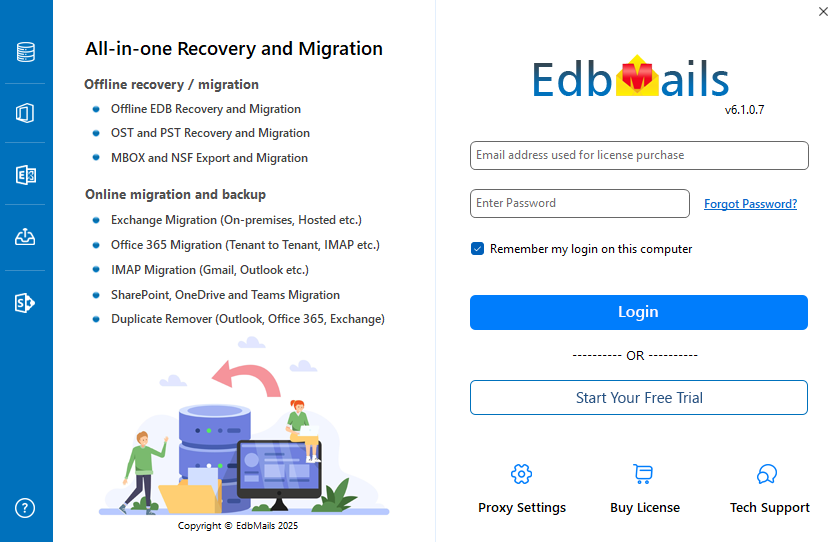
        Launch EdbMails software

    • Step 2: Select Office 365 to IMAP migration

      • Choose ‘Office 365 Migration’ from the main dashboard.
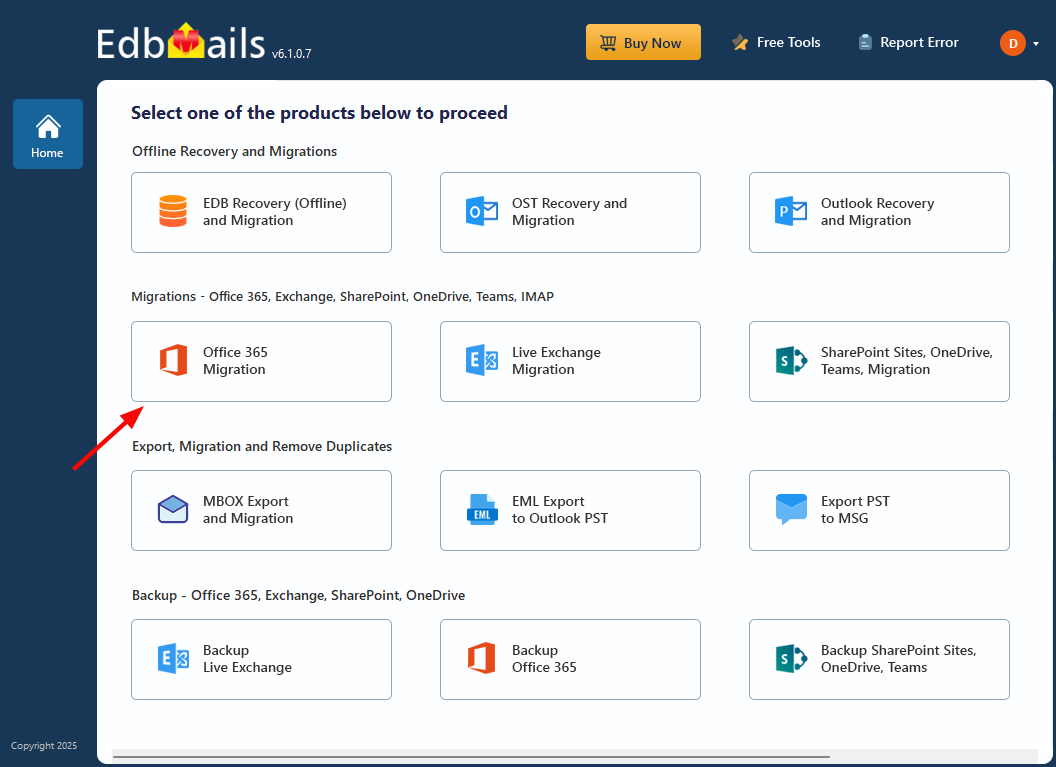
        Select Office 365 Migration

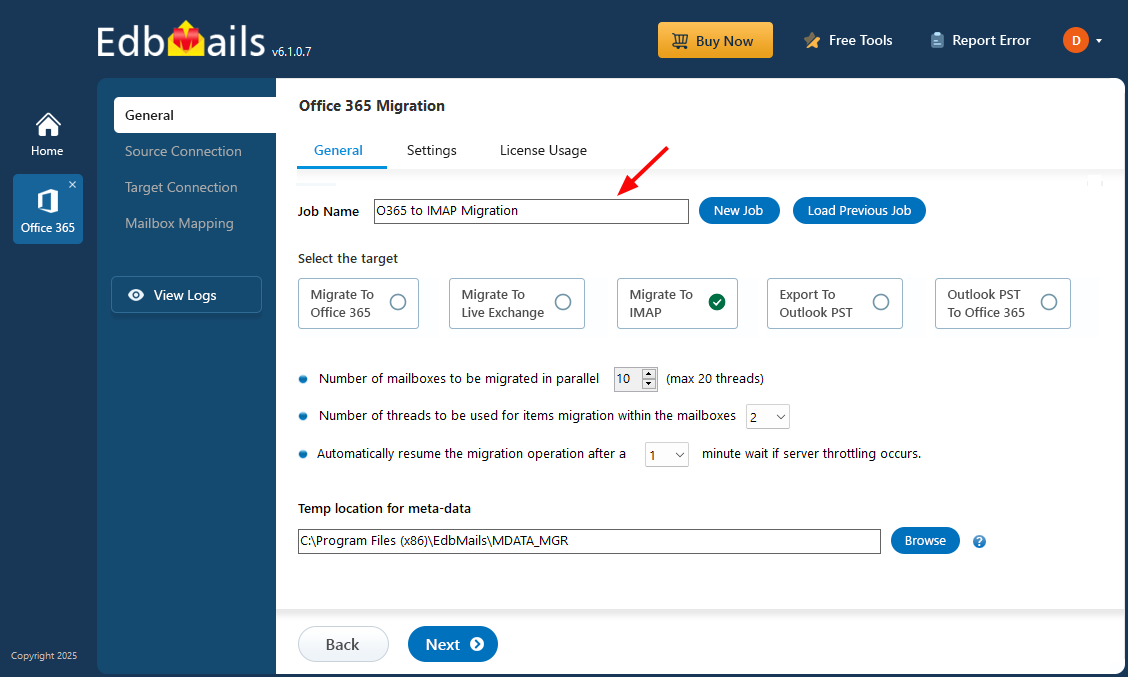
      • Select ‘Office 365 to IMAP migration’ and enter a job name or keep the default one.
      • Click ‘Next’ to continue.

        Enter Office 365 to SmarterMail migration job name

    • Step 3: Connect to the source Office 365 server

      • Click ‘Add New Connection’ to create a new source connection, or use ‘Connect to Existing’ for a saved connection.
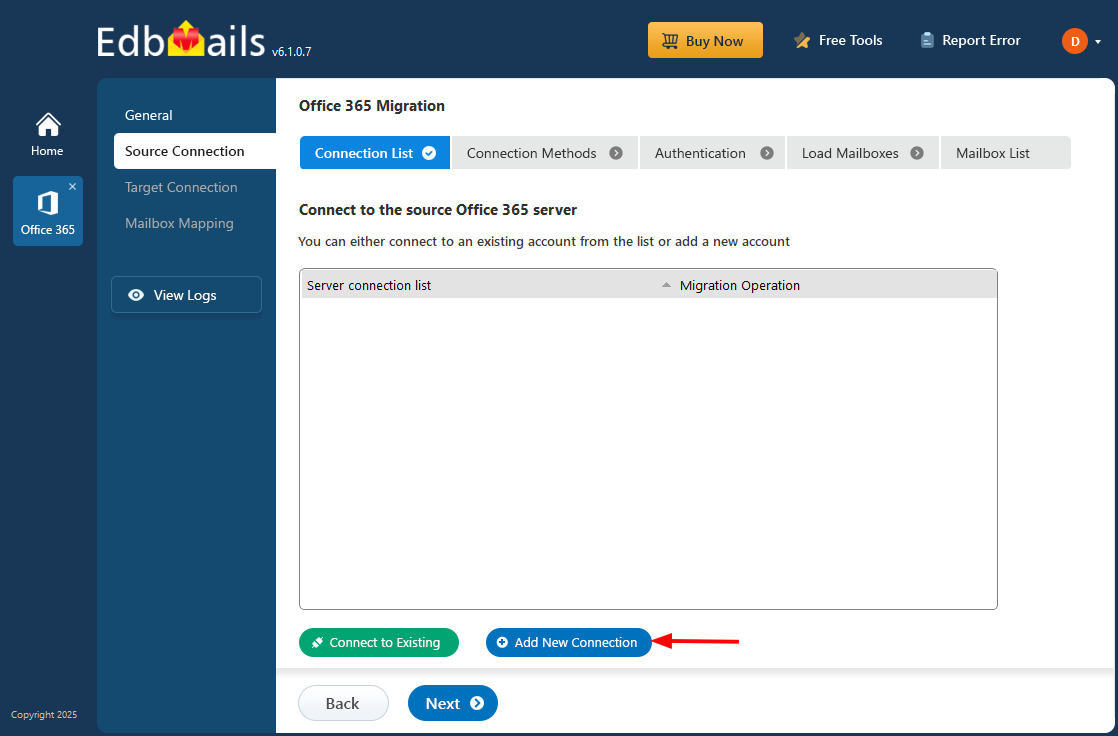
        Add a source Office 365 connection

      • Choose the required connection option and click ‘Next’.
      • Select the login method and authenticate using Microsoft secure sign-in.
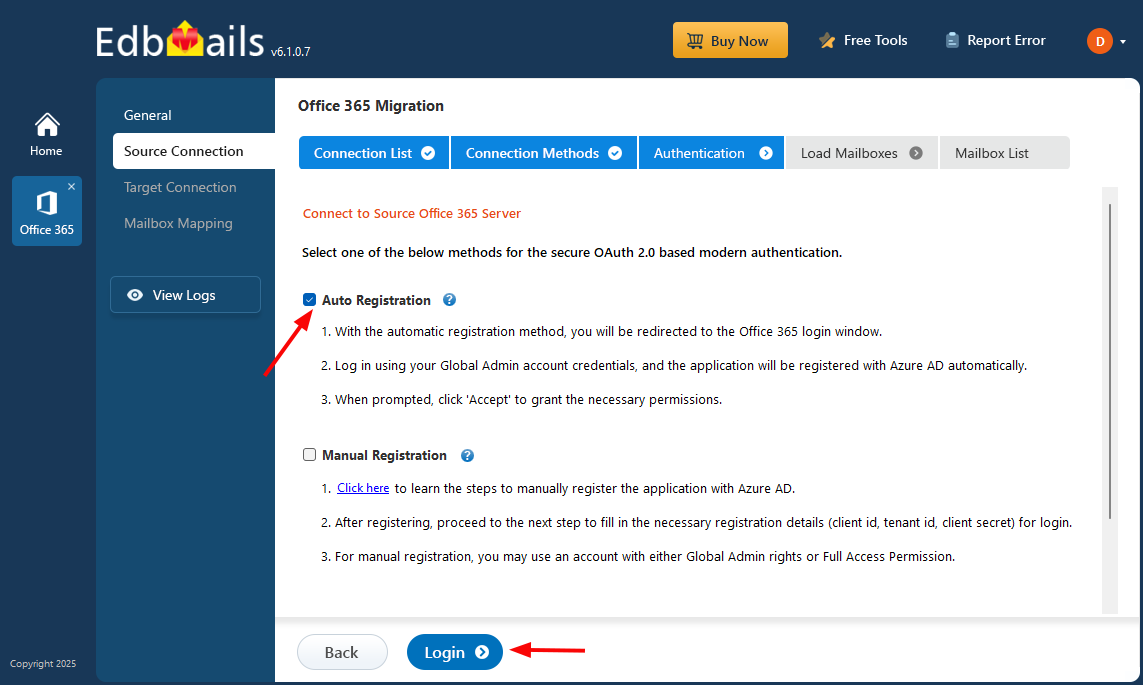
        Authenticate to Office 365

      • Load the required mailboxes and select the source mailboxes for migration.
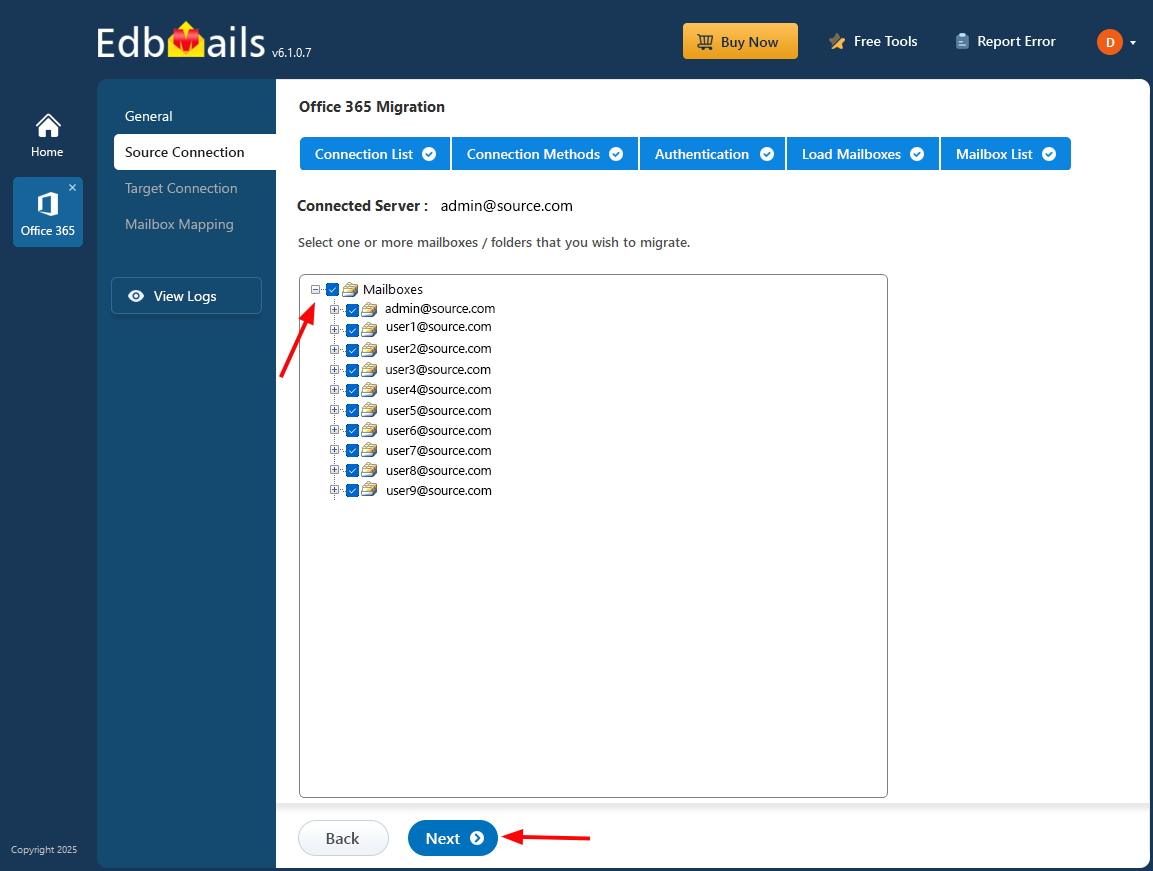
        Select Office 365 source mailboxes

    • Step 4: Connect to the target SmarterMail server

      • Select ‘Connect to IMAP’ for the SmarterMail email migration.
      • For a single mailbox, choose ‘Single User / Account Migration’ and enter the SmarterMail account credentials and IMAP connection details.
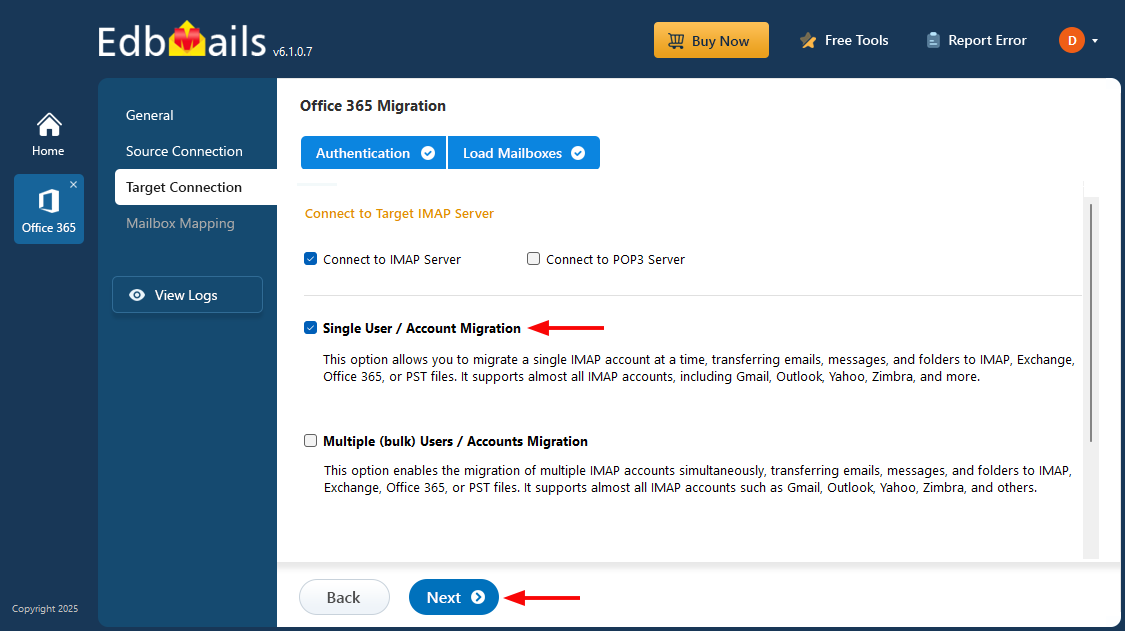
        Connect to a single SmarterMail account

      • For bulk migration, choose ‘Multiple Users / Accounts Migration’.
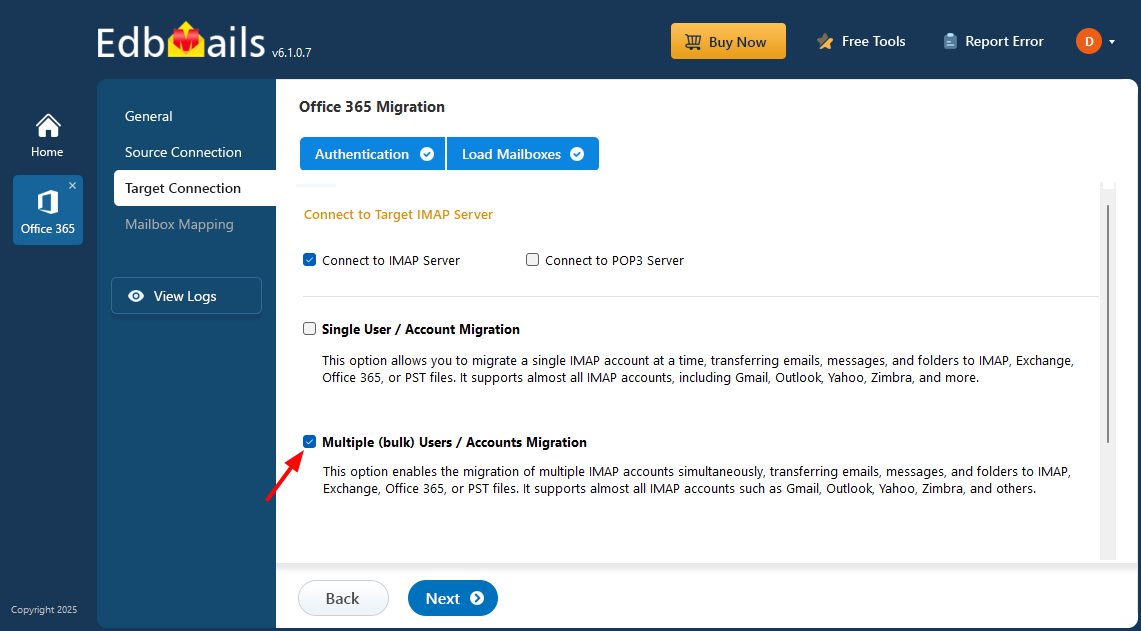
        Connect multiple SmarterMail accounts

      • Select ‘IMAP Migration CSV File’ to download the sample CSV.
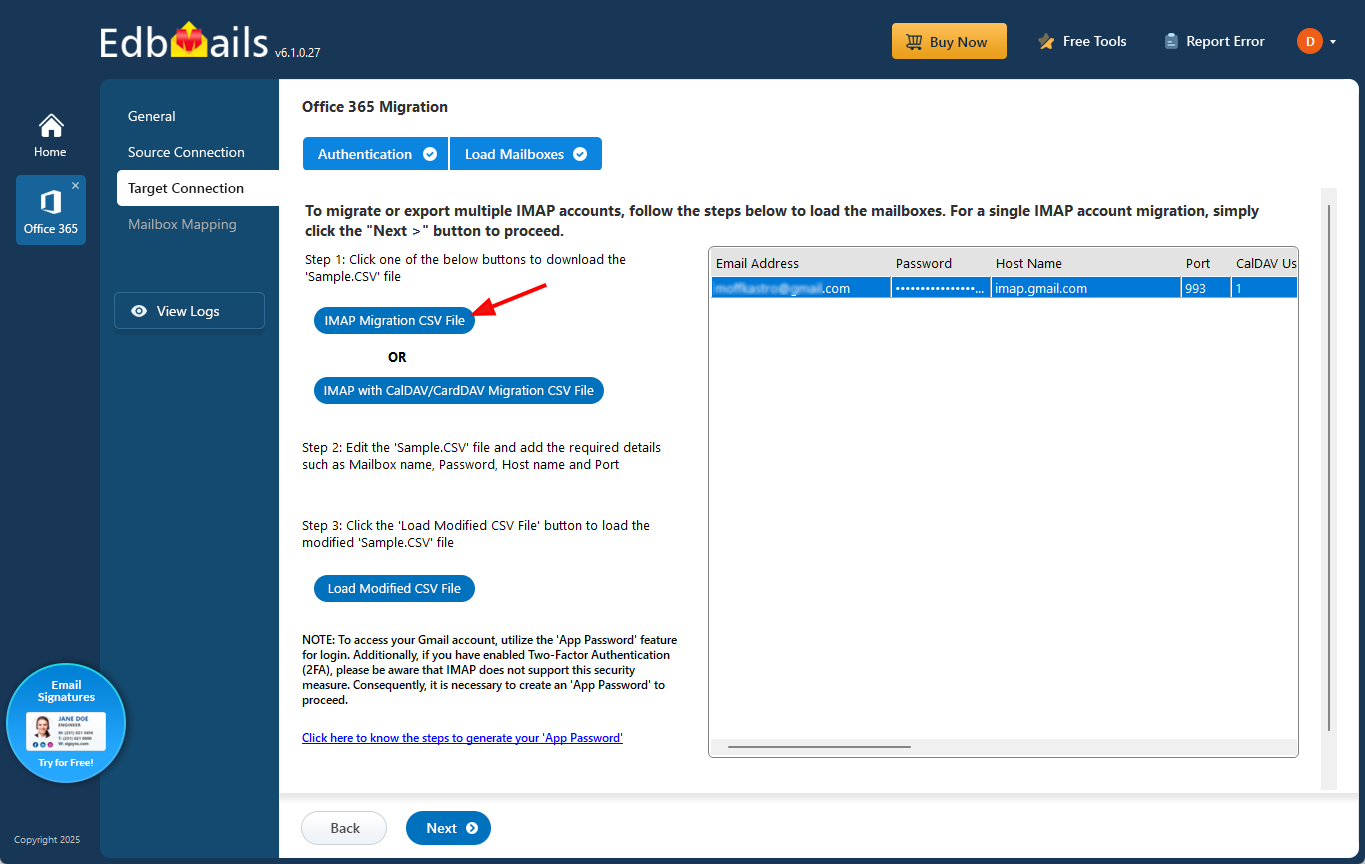
        Download the IMAP migration CSV file

      • Enter the required target account details in the CSV, including mailbox name, password, SmarterMail IMAP host, and port.

        Enter SmarterMail IMAP account details

      • Load the updated CSV file and review the listed target accounts before continuing.
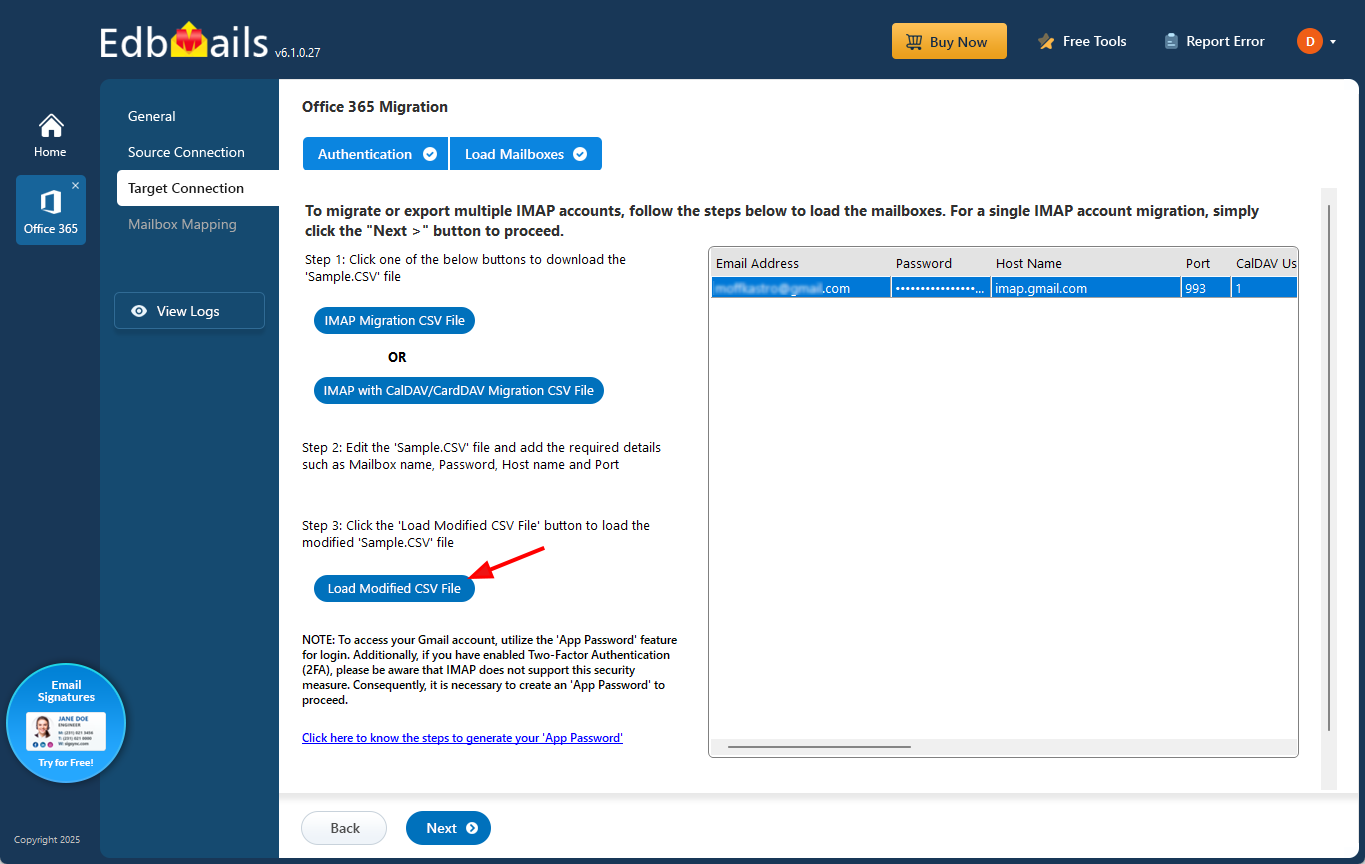
        Load the updated SmarterMail CSV file

    • Step 5: Map Office 365 mailboxes to SmarterMail

      • Review the source-to-target mailbox mapping and correct any mismatches manually.
      • Apply the required migration filters and folder selections.

        Office 365 to SmarterMail mailbox mapping

    • Step 6: Start and review the migration

      • Click ‘Start Migration’ to begin the transfer.
      • Monitor the migration job and review the available logs.
      • After the initial run, validate representative messages, folders, and attachments in SmarterMail.
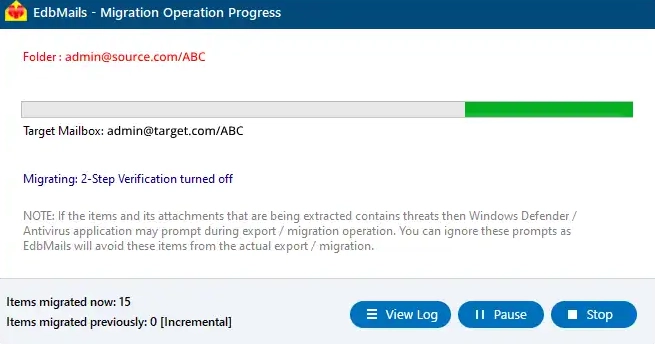
        Office 365 to SmarterMail migration progress

      • If the selected workflow supports a repeat or incremental pass, run it before the final mail-flow cutover.

Can Microsoft 365 and SmarterMail Run Together During Migration?

For staged migrations, organizations may temporarily operate Microsoft 365 and SmarterMail for different users in the same domain through a controlled mail-routing design. SmarterMail documents Split Domain Routing (SDR) for this type of coexistence. The exact DNS, connector, relay, and routing configuration depends on the environment and should be designed before the production transition.

Post-Migration Validation

  • Check Inbox, Sent, Drafts, Deleted, Junk, Archive, custom folders, and nested folders.
  • Compare representative messages, attachments, dates, and folder placement with the source.
  • Review migration logs for completed, skipped, failed, or unmapped items.
  • Confirm users can sign in to SmarterMail and access the expected mailbox data.
  • Confirm mailbox quota and available capacity after the transfer.
  • Test IMAP and SMTP/client access where those protocols are part of the production design.

DNS and MX Cutover

For a domain moving its production email service from Microsoft 365 to SmarterMail, MX and related DNS changes belong at the end of the migration sequence—not at the beginning.

  1. Complete the initial migration.
  2. Validate the SmarterMail target.
  3. Run the required final/repeat migration pass.
  4. Confirm SmarterMail inbound and outbound configuration.
  5. Update MX and other required DNS records according to the target mail-flow design.
  6. Validate inbound delivery, outbound delivery, SPF, DKIM, and DMARC after cutover.

Common Office 365 to SmarterMail Migration Problems

  • Microsoft 365 authentication fails: Review the selected authentication method, required permissions, MFA, and Conditional Access.
  • SmarterMail IMAP authentication fails: Verify the target username/password and whether IMAP access is enabled for the account.
  • Connection fails: Check the SmarterMail hostname, port, SSL/TLS requirement, certificate, firewall, and network reachability.
  • Target mailbox is missing: Provision the SmarterMail account before mapping and migration.
  • Mailbox quota is exceeded: Increase the target quota or reduce the migration scope before retrying rejected items.
  • Folders appear differently: Review special-folder names and source-to-target folder mapping.
  • Large messages fail: Compare source and destination message-size limits and handle oversized items separately where required.
  • Migration is slower than expected: Review network conditions, target server performance, Microsoft service limits, and connection concurrency.

Plan the SmarterMail Migration Around the Target Environment

An Office 365 to SmarterMail migration should be planned around the data being moved, the target mailbox configuration, authentication, folder mapping, quota/capacity, and final mail-flow cutover. Test a representative mailbox first, validate the result, and use a staged or repeat-migration approach when appropriate for the selected workflow.

Frequently Asked Questions

  1. Does SmarterMail have a native Microsoft 365 migration option?

    Yes. SmarterMail provides a mailbox-migration utility that can connect to Microsoft 365 and import the data types made available by the selected source/workflow.

  2. What IMAP settings do I need for SmarterMail?

    Use the IMAP hostname, port, SSL/TLS requirement, username, and password configured by the SmarterMail administrator or hosting provider. Secure IMAP commonly uses port 993, but the actual target configuration should be verified.

  3. Should I test folder mapping before a full migration?

    Yes. Validate standard and custom folders in a pilot mailbox because special-folder naming and behavior can differ between Office 365 and SmarterMail.

  4. Do I need to create SmarterMail mailboxes before migration?

    Prepare the target SmarterMail domain and user accounts before mapping the Office 365 mailboxes to their destinations.

  5. When should MX records be changed?

    Change production mail routing only after the initial migration is validated, the required final/repeat migration pass is complete, and SmarterMail is ready to receive production email.


Additional Resources:

  • Office 365 to IMAP Migration Guide
  • Office 365 to IceWarp Migration
  • Office 365 to cPanel Migration
  • Automatic Mailbox Mapping
Additional resources and related guides

 In this manual

IntroductionMigration MethodsReasons Migration PrerequisitesMigration PlanningMigration StepsPost-Migration ValidationCommon ProblemsFAQs

Office 365 Migration

100 Mailboxes $299 Only

Buy Now

Need help?

24/7 Customer support

Contact us on Live chat

Personalized Demo

Book a personalized demo

Still need help?

Email us / Call us

@edbmails.com All rights are reserved Privacy Policy | Terms of Use | GDPR | Security | Press Releases

hidden msg
Live Chat

Hi, May I help you?

Hide Chat Now