Office 365 to Gmail Migration
Migrating from Office 365 to Gmail involves transferring supported mailbox data from Microsoft 365 to a Gmail or Google Workspace account, preparing authentication on both sides, mapping the source and target mailboxes, transferring the selected email data, and validating the destination before completing any final mail-flow changes.
This page focuses specifically on the Office 365 → Gmail / Google Workspace direction. For broader Microsoft 365 migration capabilities, see the Office 365 migration Tool.

Prepare the destination Gmail or Google Workspace account, confirm the authentication required by the selected migration method, connect Microsoft 365 and Gmail, map each source mailbox to its destination, migrate the selected email data, review the migration report, validate the target mailbox, and plan any final mail-flow change separately.
Gmail Account vs Google Workspace
A personal Gmail mailbox and an organization-managed Google Workspace mailbox both use Gmail, but their migration planning is different.
| Requirement | Personal Gmail | Google Workspace |
|---|---|---|
| Typical scope | Individual mailbox | Organization-managed users/mailboxes |
| Email address | Usually an @gmail.com account | Usually a company or custom domain |
| Admin Console | Not used for an individual consumer Gmail account | Used by administrators for users, services, and security policies |
| Bulk organizational migration | Different account-by-account planning | Administrator-managed migration options are available |
| Domain/MX cutover | No organization-owned MX cutover to an @gmail.com mailbox | May be required when moving a custom domain from Microsoft 365 to Google Workspace |
Office 365 to Gmail Migration Scope
The EdbMails procedure documented on this page uses the Office 365-to-IMAP workflow for email migration. Define the data in scope before the project begins.
| Data | Planning guidance |
|---|---|
| Email messages | Primary data handled by the IMAP workflow. |
| Attachments | Migrate with supported email messages; test unusually large messages during the pilot. |
| Mail folders | Supported mail organization can be transferred where source folders and Gmail labels are compatible; validate special and custom folders. |
| Contacts | Not part of basic IMAP email transfer; verify a separately supported migration method if required. |
| Calendars | Not part of basic IMAP email transfer; verify a separately supported migration method if required. |
| Tasks | Verify the selected migration method before including them in scope. |
| Microsoft 365 collaboration services | Teams, SharePoint, OneDrive, and Microsoft 365 Groups require separate workload planning. |
| Exchange/Microsoft 365 configuration | Mailbox permissions, retention/compliance configuration, and transport settings require separate planning. |
IMAP and Google Workspace Migration Options
For an email-focused Office 365 → Gmail migration, an IMAP-based workflow can be appropriate. Google Workspace also provides administrator-managed migration/import options for organization-wide projects. Choose the method according to the data types, account scale, administrative model, and validation requirements of the project.
Do not assume that an IMAP email migration is equivalent to a complete Microsoft 365-to-Google Workspace transformation.
Microsoft 365 Source Requirements
- Confirm that the source mailboxes are active and accessible.
- Use the Microsoft 365 authentication/application-registration method required by the current EdbMails connection workflow.
- Grant only the permissions required for the selected connection method.
- Review MFA and Conditional Access settings that could affect sign-in.
- Inventory mailbox size, folder count, large messages, and the users included in the migration.
- Prepare the source-to-target mailbox mapping before the bulk run.
- Confirm that the network connection is suitable for the expected migration volume.
Gmail / Google Workspace Destination Requirements
For an individual Gmail account:
- Confirm that the Gmail account is active and can sign in successfully.
- Confirm the authentication required by the EdbMails IMAP connection.
- Check the storage currently available in the Google account.
- Test the destination connection before migrating a large mailbox.
For Google Workspace:
- Provision the required destination users/mailboxes.
- Confirm that Gmail is enabled for those users.
- Review Google Workspace administrative and security policies that affect third-party access.
- Confirm whether the project will use the EdbMails IMAP workflow or another Google Workspace migration/import method.
- For a custom-domain cutover, verify the domain and prepare the final mail-flow change separately.
Gmail Authentication and App Passwords
Google recommends Google-account authorization methods where an application supports them. For an IMAP workflow that uses a Google app password, the Google account must have 2-Step Verification enabled and the app-password option must be available for that account.
App passwords are not available in every Google account configuration, including some organization-managed or Advanced Protection scenarios. If an app password cannot be created, review the Google account policy and the authentication options supported by the current EdbMails workflow before starting the migration.
Check Target Storage and Large Messages
Compare the size of each Microsoft 365 mailbox with the storage available in the destination Google account. Identify large mailboxes and messages with unusually large attachments before migration, because source and destination services can have different import and message-handling limits.
Use a pilot mailbox to test representative large messages instead of assuming that every source item will be accepted unchanged by the destination.
How Gmail Handles Office 365 Folders
Microsoft 365 uses mailbox folders, while Gmail organizes mail with labels. These models are not identical. Review how Inbox, Sent Items, Drafts, Deleted Items/Trash, Junk/Spam, custom folders, and nested folders appear after migration.
Supported source folders can be migrated while retaining their organization where the source folder and Gmail label models are compatible. Review special folders and custom folders during the pilot and again after the production migration.
Run a Pilot Migration First
- Select one representative Office 365 mailbox.
- Connect Microsoft 365 using the selected EdbMails connection method.
- Connect the target Gmail or Google Workspace account.
- Migrate a controlled set of messages and folders.
- Check folder/label behavior.
- Check representative attachments and message dates.
- Test unusually large messages.
- Review the migration report.
- Adjust mailbox mapping, folder mapping, filters, or target settings before the bulk migration.
Office 365 to Gmail Migration Using EdbMails
The current EdbMails procedure on this page uses the Office 365 to IMAP workflow for supported email migration to Gmail. Follow the steps below and validate the target mailbox after the transfer.
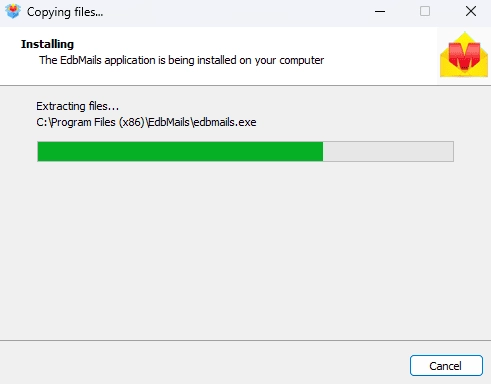
Step 1: Download and Install EdbMails software
- Download and install the EdbMails application on your computer having Windows Operating system.
Click here to know the system requirements to migrate Office 365 to Gmail account
- Launch the EdbMails application.
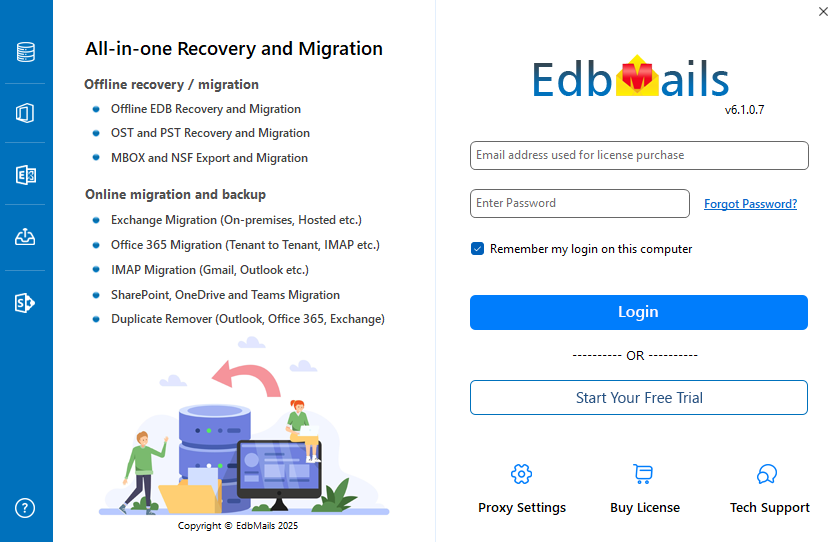
- Enter your email address and password, then click ‘Login’. If you have not created an account yet, select ‘Start Your Free Trial’ to continue with the trial version.
Note: The Free Trial gives full access to all features and also migrates up to 30 items per folder across all mailboxes. Use the appropriate Office 365 Migration License for the production migration.
Click here to purchase the license directly from the EdbMails website.
Once the purchase goes through, close EdbMails and reopen it. Log in back with the same email address and password used during the license purchase — the license activates on its own from there.
- Choose 'Office 365 Migration' option from the products list.
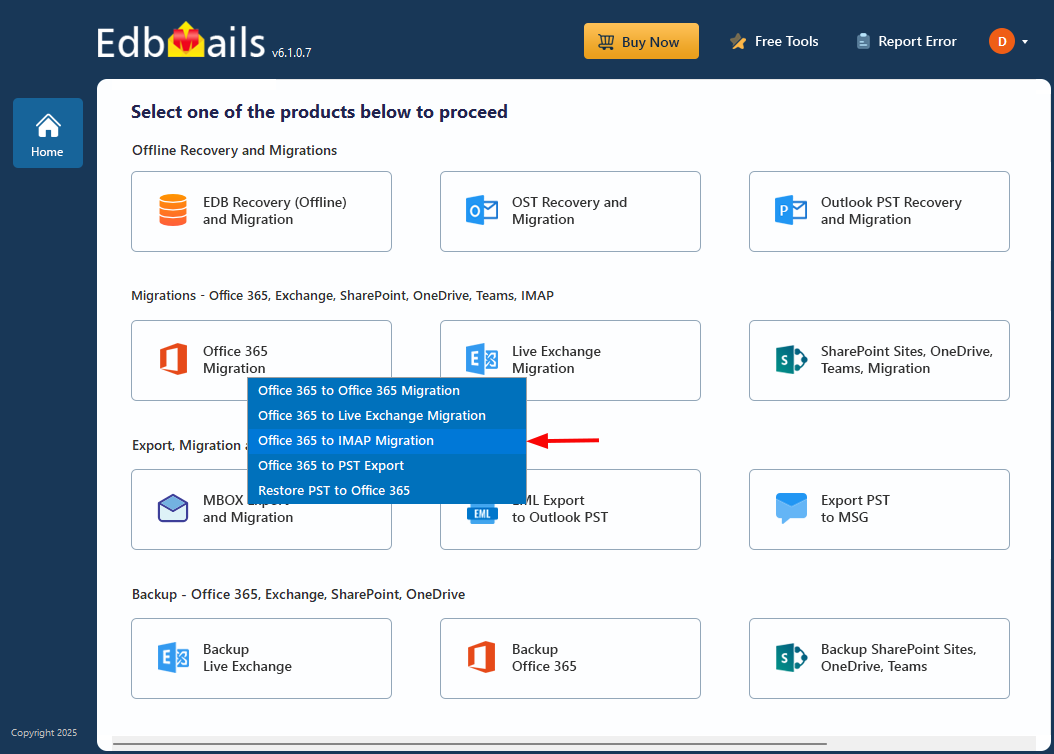
- Select ‘Office 365 to IMAP Migration’ option
- Keep the default job name or click the ‘New Job’ button to enter a name of your choice, then click ‘Next’ to continue.

- Download and install the EdbMails application on your computer having Windows Operating system.
Step 2: Connect to Source Office 365 Server
- To connect to the source Office 365, click 'Add New Connection' for a fresh setup, or select an existing connection from the list and choose 'Connect to Existing' to proceed.
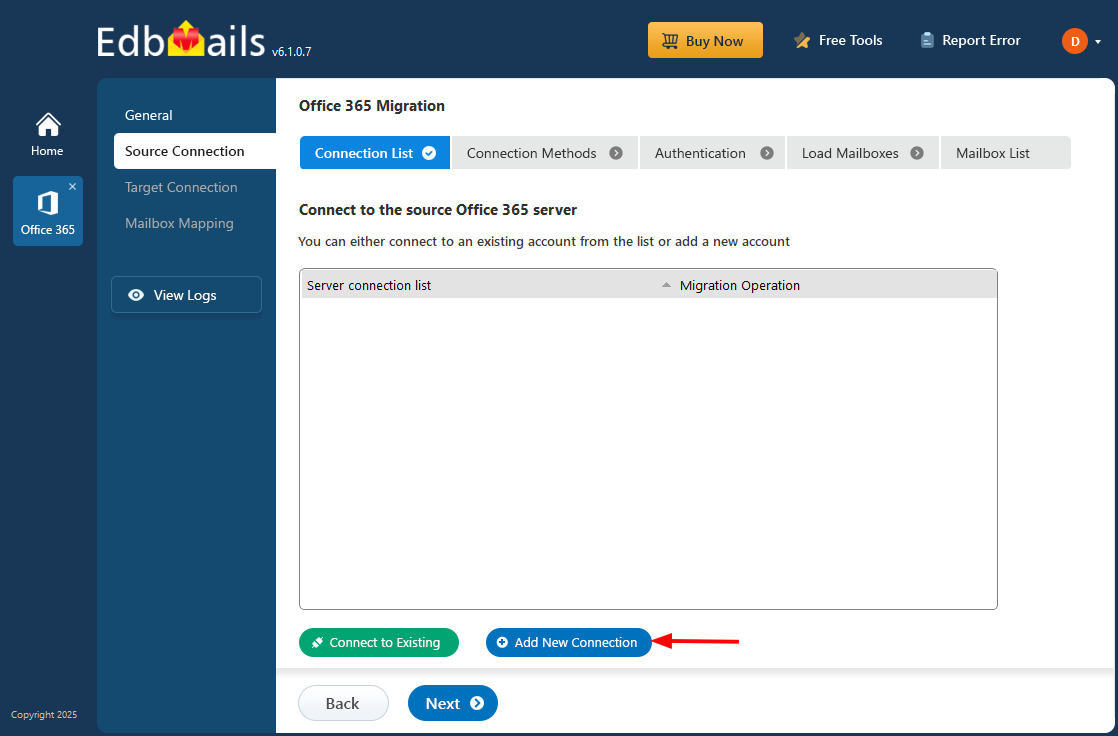
- Select the necessary connection options and click ‘Next’ to proceed.
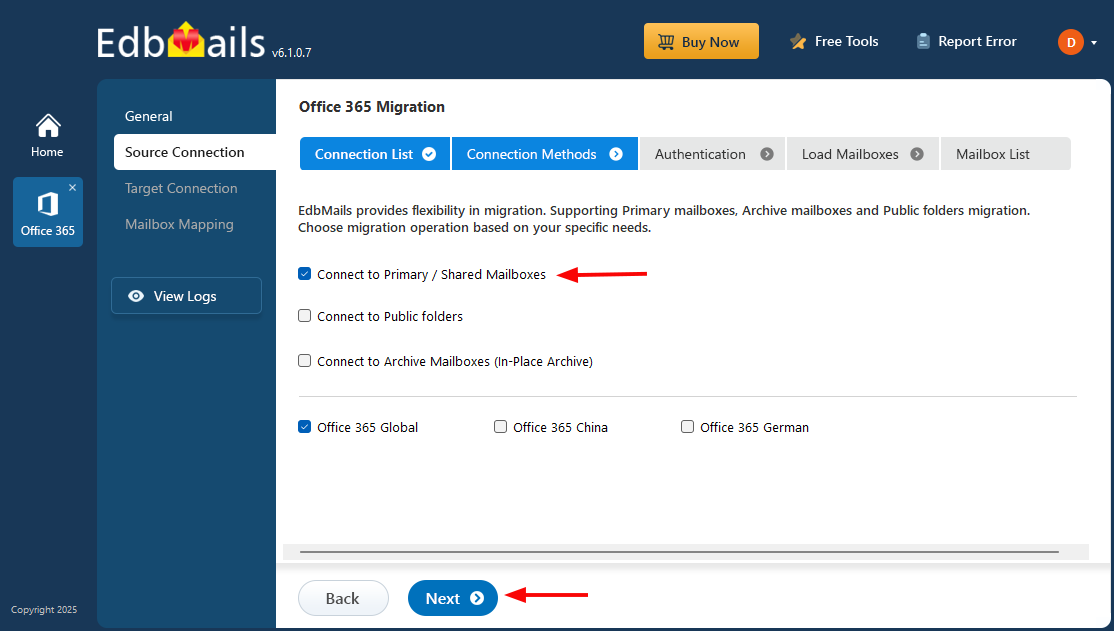
- Choose the appropriate connection method and click the ‘Login’ button to proceed.
Connect to Office 365 server using secure modern authentication
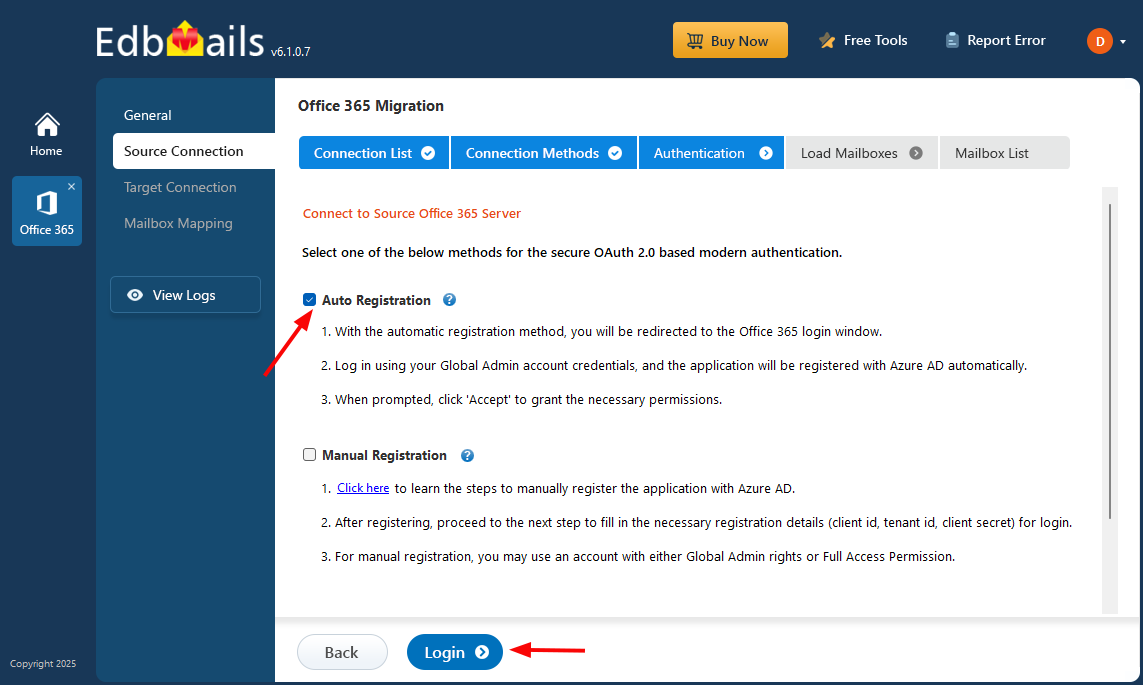
- Sign in on the Microsoft page with the account required by the EdbMails connection and application-registration method selected for this migration.
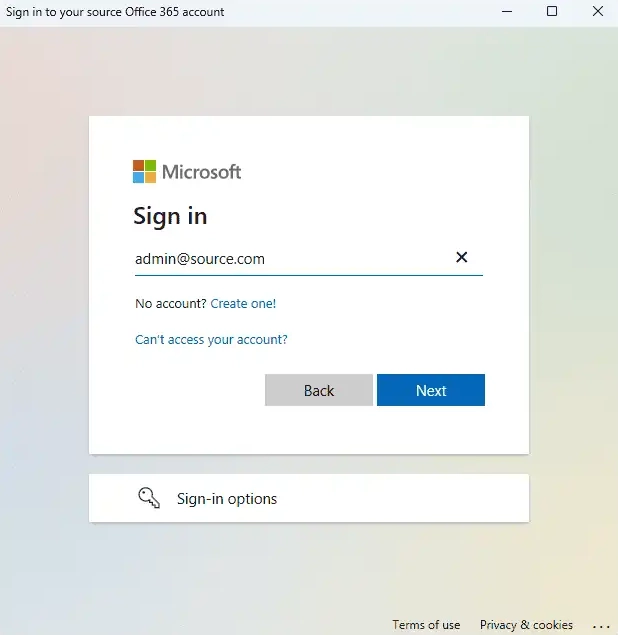
- After authentication, choose how to load the source mailboxes. You can use the available mailbox-loading option or a CSV file to load the mailboxes when that is more appropriate for the migration batch.
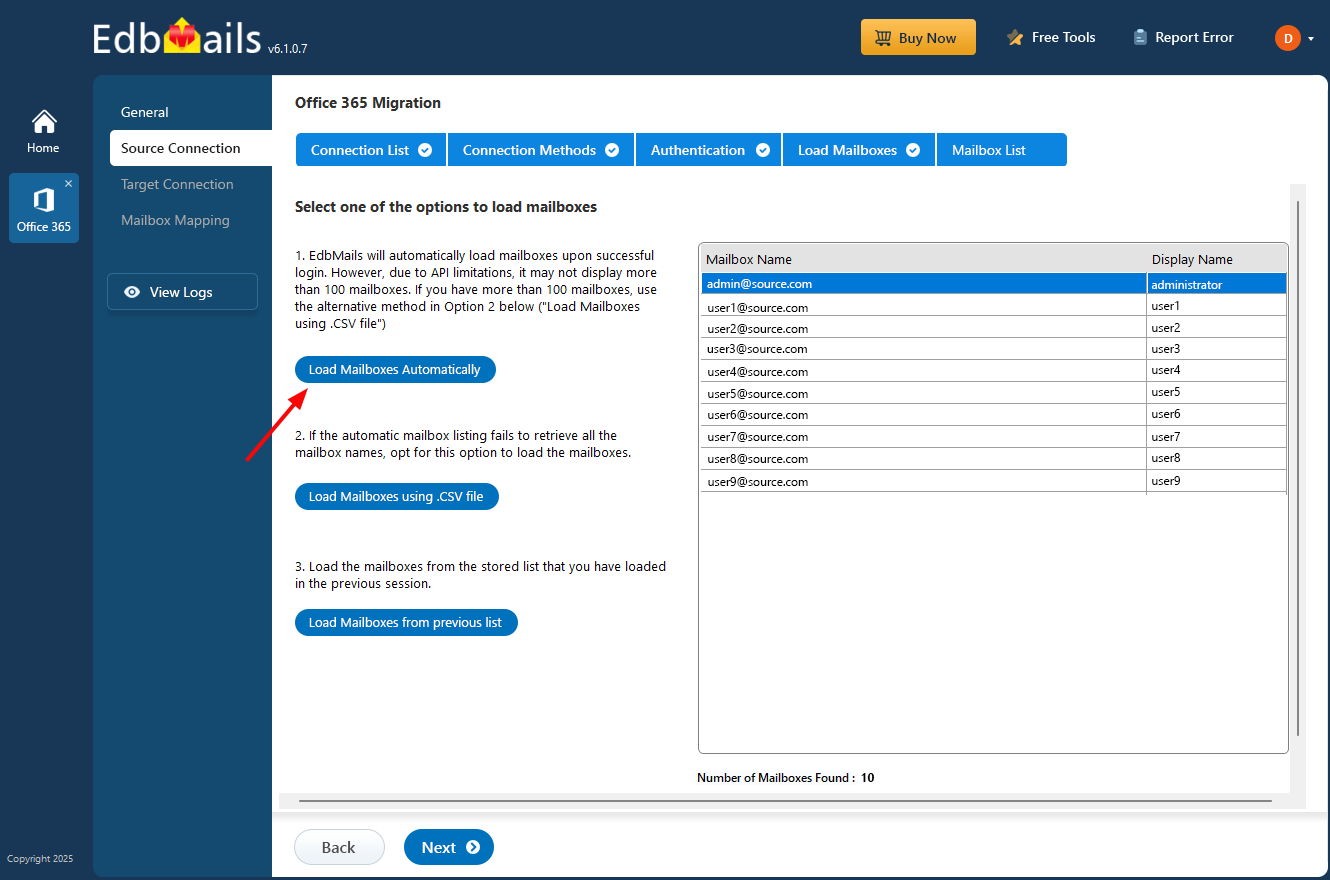
- To connect to the source Office 365, click 'Add New Connection' for a fresh setup, or select an existing connection from the list and choose 'Connect to Existing' to proceed.
Step 3: Select the mailboxes
- Choose the mailboxes and folders from the left pane of the main migration window.
- Click 'Next' to establish a connection with the target Gmail server.
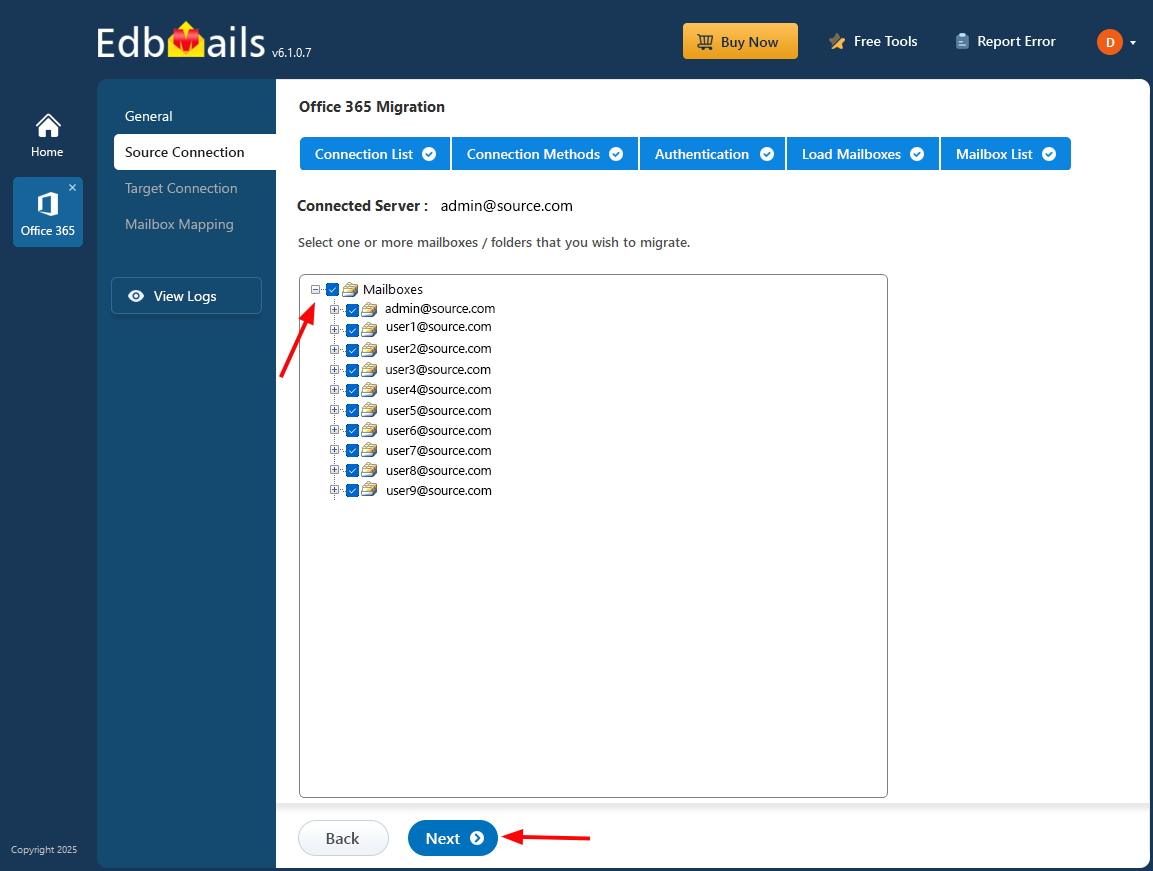
Step 4: Connect to the Target Gmail Server
- Select 'Connect to IMAP' for the Gmail email migration. For a single user, choose 'Single User / Account Migration.'
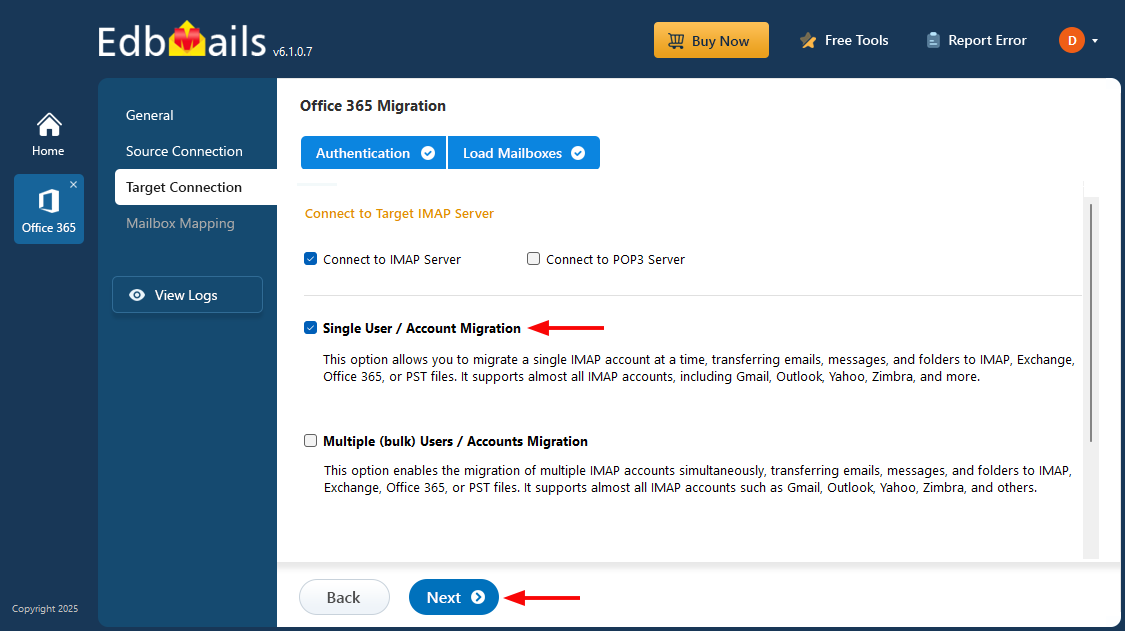
- Select ‘Gmail [imap.gmail.com]’ as the host name from the list or enter it manually. Enter the target Gmail address and the credential required by the current EdbMails IMAP connection. If this workflow uses a Google app password, 2-Step Verification must be enabled for that Google account.
- Finally, click the ‘Login’ button.
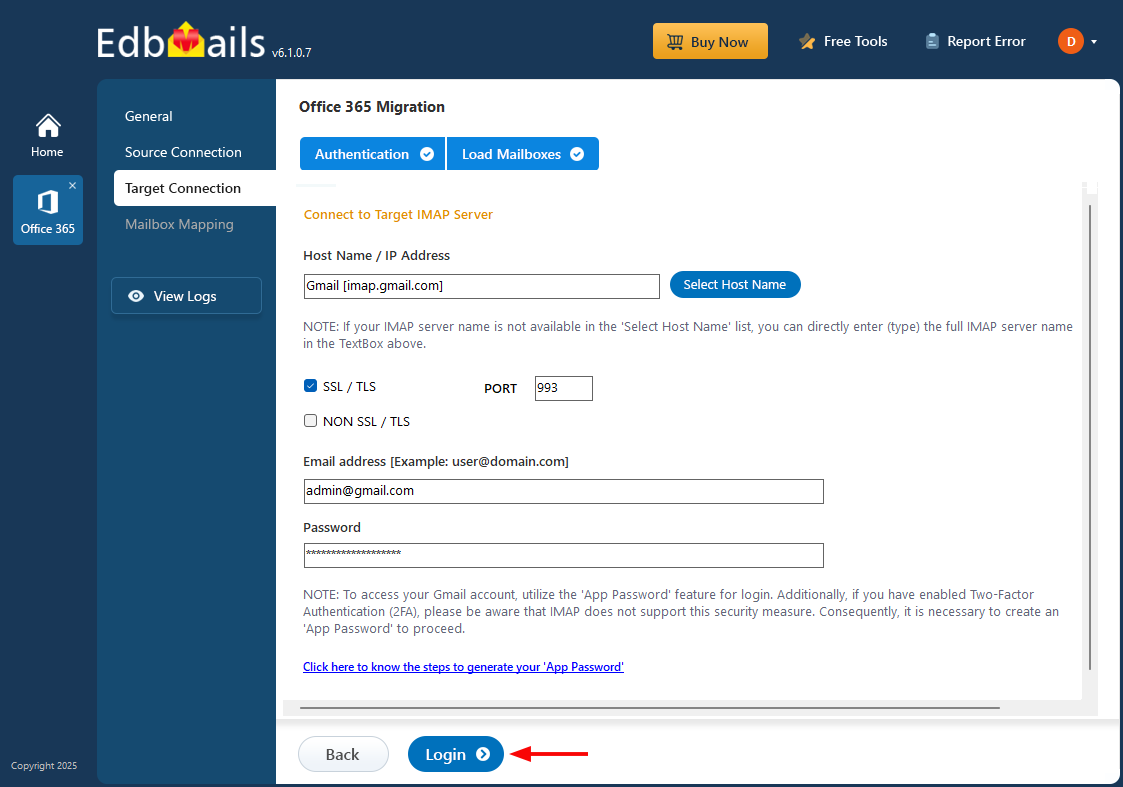
- Once the mailboxes are loaded, click ‘Next’ to proceed.

- To migrate multiple mailboxes, select 'Multiple (Bulk) Users/Accounts Migration,' and click 'Next' to continue.
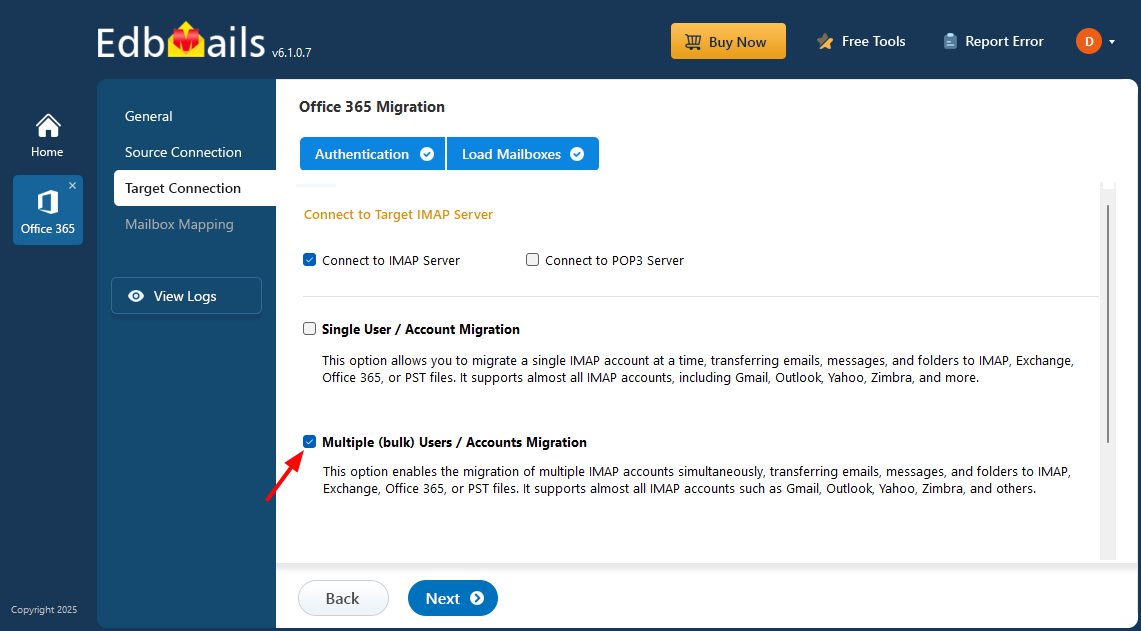
- Click on ‘IMAP Migration CSV File.’
- You will receive a prompt to download the sample .csv file. Pick the destination folder to store it.
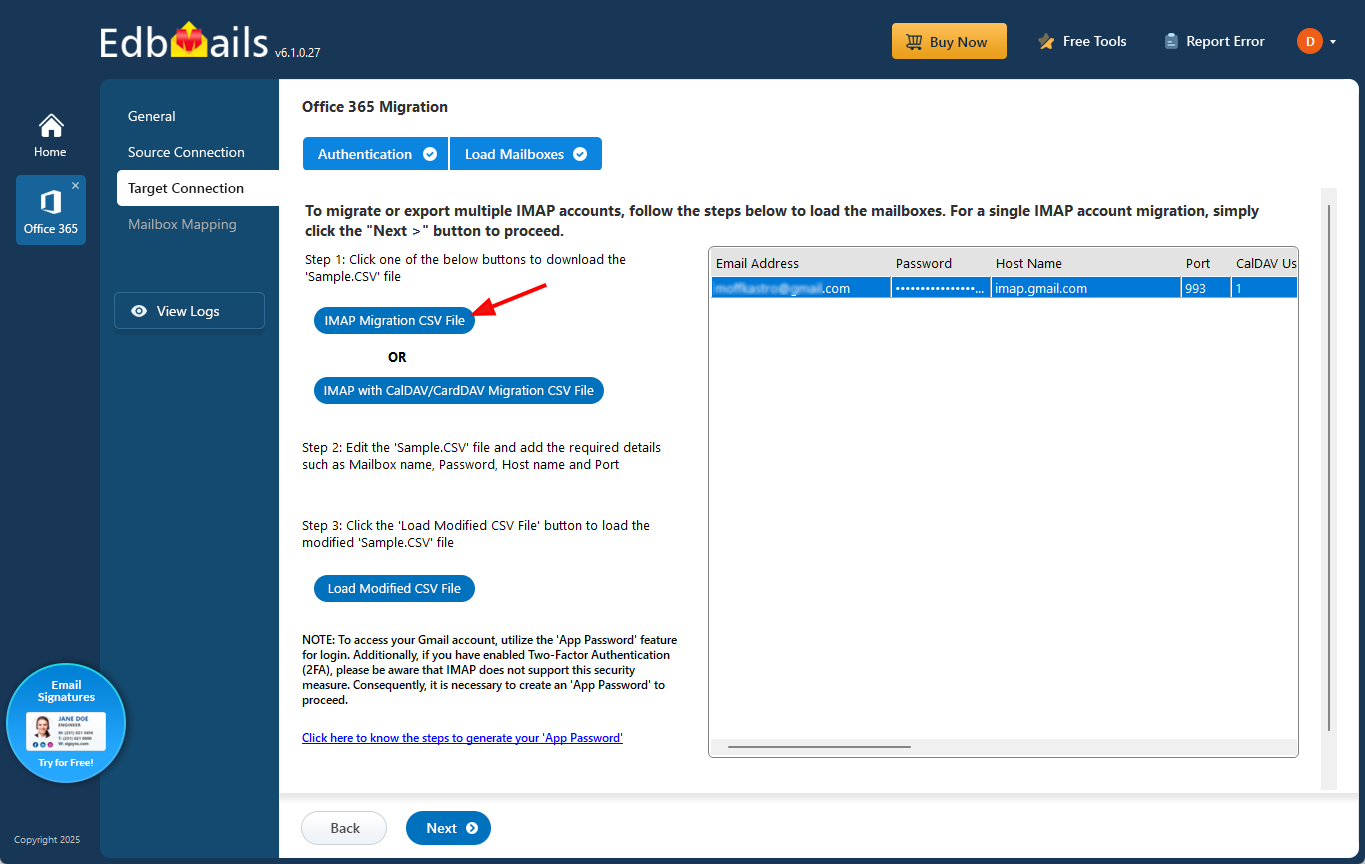
- Open the downloaded CSV file and fill in the required fields such as Gmail address, the credential required by the connection method, host name, and port number. Any fields not relevant to the email migration can be left as 'NA'. Save and close the file after reviewing the entries.

- Click ‘Load Modified CSV File’ to choose your updated CSV.
- Review the listed mailboxes and continue by selecting ‘Next’.
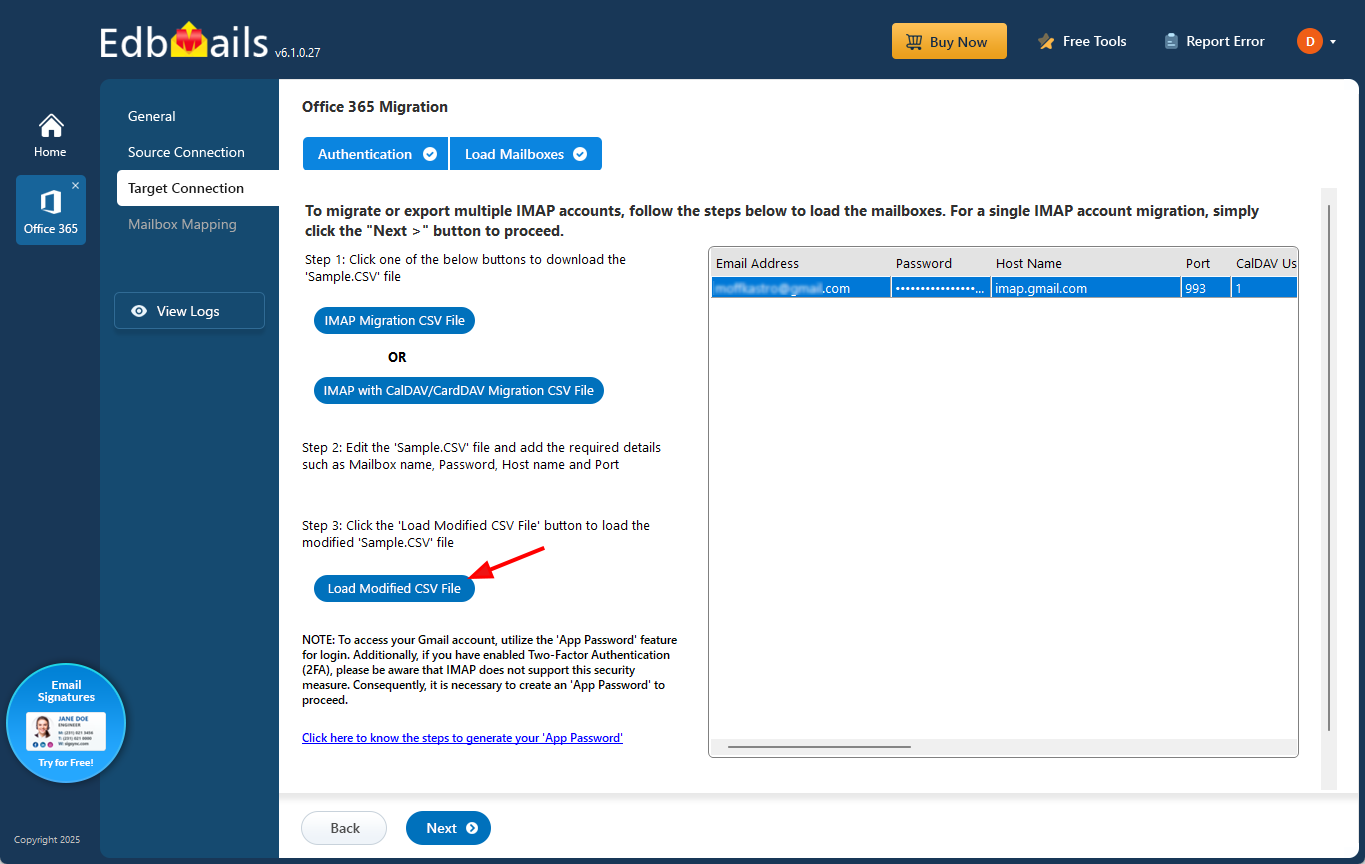
- Select 'Connect to IMAP' for the Gmail email migration. For a single user, choose 'Single User / Account Migration.'
Step 5: Source and target server mailbox mapping
- Choose the required option to map the mailboxes
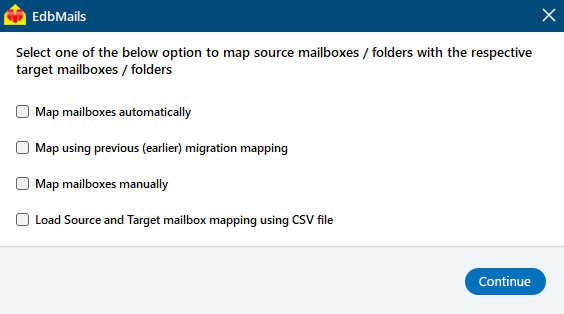
- Use the EdbMails mapping screen to review the proposed source Office 365 and target Gmail mailbox mappings. Correct any mismatch manually, review folder-to-label behavior, or use a CSV file for mailbox and folder mapping where appropriate.
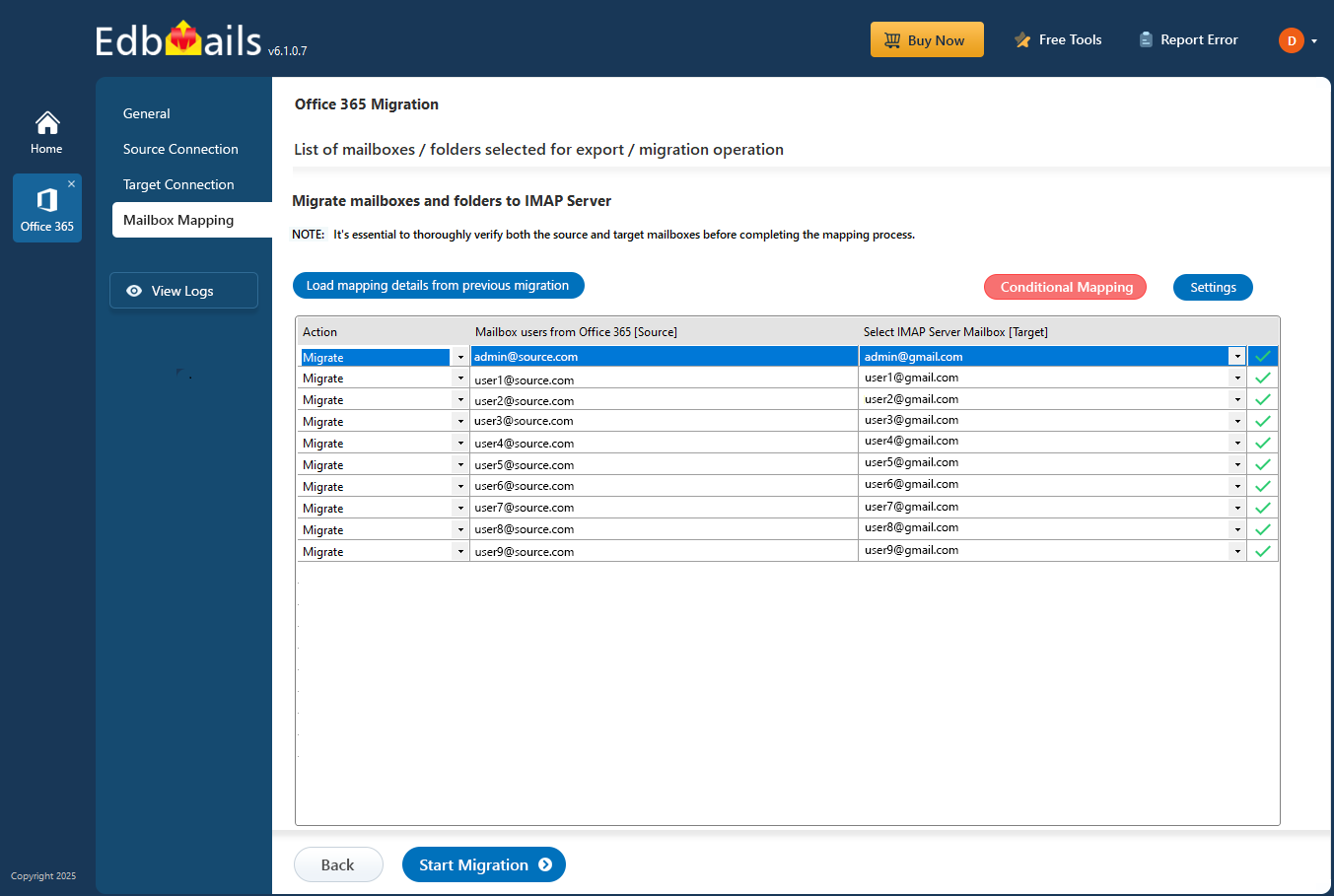
- Choose the required option to map the mailboxes
Step 6: Start Migration From Office 365 to Gmail
- Once the mailboxes are mapped, click the ‘Start Migration’ button to begin the migration process.

- You can monitor the migration status using the progress bar. Once the migration is complete, you will be prompted to review the migration report.
- Click the ‘View Log’ button to review the migration report. Check the completed, skipped, failed, or unmapped results and then validate representative messages and folders in Gmail.
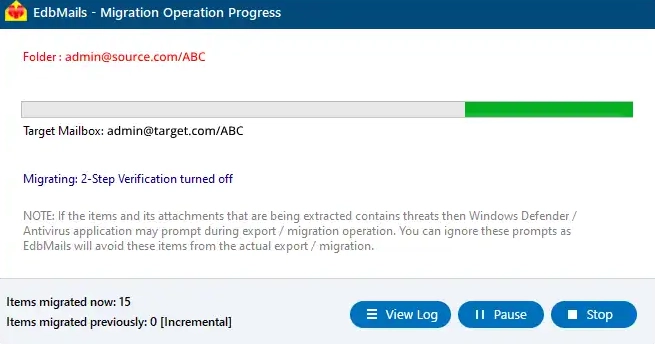
- Once the mailboxes are mapped, click the ‘Start Migration’ button to begin the migration process.
Staged and Incremental Migration
A staged migration can reduce disruption by moving existing mailbox data before the final mail-flow change. Users may continue receiving new mail in Microsoft 365 while the initial data transfer is running.
If the current EdbMails job supports a repeat or incremental pass for this workflow, use it after the initial migration to process the applicable new or changed email data before final cutover. Review the report after each pass rather than assuming the destination is complete.
What Happens to New Emails During Migration?
Messages received in Microsoft 365 after the initial migration may require another migration pass before they appear in Gmail. Plan the final migration pass and the mail-flow cutover together so that messages received during the migration window are accounted for.
When Should You Change MX Records?
Personal Gmail: Moving historical mail to an individual @gmail.com account does not require your organization to point its domain's MX records to that personal mailbox.
Google Workspace with a custom domain: If the organization is moving its production mail service from Microsoft 365 to Google Workspace, change the domain's MX records only during the final mail-flow cutover after the initial migration, validation, and required final migration pass are complete.
- Verify the custom domain and destination users in Google Workspace.
- Confirm Gmail is enabled for the destination users.
- Review the required Google MX records.
- Review SPF, DKIM, and DMARC for the new mail-flow design.
- Test inbound and outbound mail after the cutover.
Post-Migration Validation
- Compare Inbox, Sent, Drafts, custom folders/labels, and representative nested folders with the source.
- Check representative messages, attachments, dates, and read/unread state where applicable.
- Review the EdbMails migration report for completed, skipped, failed, or unmapped items.
- Verify every source-to-target mailbox mapping used in the production batch.
- Test the destination account sign-in and normal Gmail access.
- For Google Workspace custom-domain projects, verify inbound and outbound mail after the MX cutover.
- Keep the Microsoft 365 source available until migration validation and any required retention/compliance review are complete.
Common Office 365 to Gmail Migration Problems
- Gmail authentication fails: Check the Google account security settings, 2-Step Verification, app-password availability when that method is used, and the authentication expected by the current EdbMails workflow.
- IMAP connection fails: Verify the Gmail host, secure IMAP connection settings, account credential, and any Google Workspace policy restricting third-party access.
- Some folders are missing or appear differently: Review source-folder selection, special-folder behavior, and Gmail folder/label mapping.
- Large messages fail: Review destination-side import/message constraints and test oversized items separately.
- Migration is slower than expected: Review mailbox size, folder/item count, concurrency, network throughput, Microsoft 365 throttling, and Google-side processing.
- New mail is missing after the first pass: Run the appropriate repeat/incremental migration pass before finalizing the cutover.
Related Office 365 Migration Scenarios
Use the destination-specific guide that matches the actual migration direction:
- For Zimbra as the destination, see how to migrate from office 365 to zimbra.
- For the reverse Zimbra-to-Microsoft 365 direction, see migrate from google zimbra to office 365.
- For supported Exchange 2016/2019 destination planning, see office 365 migration to exchange 2016 2019.
- For the current Office 365-to-Exchange workflow, see Office 365 to Exchange migration.
Frequently Asked Questions
Can I migrate Office 365 emails to Gmail?
Yes. The EdbMails workflow on this page uses Office 365 to IMAP to move supported email data from Microsoft 365 to a Gmail or Google Workspace mailbox.
What is the difference between migrating to Gmail and Google Workspace?
A personal Gmail migration normally targets an individual Google account. Google Workspace is organization-managed and can involve multiple users, a custom domain, administrator policies, and a final domain mail-flow cutover.
Does IMAP migrate Office 365 contacts and calendars?
Basic IMAP migration is email-focused. If contacts or calendars are required, verify and configure a separate migration method that supports those data types.
Do I need an app password for Gmail migration?
Use the authentication required by the current EdbMails Gmail connection. If an app password is used, Google requires 2-Step Verification and the app-password option must be available for that account.
How are Office 365 folders handled in Gmail?
Gmail uses labels rather than the same folder model as Exchange Online. Validate standard folders, special folders, nested folders, and custom folders during the pilot and after the migration.
When should I change MX records?
Change MX records only when moving an organization-owned custom domain to Google Workspace and only after the target is prepared and the initial migration and validation are complete. A personal @gmail.com mailbox does not require an organization-owned MX cutover.
How do I verify the Office 365 to Gmail migration?
Review the migration report and compare representative messages, attachments, dates, folders/labels, and mailbox mappings with the Microsoft 365 source before retiring or changing the source environment.