


Office 365 to IceWarp Migration
Migrating from Microsoft 365 (Office 365) to IceWarp requires careful planning around mailbox preparation, authentication, folder mapping, and post-migration validation. Organizations moving to IceWarp typically need a reliable way to transfer mailbox data while maintaining the required email structure and minimizing manual effort.
EdbMails supports Office 365 to IceWarp migration through IMAP connectivity. The migration workflow helps administrators connect the source Microsoft 365 environment, configure IceWarp destination accounts, map mailboxes, transfer supported mailbox data, and review migration reports after completion.
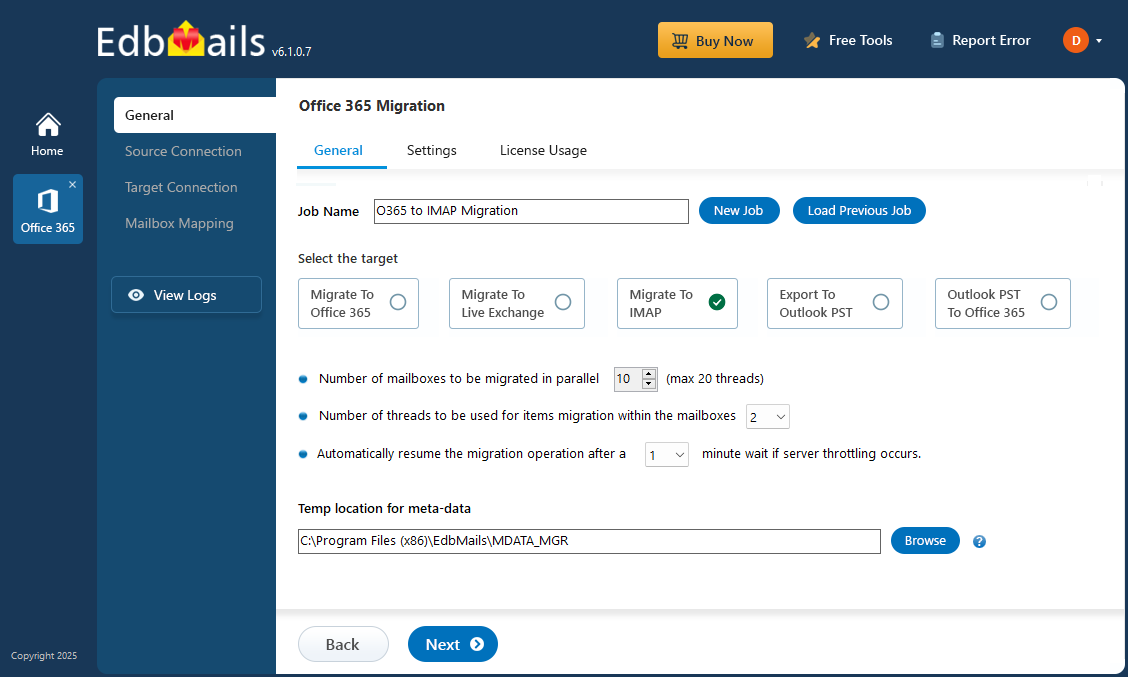
The features offered in EdbMails Office 365 migration software help administrators manage the migration process with mailbox mapping, selective migration, batch mailbox migration, progress monitoring, and detailed migration reports. The migration process depends on the source configuration, destination settings, mailbox size, and network conditions. This guide explains the requirements, preparation steps, migration process, and validation practices for moving from Office 365 to IceWarp.
Office 365 to IceWarp Migration Checklist
Before starting the migration, administrators should review the source and destination environments to avoid configuration issues during mailbox transfer.
- Review Office 365 mailbox inventory and identify mailboxes that need to be migrated.
- Verify IceWarp mailbox availability and confirm IMAP connection details.
- Test source and target connectivity before running the full migration.
- Perform a pilot migration with selected mailboxes to validate folder mapping and migration settings.
- Run validation checks and review migration reports after completion.
Office 365 to IceWarp: Why Organizations Opt for the Move
Organizations move away from Office 365 to alternative platforms like IceWarp for a range of business reasons, from cost control to infrastructure preferences.
- Self-Hosted or Provider-Choice Control: Some organizations prefer platforms that can be deployed on-premises or through a hosting provider of their choice, giving administrators direct control over mailbox storage, retention policies, and server configuration.
- Licensing Cost: Office 365 runs on a recurring per-user subscription model. Organizations with predictable mailbox counts sometimes find alternative licensing structures more cost-effective over time.
- Data Residency: Organizations with strict data residency or compliance requirements may prefer a platform where they can choose where their mail data physically resides.
- Simplified Administration for Smaller Teams: Organizations that don't need the full Microsoft 365 productivity suite at enterprise scale may prefer a more focused email and groupware setup that's easier to administer.
Whatever the reason for the move, EdbMails handles the technical side of the transition - connecting securely to Office 365, transferring mailboxes over IMAP, and preserving folder structure and mailbox data throughout the process.
EdbMails Features for Office 365 to IceWarp Migration
| Feature | Description |
|---|---|
| Office 365 to IMAP Support | Connects directly to Office 365 and transfers mailbox data to any IMAP-accessible platform, including IceWarp. |
| Granular Filtering | Choose exactly which folders, date ranges, senders, or attachments to migrate, rather than transferring an entire mailbox. |
| Incremental Sync | On repeat migration runs, only new or modified items are transferred, so no duplicate data is created on the target. |
| Auto Mailbox Mapping | Automatically matches source and target mailboxes, with manual mapping available if needed. |
| Modern Authentication | Connects securely to Office 365 using OAuth 2.0, avoiding outdated basic-authentication login methods. |
| Real-Time Logs | Track migration progress live and review a detailed report once the migration completes. |
Office 365 to IceWarp migration: Planning
Before initiating the migration process from Office 365 to an IceWarp server, ensure the following preparatory tasks are completed:
On the source Office 365 server side:
- For Auto Registration of the EdbMails application in Entra ID (Azure Active Directory), a global administrator account with an associated mailbox is required. If you prefer Manual Registration, you can use either a global admin account or any user account that has full mailbox access permissions.
- Assign the suitable Office 365 licenses for the mailboxes you wish to migrate
Click here to assign Microsoft 365 licenses to user accounts
- To migrate Office 365 public folders, archive mailboxes and shared mailboxes, ensure that you configure them appropriately.
Click here to create Office 365 Public folder and assign admin permissions.
Click here to create Shared mailboxes on Office 365 and set the required permission
Click here to enable archive mailboxes on Office 365
- Verify that you have enough bandwidth for Office 365 migration
Click here for network and migration planning, performance factors and best practices for Office 365 migration.
- For large messages(items) migration, configure Office 365 to increase the message size limit.
Click here for the steps to increase the message size on Office 365 to 150MB.
On the target IMAP server side :
- Get your IceWarp account IMAP host name, port number, email address and password required for login.
- If you're migrating multiple mailboxes, download the sample CSV file from EdbMails and fill in the required details, including the email address, password, IceWarp IMAP server hostname, and port number.
Steps to migrate from Office 365 to IceWarp using EdbMails
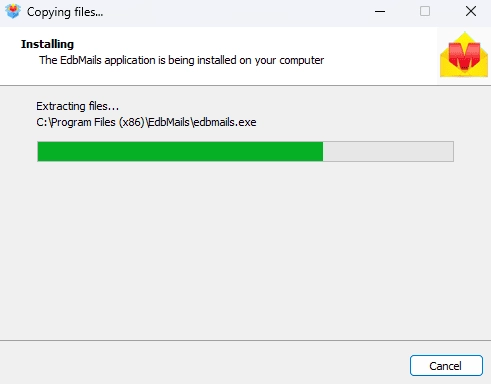
Step 1: Download and install EdbMails tool
- Download and set up the EdbMails application on your computer.
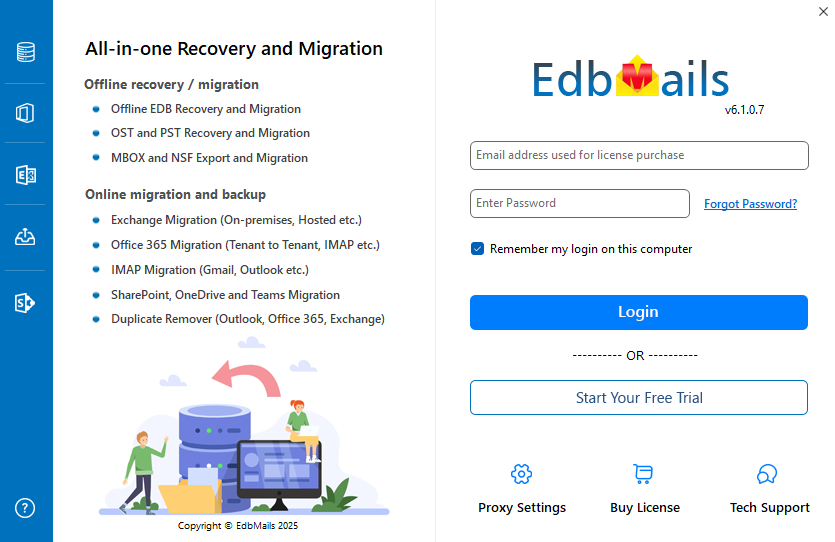
- Open the software and either Login with your registered email and password or click on ‘Start Your Free Trial’ to get started.
See EdbMails system requirements to ensure compatibility for Office 365 to IceWarp migration
- Open the EdbMails application and proceed by clicking ‘Login’ using your registered email and password, or select ‘Start Your Free Trial’ to begin without an account.
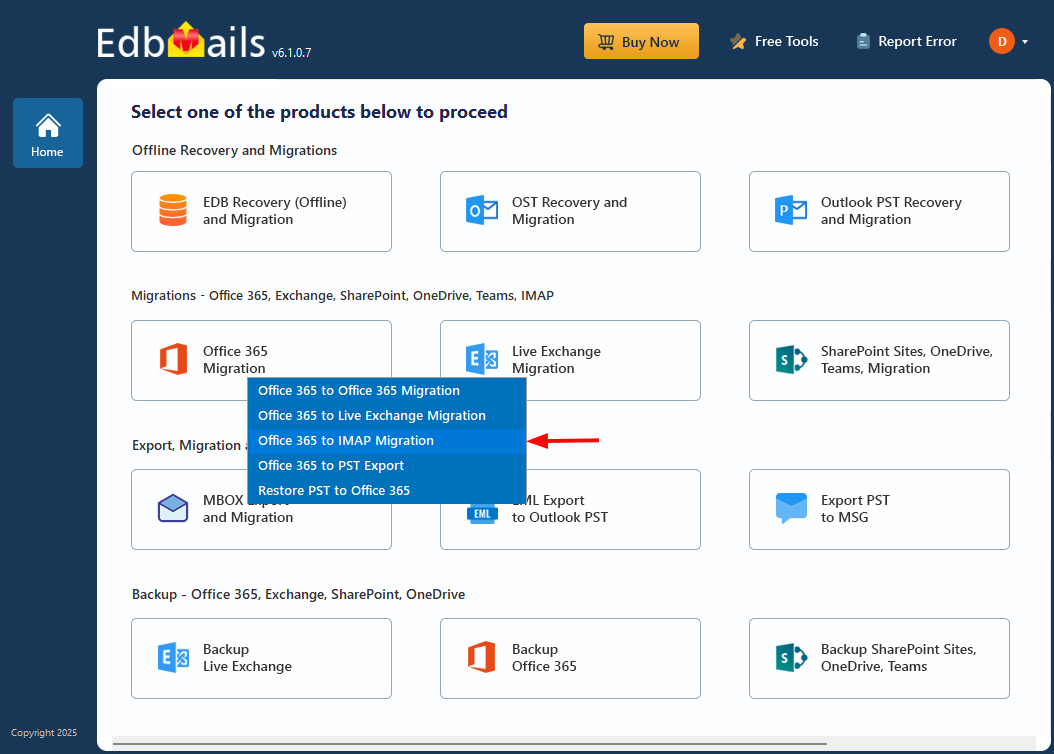
Step 2: Choose the Office 365 to IMAP migration
- Click on ‘Office 365 Migration’ and choose ‘Office 365 to IMAP migration’.
- Use the default job name or click ‘New Job’ to set a different name.
Step 3: Connect to source Office 365 server
- Click on ‘Add New Connection’ to configure a fresh link to your source Office 365 account, or select ‘Connect to Existing’ if you’ve already set one up.
- Select the appropriate connection options and click ‘Next’.
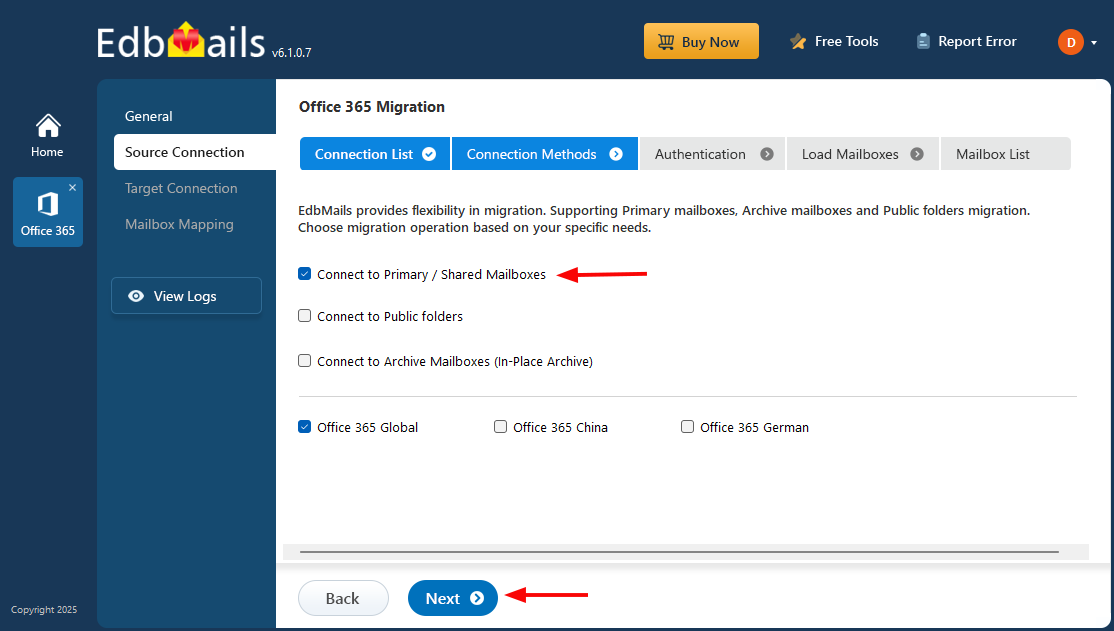
- Choose your authentication type, enter the required details, and click ‘Login’ to move forward.
- Log in using the Microsoft authentication page to access your Office 365 account.
- Once the mailboxes are loaded, select the ones you wish to migrate and click ‘Next’ to continue.
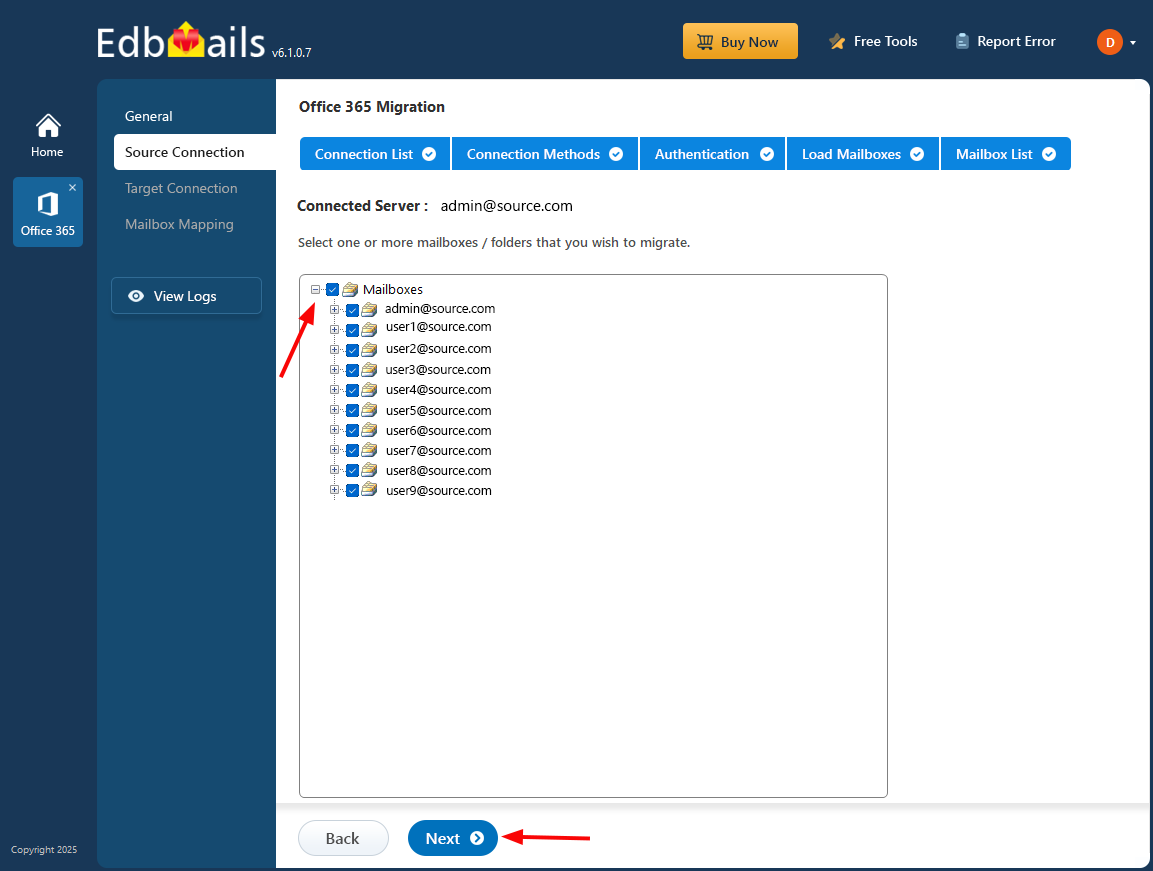
Connect to Office 365 server using secure modern authentication
Step 4: Connect to target IceWarp server
- Choose either ‘Connect to IMAP’ or ‘Connect to POP3’ based on your destination platform.
- If you're migrating a single mailbox, select ‘Single User / Account Migration’ and enter the target email address along with the IMAP server details.
- Click ‘Login’ to establish the connection, wait for the mailbox to load, then click ‘Next’ to proceed.
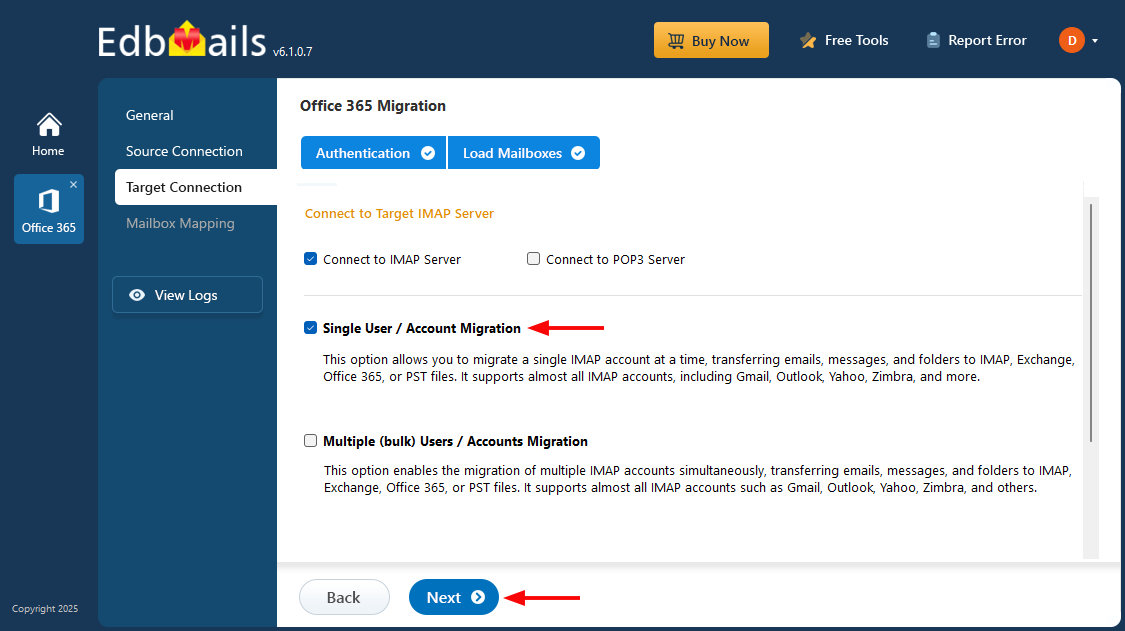
- To migrate multiple mailboxes, select ‘Multiple (Bulk) Users/Accounts Migration’ and click ‘Next’.
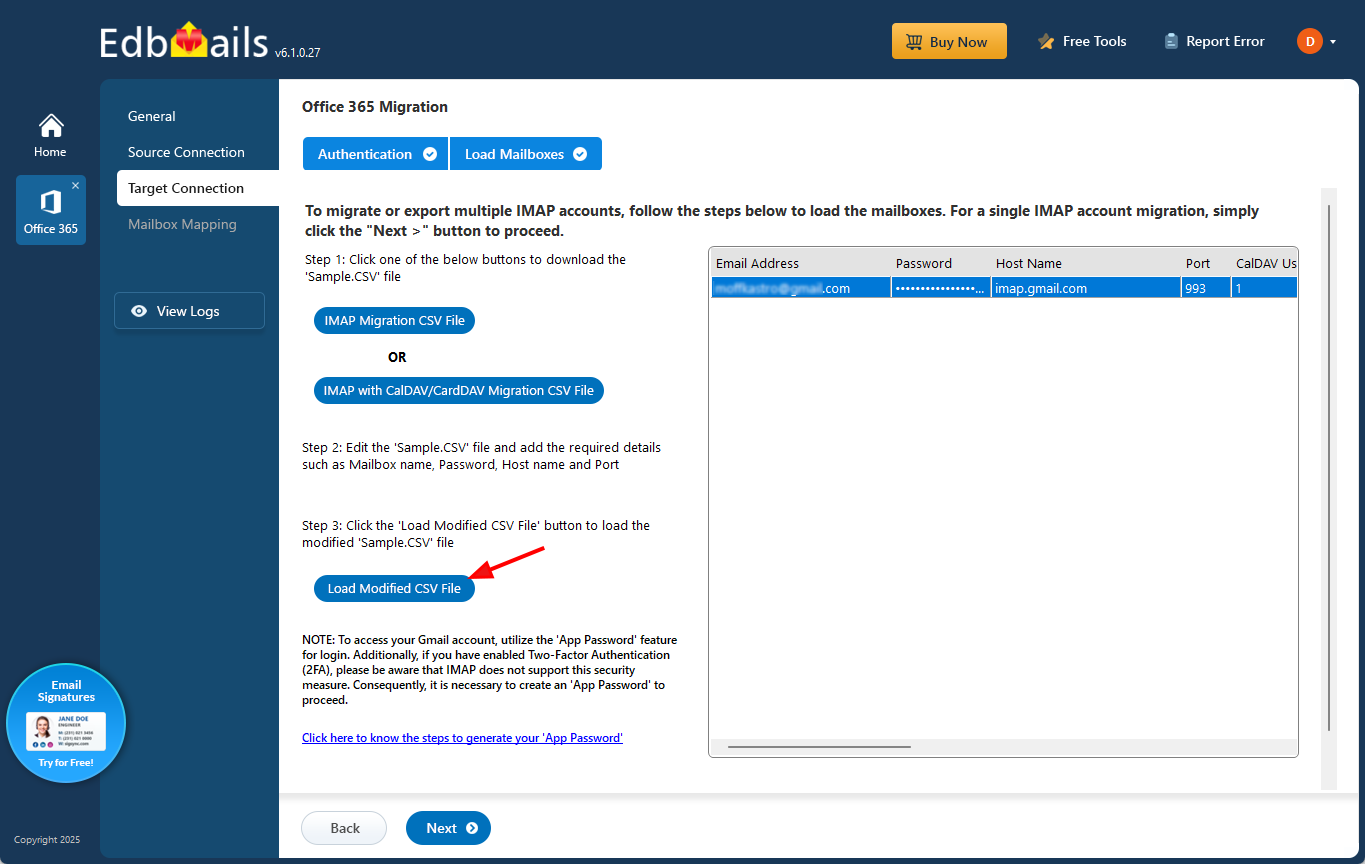
- Select the option ‘IMAP Migration CSV File’.
- A prompt will appear to download the sample .csv file. Select a destination folder on your system to save it.
- Open the downloaded CSV file and enter the necessary information such as email address (mailbox name), password, host, and port. Fields that are not relevant for email migration can be marked as ‘NA’. Once updated, save the file and close it.
- Click on the ‘Load Modified CSV File’ option and choose your updated CSV. Review the listed mailboxes, then continue by selecting ‘Next’.
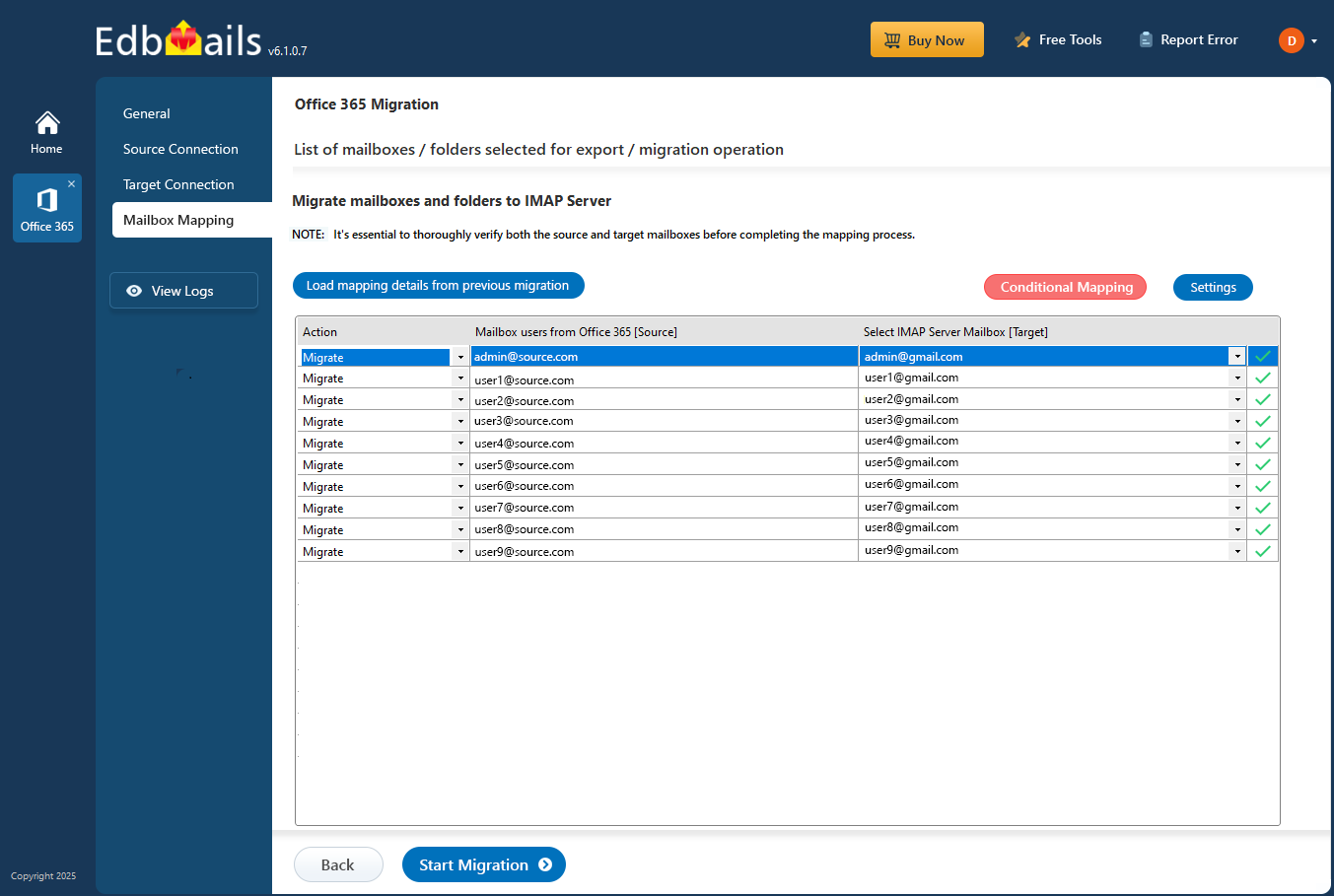
Step 5: Map Office 365 to IceWarp mailboxes
- Choose the mailbox mapping option that fits your needs.
- EdbMails offers automatic mailbox mapping between Office 365 and IceWarp accounts, but you also have the flexibility to perform manual mapping if preferred.
Step 6: Start Office 365 to IceWarp migration
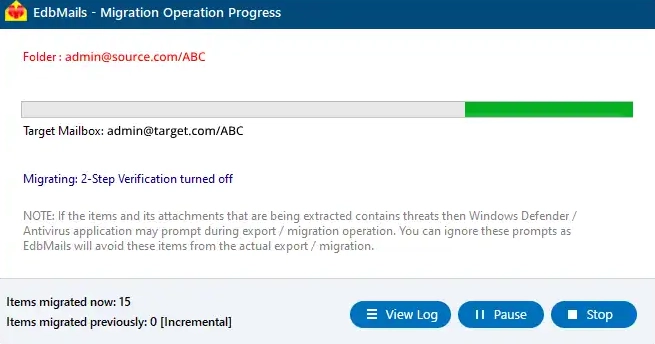
- Click on ‘Start Migration’ to initiate the mailbox transfer process.
- Once the migration is finished, select ‘View Log’ to review the migration report and verify the items on the destination server.
Run Incremental Migration Before Cutover
After the initial migration, administrators can run an incremental migration to transfer new or modified mailbox items before switching users to IceWarp. This helps capture recent changes made after the first migration pass and reduces the amount of data that needs to be transferred during the final transition.
Office 365 to IceWarp: Post migration tasks
After migration, update your domain’s MX records to route all new emails to IceWarp.
Best practices for a successful Office 365 to IceWarp migration
- You will have to begin with a full analysis of your Office 365 environment so that you can detect mailboxes, shared folders and data volume.
- You can pre-configure IceWarp server by creating user accounts and switching on necessary services like IMAP etc.
- Verify that the network connectivity is stable, check bandwidth limitations or latency problems prior to the migration.
- Automate the entire Office 365 to IMAP migration process with a reliable and safe EdbMails tool and also retain mailbox mapping and folder structure.
- Run a pilot migration to test mailbox performance, verify folder integrity, and fix configuration gaps.
- Monitor the live migration process using detailed logs from EdbMails and address any failed items or warnings.
- Reconfigure mail clients and verify access on web, desktop, and mobile platforms.
- Perform a final data integrity check to ensure all folders, emails, and attachments have migrated accurately.
- By filtering out heavy or irrelevant folders, you cut down the data volume and dramatically improve migration speed and efficiency.
Common Mistakes to Avoid During Office 365 to IceWarp Migration:
- Deleting source Office 365 mailboxes before verification: EdbMails suggests to verify the migrated mailboxes completely before deleting the source accounts so that none of the mailboxes data should be missed out.
- Using incorrect hostname, port field, or SSL settings: Incorrect server settings result in failed connections, EdbMails supports secure IMAP configuration.
- Skipping pilot / test migrations: EdbMails advises running a pilot migration to validate folder mapping, mailbox size, and performance before the full migration.
Office 365 to IceWarp Migration: Common Challenges and How EdbMails Solves Them
- Authentication Differences: Office 365 uses OAuth 2.0 / Modern Authentication, while destination IMAP servers often rely on standard IMAP login credentials. EdbMails supports both, allowing a secure connection to Office 365 and a standard IMAP connection to the target server within the same migration job.
- Folder Mapping Mismatches: Folder names and hierarchies don't always match automatically between two different platforms, which can leave emails misplaced after migration. EdbMails' automatic mailbox mapping matches source and target folders, with the option to map folders manually where needed.
- Large Mailbox and Attachment Handling: Mailboxes with large attachments or high item counts can slow down or fail during a direct transfer. EdbMails is designed to handle large mailboxes and large attachments as part of the standard migration process.
- Server Throttling and Rate Limits: Office 365 enforces throttling limits on high-volume operations, which can interrupt large migrations if not managed. EdbMails includes automatic throttling management that adjusts migration speed to stay within these limits without failing the job.
- Selective Migration Needs: Not every organization wants to migrate an entire mailbox as-is; some need to exclude specific folders, date ranges, or message types. EdbMails' advanced filtering options let you migrate by date, subject, sender, recipient, or attachment, rather than an all-or-nothing transfer.
- Duplicate Data on Repeat Migrations: Running a migration more than once (for example, to catch up on new emails before cutover) risks creating duplicate items. EdbMails' incremental migration transfers only new or modified items on subsequent runs, avoiding duplicates.
- Verifying Migration Completeness: Without detailed reporting, it's difficult to confirm every mailbox, folder, and item transferred correctly. EdbMails provides a detailed migration report and real-time logs so you can verify results before decommissioning the source mailboxes.
- Network Interruptions During Large Transfers: A dropped connection partway through a large migration can leave data in an inconsistent state. EdbMails lets you pause and resume migrations so an interruption doesn't force a full restart.
Conclusion
Moving from Office 365 to IceWarp involves careful planning around authentication, folder mapping, and mailbox data integrity. EdbMails handles these technical steps through a single guided workflow, so you don't need to manage manual exports, PST conversions, or custom scripts.
From initial connection to final verification, EdbMails keeps folder structure intact, supports selective and incremental migration, and provides detailed reporting at every step, whether you're migrating a handful of mailboxes or an entire organization.
Frequently Asked Questions
Do I need any special permissions to migrate from Office 365 to IceWarp?
Yes. You need a Global Admin account (or a full-access user account for manual registration) on Office 365, and IMAP login credentials for the target IceWarp mailbox.
Will my folder structure be preserved during migration?
Can I migrate only specific folders or a date range instead of the whole mailbox?
What happens if I need to run the migration more than once before cutover?
Can I migrate multiple mailboxes at once?
Which license do I need for Office 365 to IceWarp migration?