


Selective Mailbox Office 365 Migration
Most Office 365 migrations do not need to move every mailbox in the tenant at once. A project may cover one department, a pilot group of users, or only the mailboxes affected by a merger, while the remaining users stay on the source until their turn. Selective mailbox Office 365 migration lets you define that scope yourself, choosing which mailboxes and folders are migrated instead of moving the complete environment in a single job.
EdbMails Office 365 migration software supports selection at the mailbox level and the folder level, along with filters that narrow the items migrated from each selected mailbox. This page explains how selective migration works in EdbMails, when to use it, and how to combine it with incremental migration for phased Microsoft 365 projects.
What is Selective Mailbox Office 365 Migration?
Selective mailbox migration is a migration in which the administrator controls the scope instead of migrating the whole tenant by default. In EdbMails, the scope is set at four levels:
- Mailboxes: choose the specific user mailboxes to include from the list loaded from the source tenant.
- Folders: within a selected mailbox, choose only the folders you need, or exclude standard and custom folders that should not be migrated.
- Items: apply include or exclude filters, such as date, subject, sender or recipient, to control which items in those folders are migrated.
- Migration runs: migrate one group of mailboxes now and the next group later, instead of running one large job for the whole organization.
Why Perform Selective Mailbox Migration?
Selective migration is useful whenever the migration scope is smaller than the tenant, or when a large migration needs to be broken into manageable stages. Common reasons include:
- Phased migration: move users in batches by department, location or business unit, so each batch can be planned, migrated and verified before the next one starts.
- Pilot migration: migrate a small set of test mailboxes first to confirm connection settings, mailbox mapping and folder structure on the target before migrating production users.
- Department-based migration: during a merger, acquisition or divestiture, move only the departments or user groups that are changing tenants while the rest stay on the source.
- Migration testing: run a trial with a few mailboxes and a limited date range to check how items and folders appear on the target before committing to the full scope.
- Data scope control: for offboarding, compliance or legal hold requests, migrate only the mailboxes named in the request, and exclude low-value folders such as Junk Email or old Notes where target storage or license count is limited.
Before defining the scope, review the Office 365 migration checklist and the Office 365 migration guide, which cover the preparation steps that apply to every phase.
Select Specific Mailboxes and Folders for Migration
When you connect the source Office 365 tenant in the EdbMails Office 365 migration tool, you can load mailboxes automatically after signing in or, for larger tenants, import the list from a CSV file (see listing Office 365 mailboxes using a CSV file). Check only the mailboxes you want to include and click Next. Mailboxes that are not selected are not processed in this job, which is useful when only a subset of users needs to move, such as a single department during a phased migration or one employee's mailbox during offboarding. The selected mailboxes are then matched to their target mailboxes, which EdbMails can do with automatic mailbox mapping.
Selection also works below the mailbox level. Expand a selected mailbox in the tree view and choose only the folders you need, such as Inbox and Contacts. Folders you do not select are not migrated, which reduces the data transferred and keeps the target mailbox limited to what users need. This is different from excluding standard or custom folders, covered below: folder selection builds the migration from only the folders you choose, while folder exclusion removes named folders from an otherwise complete mailbox migration.
Exclude Standard Folders
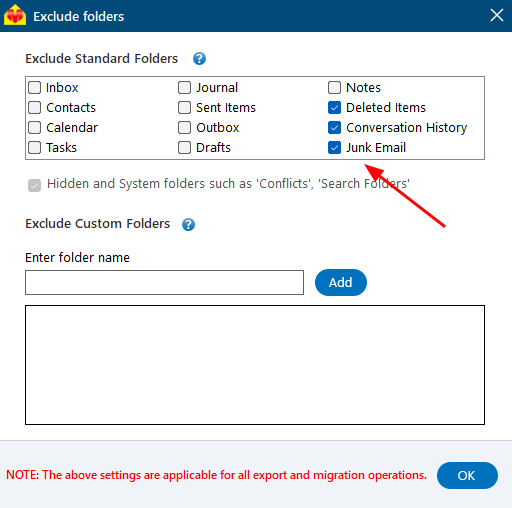
EdbMails lets you exclude common system folders from the migration when they are not required on the target.
- Go to the ‘Settings’ window, then click on ‘Exclude Standard / Custom Folders’.
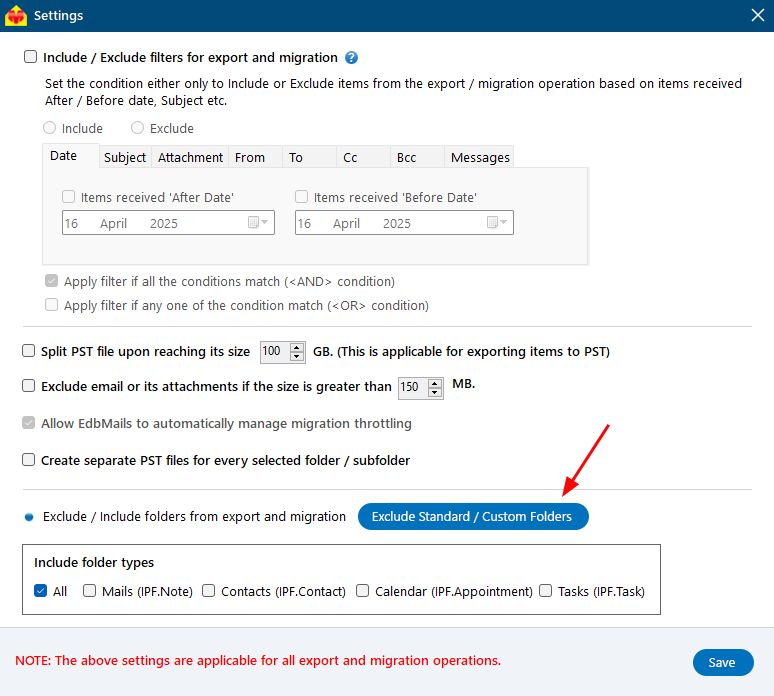
- You can exclude standard folders such as ‘Inbox’, ‘Contacts’, ‘Calendars’, ‘Tasks’, ‘Journal’, ‘Sent Items’, ‘Outbox’, ‘Drafts’, and ‘Notes’ during migration. By default, the ‘Deleted Items’, ‘Conversation History’, and ‘Junk Email’ folders are excluded.
Exclude Custom Folders
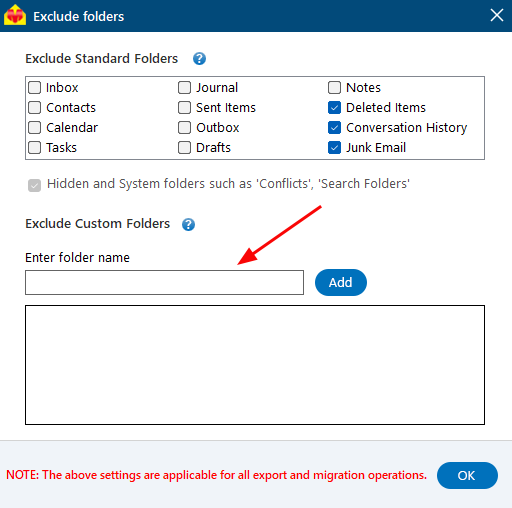
In addition to standard folders, you can exclude custom folders created by users, for example old project folders that are not needed on the target.
- Enter the folder name manually and click ‘Add’, then click ‘OK’ to save the changes.
- Save the settings by clicking the ‘Save’ button.
Filter Mailbox Items Before Migration
Mailbox and folder selection decide where data comes from. Filters decide which items within those folders are migrated. EdbMails provides include and exclude filters in the migration settings, so you can narrow the data set further without changing the mailbox selection.
- Date-based filtering: migrate items received after a date, before a date, or within a date range. For example, migrate recent mail in the first pass and handle older items in a later run.
- Subject filtering: include or exclude email and calendar items by subject, such as automated notifications or system alerts that are not needed on the target.
- Sender and recipient filtering: include or exclude items by From, To, Cc or Bcc address, for example to leave out mail from a retired distribution list or an external system.
- Folder-based selection: limit the migration to specific item types such as emails, contacts, calendars or tasks, in addition to the folder selection and exclusions described above.
Other filters cover attachment names, read or unread status, and item size. For the complete list of options and the steps to configure them, see Advanced Filter Settings for Office 365 Migration.
Selective Migration with Incremental Migration
Selective migration and incremental migration work together in phased projects. Users usually keep working in the source mailboxes while a phase is in progress, so new mail continues to arrive after the first pass completes.
- Initial migration: run the first migration for the selected mailboxes, folders and filters. EdbMails performs a full transfer of the data within that scope.
- Repeat migration: run the same migration again. EdbMails compares the source mailboxes with metadata from the previous run and migrates only new or modified items, so items that were already migrated are not copied again.
- Final pass before cutover: run the migration once more just before switching users to the target, for example just before the MX record change, to capture items created or modified since the last run.
After each run, check the Office 365 migration reports. They record the migrated item counts per mailbox, excluded folders and migration errors when present, which helps confirm that each phase covered the intended scope.
Benefits of Selective Office 365 Mailbox Migration
- Better migration scope control: you decide which mailboxes, folders and items are migrated, instead of moving the whole tenant by default.
- Reduced migration workload: leaving out mailboxes, folders and older items that are not needed reduces the data transferred and the time each job takes.
- Supports phased migration: departments or user groups can be migrated in planned stages, each with its own schedule and cutover.
- Easier validation: smaller, clearly defined batches are quicker to verify against migration reports and in the target mailboxes.
- Better planning: a pilot batch shows how the migration performs in your environment, which helps you estimate and schedule the remaining phases.
Frequently Asked Questions
Can I migrate only selected mailboxes from Office 365?
Can I migrate specific folders from a mailbox?
Can I filter mailbox items before migration?
Is selective migration useful for large Office 365 migrations?