


Export Exchange Server emails to PST by Specific Date Range
Exporting Exchange Server mailboxes to PST for a specific date range is useful when access is required only to data from a specific time period. This approach is commonly used for compliance reviews, legal matters, or targeted migrations where only selected emails, calendar items, or contacts are needed. Extracting the full mailbox in such cases can be unnecessary, time-consuming, and inefficient, particularly when most of the data is outside the required timeframe.
To simplify the conversion process, EdbMails EDB to PST Converter offers an integrated date filter that lets you selectively extract and export mailbox items from a specific time frame. This eliminates the need to process unnecessary data, allowing you to export only relevant emails, tasks, or calendar entries within the defined date range. Compatible with all major Exchange Server versions from 2003 to 2019, EdbMails delivers a targeted, efficient, and easy-to-use export solution.
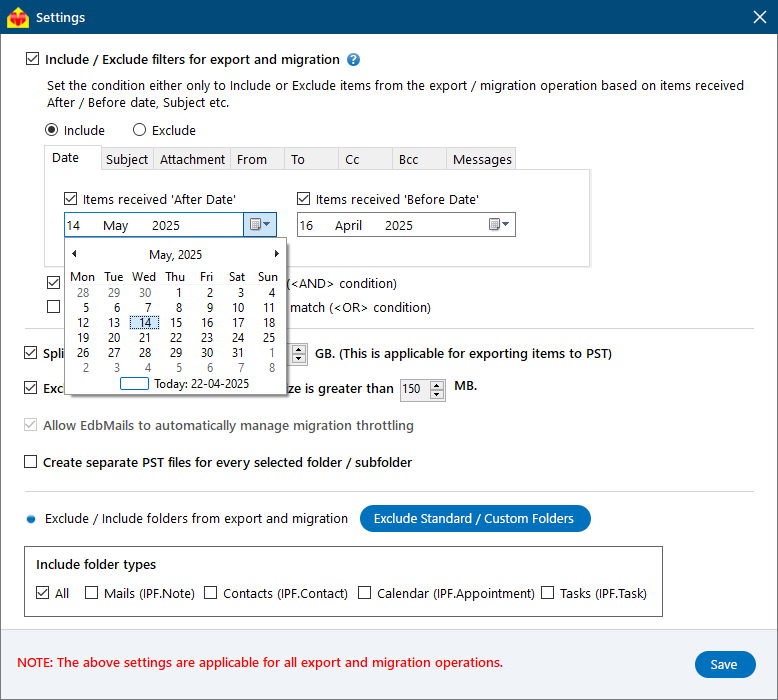
With a user-friendly interface, EdbMails allows you to easily choose a specific date range and export Exchange Server mailbox data to PST or other supported formats, including MHT, EML, and HTML. This step-by-step guide explains how to use EdbMails to efficiently extract mailbox data, helping you retrieve only the required information while maintaining data accuracy and integrity.
How to export an Exchange server mailbox to PST for a Specific Date Range?
To export Exchange server mailboxes to PST for a specific date range, you can either use the New-MailboxExportRequest -ContentFilter PowerShell cmdlet in the Exchange Management Shell (EMS) or set up your account in Outlook and apply the Advanced Date filter to select emails based on their Sent and Received dates.
Steps to export Exchange server mailboxes to PST by Date Range.
- Step 1: Create a Shared Network folder on your computer and copy the Network path.
- Step 2: Launch the EMS on your computer as a system administrator.
- Step 3: Run the New-MailboxExport request PowerShell cmdlet to filter your emails.Command: Copy & Paste it on PowerShell
New-MailboxExportRequest -Mailbox stevesmith@yourdomain.com -ContentFilter {(Received -gt '04/05/2022') -and (Received -lt '04/06/2022') -or (Sent -gt '01/02/2022') -and (Sent -lt '01/06/2022')} -Filepath "\\Network Location\Export folder\backup.pst
Note: The above command exports both sent and received emails from Steve Smith’s mailbox using an OR filter. Received emails are filtered between May 4, 2022, and June 4, 2022, while sent emails are filtered between February 1, 2022, and June 1, 2022. All the selected emails are then saved as a backup file named backup.pst.file at the specified network location.
- Step 4: To export multiple mailboxes, create a CSV file and use a Foreach loop in the cmdlet.Command: Copy & Paste it on PowerShell
$mailboxes = Get-Content "C:\Users\admin\Desktop\export_file.csv” foreach ($mailbox in ($mailboxes)) {New-MailboxExportRequest -Mailbox $mailbox -ContentFilter {(Received -gt '04/05/2022') -and (Received -lt '04/06/2022') -or (Sent -gt '01/02/2022') -and (Sent -lt '01/06/2022')} -Filepath "\\Network Location\Export folder\$($mailbox).pst" }
- Step 5: Execute the cmdlet Get-MailboxExportRequestStatistics to verify the status of the export.
- Step 6: Finally stop and remove the export request with the cmdlet Remove-MailboxExportRequest.
Limitations of using the PowerShell method of exporting Exchange server mailboxes
- Thorough knowledge and expertise of running the PowerShell commands is required.
- This method fails to export mailboxes if the Exchange EDB file is corrupted.
- The PowerShell method of filtering emails may not work on all Exchange server versions.
- Cannot recover the Exchange database file from Jet Error corruptions
- Additional options such as exporting specific folders or based on other rules and conditions is not possible.
- The operation requires export permissions and access to a Shared Network folder on your computer.
- Not a very user friendly approach of exporting emails based on date range.
- Difficult and time-consuming export method when your mailboxes are very large or oversized.
How to export mailboxes to PST by Date Range in Exchange server using EdbMails?
Using EdbMails EDB to PST Converter, you can easily export mailboxes from Exchange Server 2010, 2013, 2016, and 2019 with the help of filtering options. The tool lets you refine the export process by selecting specific date ranges, sender or recipient details, attachments, CC, BCC, and other criteria, ensuring accurate data selection and a more streamlined mailbox extraction experience.
Steps to export mailbox to PST by Date Range in Exchange server 2019, 2016, 2013 and 2010
Step 1: Download and install EdbMails EDB converter software
- Download and set up EdbMails on any Windows PC, even if Exchange Server isn’t installed.
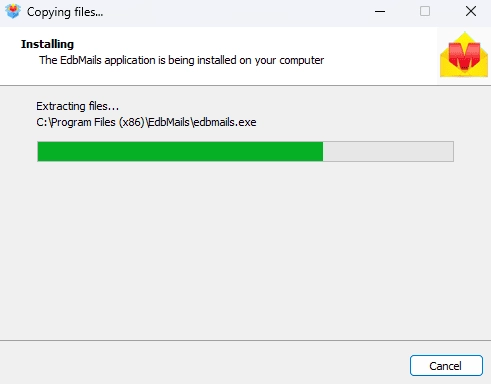
- Start by launching the EdbMails software on your computer.
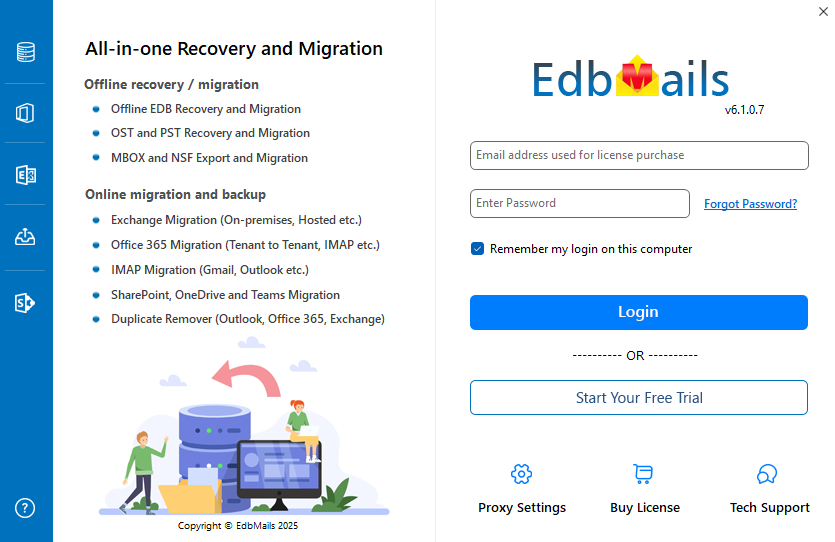
- Enter your email address and password, then click ‘Login’. New users can select ‘Start Your Free Trial’ to continue with the trial version without registering in EdbMails.Note: The trial edition allows mailbox export with a limit of 30 items per folder. To export the complete mailbox without restrictions, you must upgrade to a licensed version.
Click here to purchase the license from the EdbMails website.
After purchasing the license from the EdbMails website, close and reopen the application, then sign in with the same credentials used during purchase to enable full access.
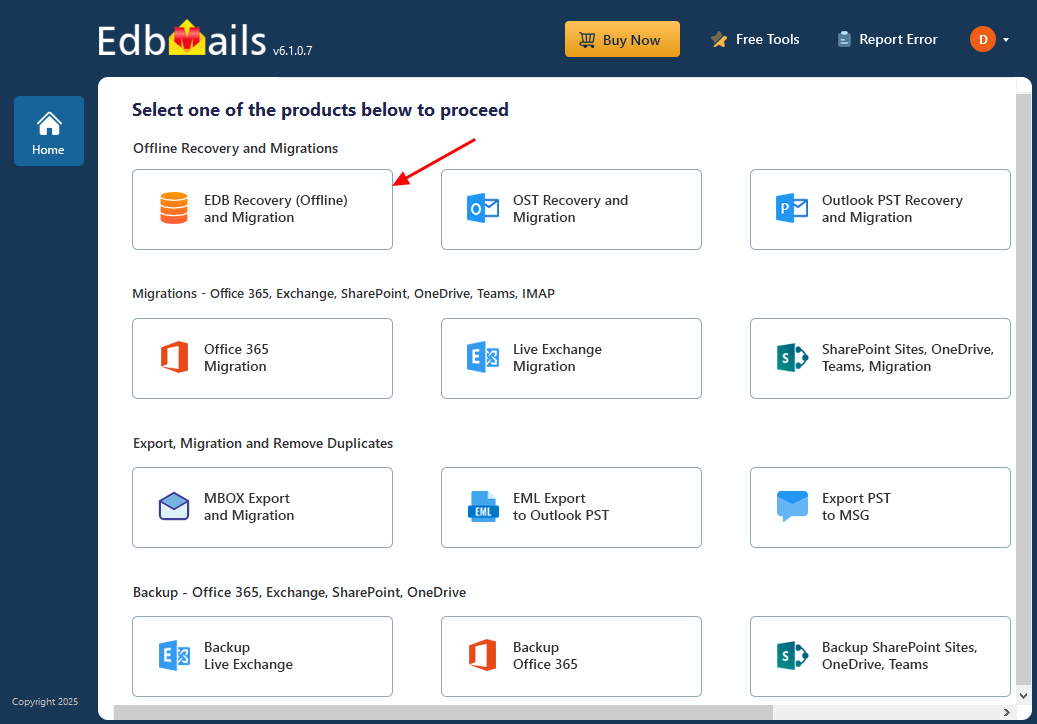
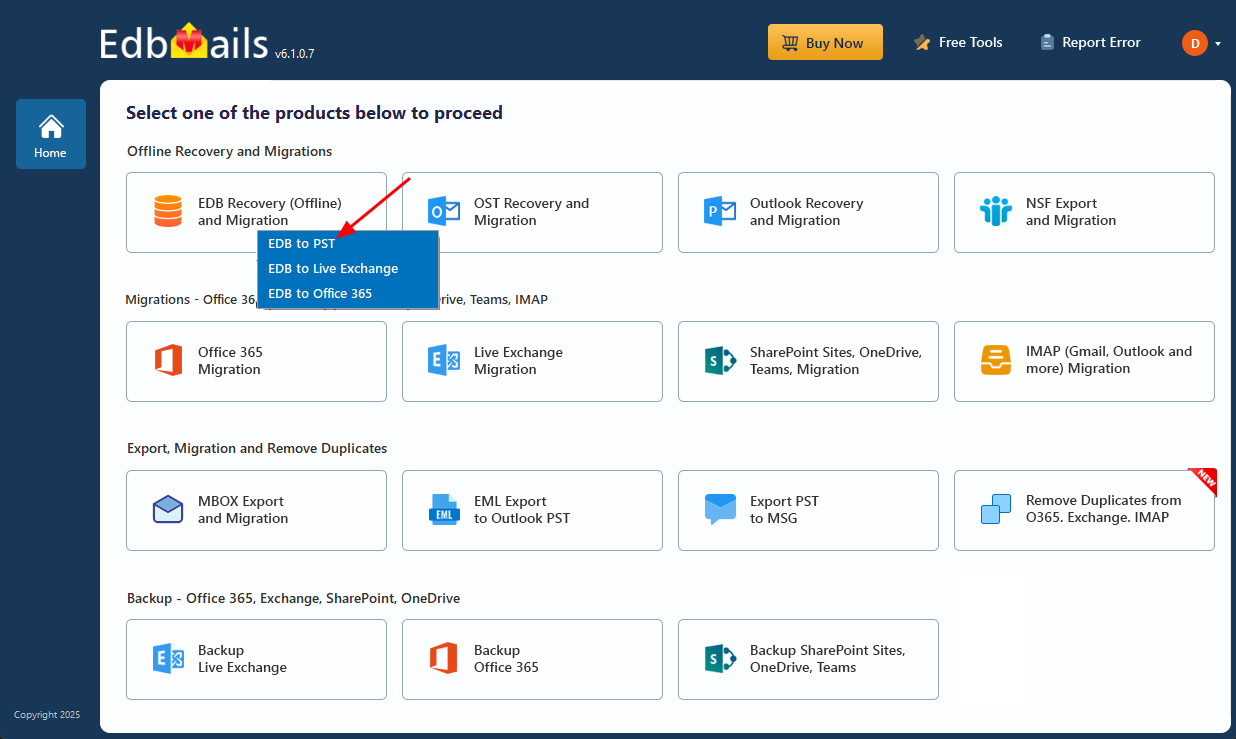
- From the product list, choose ‘EDB Recovery (Offline) and Migration’ to proceed.
- Select ‘EDB to PST’ option.
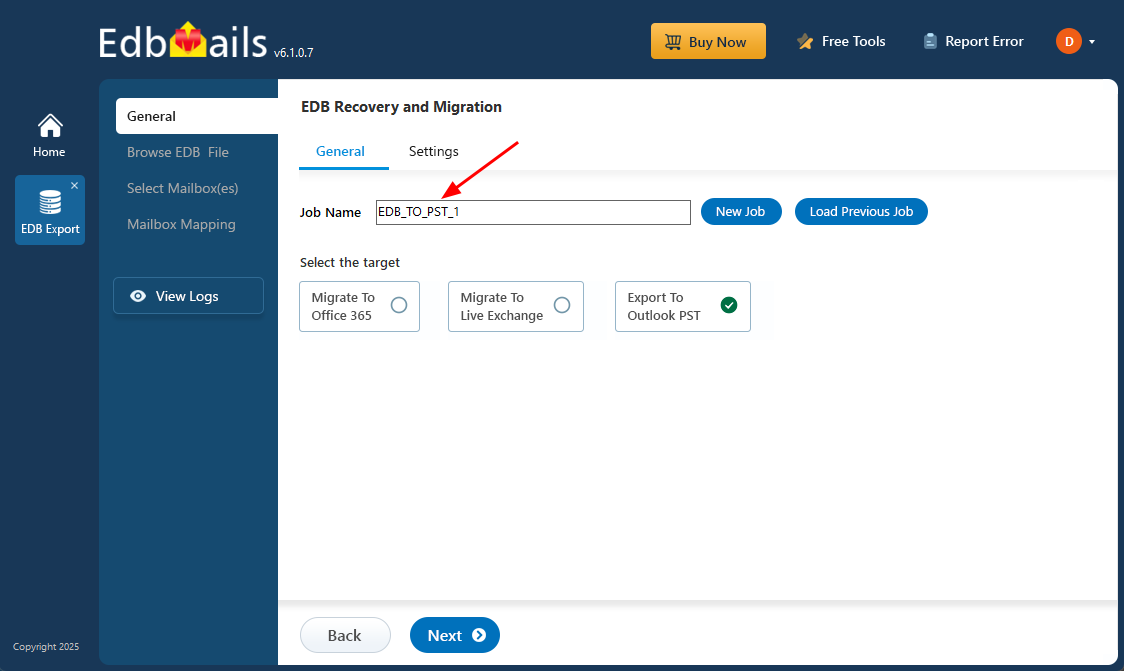
- You may keep the default job name or select ‘New Job’ to assign a custom name, making it easier to identify and track the task.
- Then, click ‘Next’ to continue.
- Download and set up EdbMails on any Windows PC, even if Exchange Server isn’t installed.
Step 2: Select offline Exchange EDB file
- Click the ‘Browse for EDB file’button.
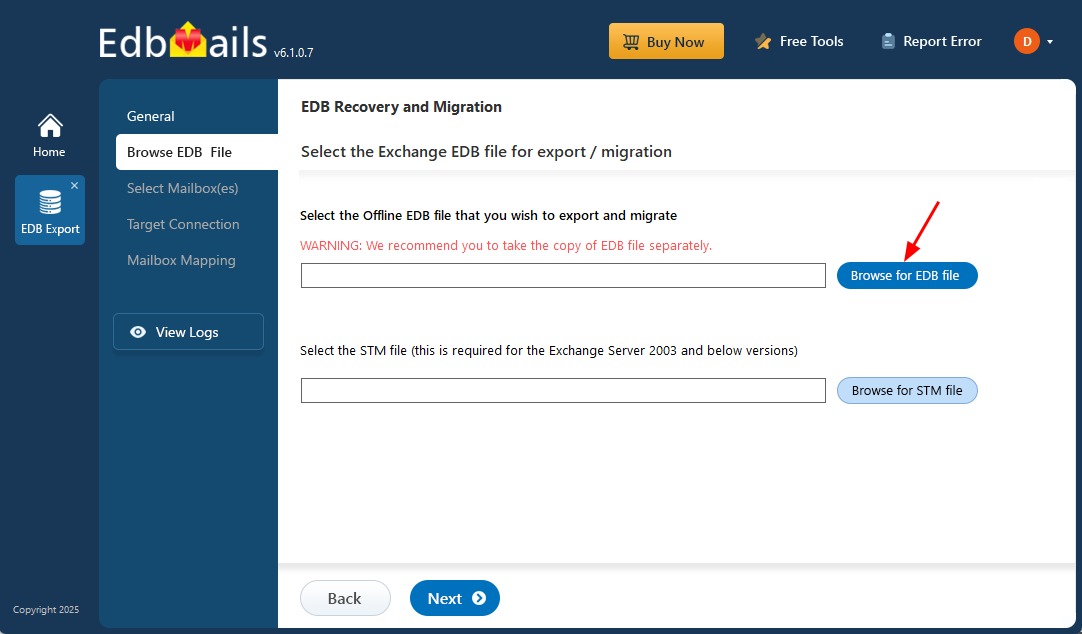
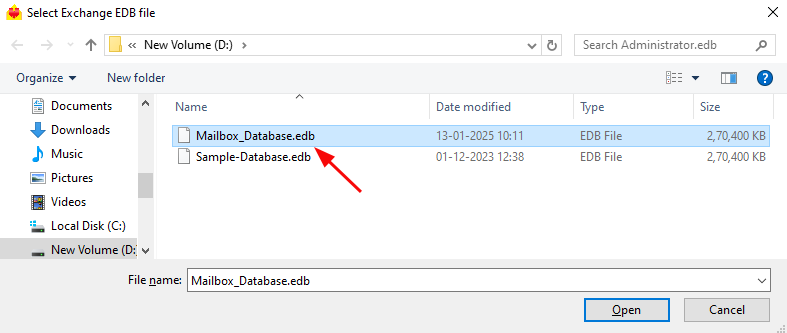
- Select the offline Exchange EDB file you want to export by specific date.
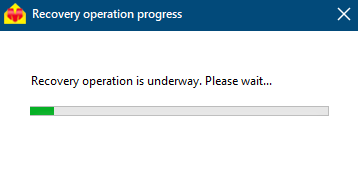
- EdbMails thoroughly scans the offline EDB file to retrieve mailbox data, even if the database is corrupted. The recovery time depends on the file size and the extent of the damage, so allow the scan to complete fully before proceeding.
- For filtering email items based on the Date, click ‘Settings’. Select the option Include/Exclude filters for export and migration.
- EdbMails comes with built-in filter settings to help you export mail based on various email rules such as Date, Subject, Attachment, Sender Address, Recipient Address, and conditions such as logical AND, OR.
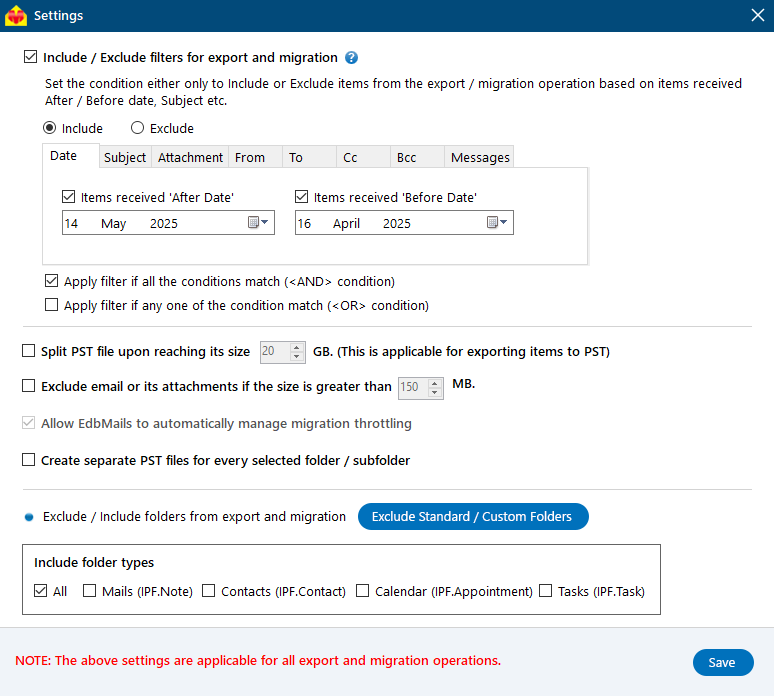
- Go to the Date tab and choose the 'After' and 'Before' filters to set your desired date range. Use the date picker to select the start and end dates, EdbMails will export all emails within that period.
- You can also customize settings like skipping emails over a certain size or splitting the EDB file into smaller PST files.
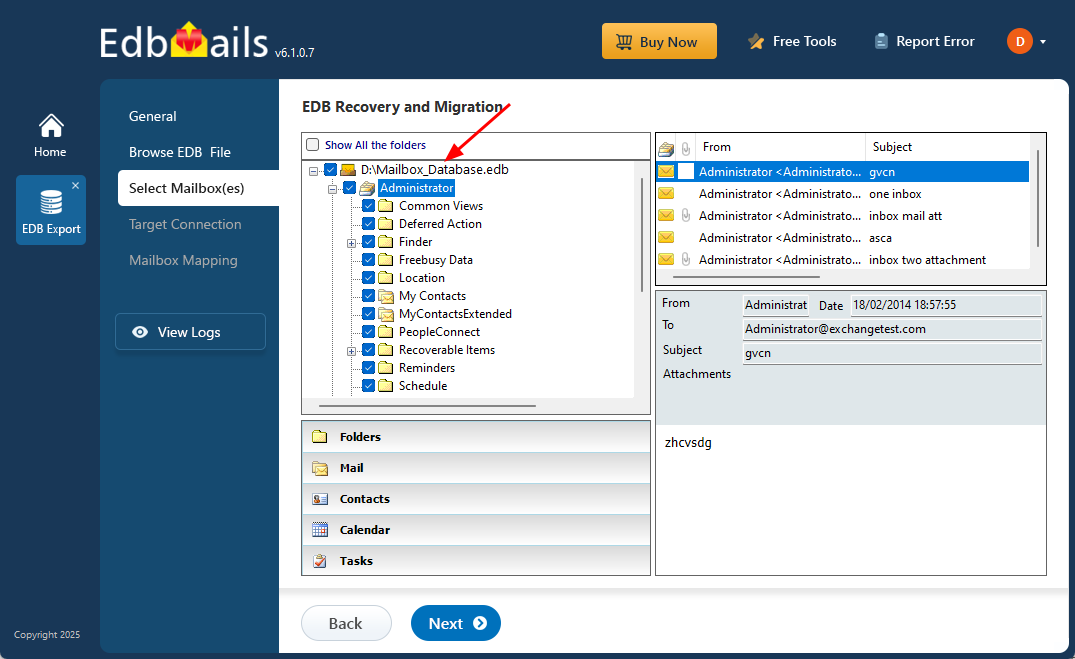
- After the recovery is complete, expand the mailbox and click on any folder to view all mailbox attributes emails, contacts, calendars, tasks, journals, and notes, in the right-side preview pane.
- Select the mailboxes or folders you'd like to export, then click ‘Next’ to move forward.
- Click the ‘Browse for EDB file’button.
Step 3: Convert EDB to PST
- Check the selected mailboxes and folders to confirm they’re ready for export. Make sure the 'Action' is set to 'Export', then click 'Start Export' to begin the export process.
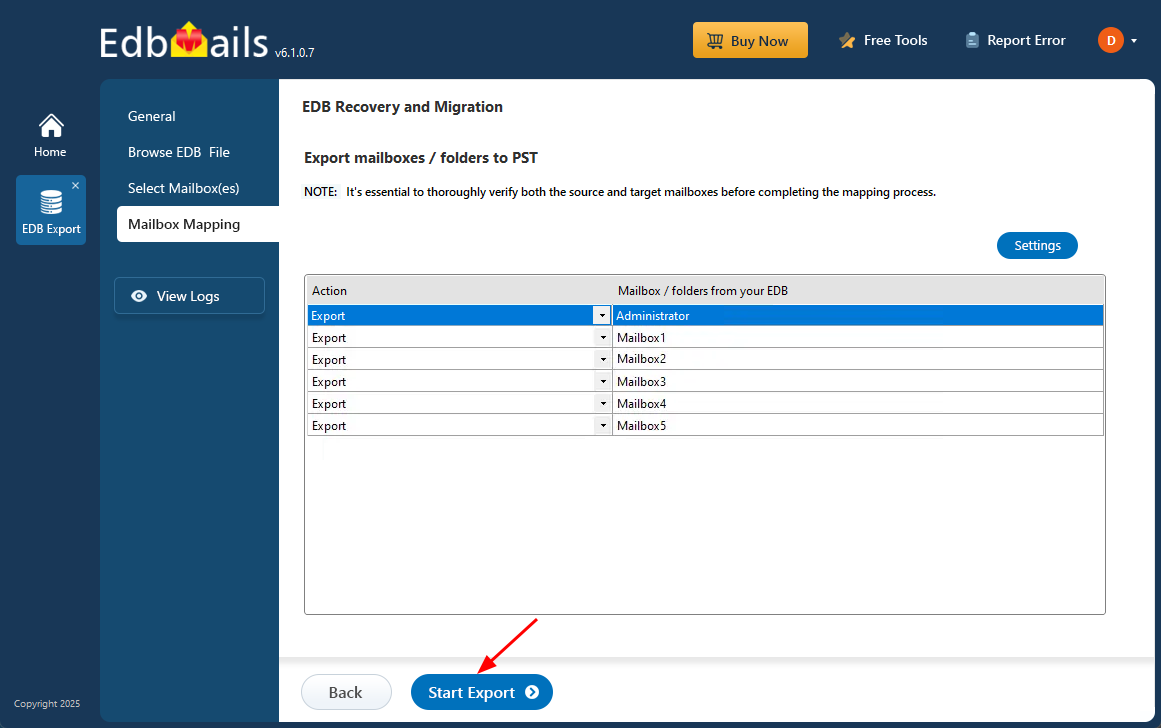
- EdbMails shows a progress window during the export, allowing you to pause or resume as needed. Once the export is finished, you can view a detailed summary of the operation in the 'View Log' section.
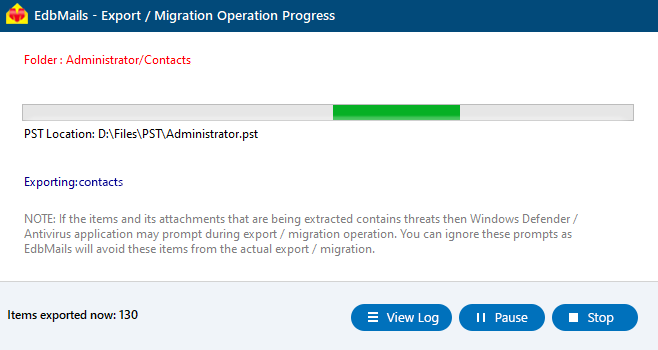
- Check the selected mailboxes and folders to confirm they’re ready for export. Make sure the 'Action' is set to 'Export', then click 'Start Export' to begin the export process.
Benefits and Features of EdbMails EDB recovery and migration software
A key benefit of using EdbMails for exporting Exchange server mailboxes is its ability to handle dismounted, corrupted, offline, or damaged EDB files. The software lets you open EDB files, browse through all available mailboxes, preview individual items, and convert the data to PST with ease—no need for Exchange Server or Active Directory access.
- EdbMails has a graphical user interface that allows you to select and export Exchange mailboxes to Outlook PST.
- You can filter mail items based on multiple conditions using the logical filters.
- The application is compatible with Windows 11, 10, 8.1, 8, 7 and XP and all Windows server versions.
- A highly practical feature of the application is that it also allows you to directly migrate EDB to another Exchange server, Hosted Exchange, Microsoft Office 365 or save items to HTML, EML and MHT formats.
- EdbMails can recover deleted, dismounted mailboxes and recover the EDB without log files.
- With EdbMails you can not only export user mailboxes but also export Exchange Public folders to Outlook PST and Archive mailboxes to PST.
- Preserves the exact folder structure and hierarchy of the old mailboxes when it is extracted into a new PST file.
Summing up everything
Exporting Exchange Server mailboxes within a specific date range is a frequent requirement in many practical situations. However, IT administrators often find the process challenging due to limited or unclear instructions. Although Exchange Management Shell (EMS) allows mailbox exports using PowerShell cmdlets, the procedure can be complicated and time-intensive, particularly for users without scripting expertise.
EdbMails Exchange Recovery tool provides a simpler and more efficient alternative. Using its built-in date-based filters, administrators can quickly extract and export Exchange mailbox data to PST files for a chosen time frame. The intuitive graphical interface removes the need for manual scripting, making the export process faster, easier, and accessible to users of all skill levels.