EdbMails EDB Recovery and Migration software
  • Products
    EdbMails
    All-in-one Recovery and Migration
    • EDB Recovery and Migration
    • OST, PST, MBOX, NSF, EML, MSG
    • Office 365, Exchange Migration
    • SharePoint, OneDrive & Teams
    • Google Workspace Migration
    • IMAP Migration
    • Duplicate Remover
    • EdbMails Data Recovery
    • Backup Solutions
    • All ProductsAll Products

    EDB Recovery and Migration

    EdbMails lets you recover corrupted, damaged, and offline Exchange EDB files, convert EDB mailboxes to PST format, and directly migrate mailbox data to Office 365 and live Exchange Server.

    EDB to PST
    EDB to PST
    Recover corrupted, damaged, offline EDB files and convert Exchange EDB mailboxes to PST file format
    Public Folder to Exchange
    Public Folder to Exchange
    Migrate public folders from an Exchange offline EDB file to live Exchange Server
    EDB to Live Exchange Migration
    EDB to Live Exchange Migration
    Directly migrate offline Exchange database (EDB) files to live Exchange server
    Archive Mailbox to Office 365
    Archive Mailbox to Office 365
    Migrate archive mailboxes from offline EDB files directly to Office 365
    EDB to Office 365 Migration
    EDB to Office 365 Migration
    Directly migrate offline Exchange database (EDB) files to Office 365
    Public Folder to Office 365
    Public Folder to Office 365
    Migrate public folders from an offline Exchange EDB file to Office 365

    OST, PST, MBOX, NSF, EML, MSG Export and Migration

    EdbMails lets you to recover OST and PST files, export OST, PST, MBOX, NSF, EML, and MSG files to PST files, and directly migrate OST, PST, MBOX, and NSF mailbox data to Office 365 and live Exchange Server.

    OST Recovery and Migration
    OST Recovery and Migration
    Recover offline OST files, convert OST to PST, and migrate OST to Office 365 and Exchange Server
    PST Recovery and Migration
    PST Recovery and Migration
    Recover Outlook PST files , Export PST to PST, migrate PST to Office 365 and Exchange Server
    MBOX Export and Migration
    MBOX Export and Migration
    Export MBOX to PST, migrate MBOX to Office 365 and Exchange Server
    NSF Export and Migration
    NSF Export and Migration
    Export NSF to PST, migrate NSF to Office 365 and Exchange Server
    EML to PST Export
    EML to PST Export
    Convert EML files to Outlook PST files
    PST to MSG Export
    PST to MSG Export
    Convert Outlook PST file to MSG file format
    MSG to PST Export
    MSG to PST Export
    Export MSG files to Outlook PST files

    Office 365, Exchange Migration

    EdbMails lets you securely migrate mailboxes across Microsoft 365, Exchange, Google Workspace (Google Workspace Migration), and IMAP-supported servers such as Outlook, Gmail, Zimbra, Zoho Mail, and cPanel, ensuring zero downtime.

    Office 365 Backup
    Office 365 Migration
    Migrate between Office 365 tenants, Office 365 to Exchange, Office 365 to PST, PST files to Office 365.
    Exchange Server Backup
    Exchange Migration
    Migrate between any Exchange Servers, Exchange to Office 365, Exchange to PST, PST files to Exchange.
    Tenant to Tenant Migration
    Tenant to Tenant Migration
    Migrate Mailboxes, Public Folders, Archive Mailboxes between Office 365 Tenants.
    Exchange to Office 365
    Exchange to Office 365
    Migrate Mailboxes, Public Folders, Archive Mailboxes from live Exchange server to Office 365.
    Office 365 to IMAP
    Office 365 to IMAP
    Migrate Office 365 to IMAP, Office 365 to Gmail, Office 365 to Outlook, Office 365 to Zoho etc.
    Exchange to IMAP
    Exchange to IMAP
    Migrate from live Exchange Server to IMAP servers such as Gmail, Outlook, and Zoho Mail.
    Public Folder to Office 365
    Public Folder to Office 365
    Migrate Public Folders between Office 365 tenants with complete folder hierarchy and mailbox data integrity.
    Exchange to PST
    Exchange to PST
    Export live Exchange Server mailboxes, public folders, and archive mailboxes to Outlook PST files.

    SharePoint, OneDrive & Microsoft Teams Migration

    EdbMails lets you migrate SharePoint sites, OneDrive data, Microsoft Teams, teams, channels, chats, permissions, and documents between Microsoft 365 tenants while maintaining the existing folder structure and data integrity.

    SharePoint, OneDrive & Teams Backup
    SharePoint Online Migration
    Migrate documents, lists, files and folders from SharePoint sites.
    OneDrive for Business Migration
    OneDrive for Business Migration
    Migrate documents, lists, files, folders, private chats from OneDrive.
    Microsoft Teams Migration
    Microsoft Teams Migration
    Migrate Teams, chats, channels, documents, files and folders etc.

    Google Workspace / G Suite Migration

    EdbMails offers secure Google Workspace migration to Office 365, Exchange, or IMAP, and export to PST covering emails, contacts, calendars and tasks.

    Google Workspace Migration
    Google Workspace Migration
    Migrate emails, calendars, contacts, tasks from Google workspace to Google workspace, office 365, Exchange and IMAP. Export to PST
    Google Workspace to Office 365
    Google Workspace to Office 365
    Migrate emails, calendars, contacts, tasks from Google Workspace / G Suite to Office 365
    Google Workspace to Exchange Server
    Google Workspace to Exchange Server
    Migrate emails, calendars, contacts, tasks from Google Workspace / G Suite to on-Premise Exchange Server
    Google Workspace to IMAP
    Google Workspace to IMAP
    Migrate emails, calendars, contacts, tasks from Google Workspace / G Suite to IMAP, Outlook, Zimbra, Zoho etc.
    Google Workspace to Google Workspace Migration
    Google Workspace to Google Workspace
    Migrate emails, calendars, contacts, tasks between two Google Workspace / G Suite tenants
    Google Workspace to PST
    Google Workspace to PST
    Export emails, calendars, contacts, tasks from Google Workspace / G Suite to Outlook PST files

    IMAP Migration

    EdbMails IMAP Migration tool lets you easily migrate emails from IMAP servers such as Outlook, Gmail, Zoho Mail, Zimbra, cPanel, and more. Supports IMAP to IMAP, Office 365, Exchange Server, PST, and bulk PST to IMAP migration.

    IMAP Email Backup & Migration
    IMAP Email Backup & Migration
    Backup and migrate emails from IMAP servers to PST, Office 365, and On-Premises Exchange Server
    IMAP to Office 365
    IMAP to Office 365
    Migrate emails, folders, and attachments from IMAP servers to Office 365
    IMAP to Exchange
    IMAP to Exchange
    Migrate emails, folders, and attachments from IMAP servers to on-premises Exchange Server
    IMAP to PST
    IMAP to PST
    Export emails, folders, and attachments from IMAP servers to Outlook PST files for backup
    PST to IMAP
    PST to IMAP
    Migrate emails, folders, and attachments from bulk PST files to IMAP servers

    Duplicate Remover

    EdbMails Duplicate Remover lets you easily remove duplicate items from Office 365 and Exchange Server, and from IMAP, Outlook, Gmail, Zimbra, Zoho Mail, etc., ensuring a clean and organized mailbox.

    Remove Duplicates
    Remove Duplicates
    Easily clean up your Office 365, Exchange, Outlook and IMAP accounts by removing duplicate emails.
    Remove Duplicates from Office 365
    Remove Duplicates from Office 365
    Remove duplicate emails, calendars, contacts, journal tasks, etc. from Office 365.
    Remove Duplicates from Exchange Server
    Remove Duplicates from Exchange Server
    Remove duplicate emails, calendars, contacts, journal tasks, etc. from live Exchange Server.
    Remove Duplicates from IMAP, Outlook
    Remove Duplicates from IMAP, Outlook
    Remove duplicate emails, attachments from IMAP, Outlook, Gmail, Zimbra, Zoho Mail etc.

    Exchange, SharePoint, OneDrive, Teams and Office 365 Backup

    EdbMails enables secure, automated backup and recovery for Microsoft 365 services including Exchange Online, SharePoint, OneDrive, Teams, and Live Exchange Server with complete data protection and restore flexibility.

    Office 365 Backup
    Office 365 Backup
    Incremental, Granular, Encrypted and Compressed Office 365 Mailboxes Backup
    Exchange Server Backup
    Exchange Server Backup
    Incremental, Granular, Encrypted and Compressed Exchange Mailboxes Backup
    SharePoint, OneDrive & Teams Backup
    SharePoint, OneDrive & Teams Backup
    Backup Online site collections, Team sites, Office 365 groups, all documents etc.

    EdbMails Data Recovery

    EdbMails Data Recovery Software lets you recover permanently deleted data, including photos, videos, documents, and archived files, from partitions on hard drives, SSDs, USB drives, SD cards, and external storage devices.

    EdbMails Data Recovery
    EdbMails Data Recovery
    Recover and restore permanently deleted data from hard drives, SSDs, USB drives, SD cards, and etc.
    Whitepaper Whitepaper
    Request a Demo Request a Demo
    Sign Up Sign Up
  • Features
  • FAQ
  • Offers
  • Pricing
  • Download
  • Support
  • Sign in
User’s Manual
EDB Recovery and Migration

User Manual

User Manual

  • Overview
  • System Requirements
  • Installation
    • Installation process
    • Reinstall or Upgrade
    • How to uninstall
  • Initial Setup
  • FAQ
    • EDB to PST
    • EDB to Office 365 Migration
    • EDB to Exchange Migration
    • EDB Public Folder to Office 365
    • EDB Archive Mailbox to Office 365
    • EDB Public Folder to Exchange
    • EDB Archive Mailbox to Exchange
  • Videos
    • EDB to PST Converter
    • EDB to Office 365 Migration
    • EDB to Exchange Migration
    • EDB Public Folder to Office 365
    • EDB Archive Mailbox to Office 365
    • EDB Public Folder to Exchange
    • EDB Archive Mailbox to Exchange
  • Screenshots
    • EDB to PST
    • EDB to Office 365 Migration
    • EDB to Exchange Migration
    • EDB Public Folder to Office 365
    • EDB Archive Mailbox to Office 365
    • EDB Public Folder to Exchange
    • EDB Archive Mailbox to Exchange
  • How it works?
    • EDB to PST Converter
    • EDB to Office 365 Migration
    • EDB to Exchange Migration
    • EDB Public Folder to Office 365
    • EDB Public Folder to Exchange
    • EDB Archive Mailbox to Office 365
    • EDB Archive Mailbox to Exchange
  • Connect to Exchange server for multiple mailboxes migration
    • Connect with Global Admin
    • Connect to multiple users using CSV file
    • Connect using full access permission
    • Connect individual users for Single / Specific user Migration
  • Connect to Hosted Exchange for its Migration
    • Connect with Full Access permissions
    • Using multiple user credentials with CSV file
    • Connecting to Individual user for its migration
  • Connect to Office 365
    • Modern Authentication Using OAuth 2.0
      • Microsoft 365 modern authentication
      • Automatic Registration
      • Manual Registration
    • Connect with Global Admin
    • Connect to Office 365 with full access permission
    • Connect to Office 365 with CSV file option
    • Connect to Office 365 as single user mailbox
  • Set Exchange Server Impersonation rights
    • Exchange 2007 and below
    • Exchange 2010, 2013, 2016 and 2019
    • Set using Exchange Server GUI
  • Knowledge Base
    • How to recover Microsoft Exchange server from Jet Errors
    • Repair a corrupted Exchange database (EDB) file
    • Open and view an EDB file without Exchange server
    • Recover data from an Exchange server crash
    • Open and view an Exchange EDB file
    • Export a disconnected Exchange mailbox
    • Resolve Exchange database consistency check failure
    • Import an Exchange database file (.EDB) into a new Exchange
    • Recover deleted Exchange server mailboxes
    • Resolve Dirty Shutdown error of Exchange database
    • Restore an Exchange server database
    • Export Exchange mailboxes to Outlook PST
    • Export Exchange Public folders to Outlook PST
    • Extract mailbox and export EDB to Outlook PST
    • Export Exchange emails to PST by specific date
    • Export Exchange Archive mailbox to PST
    • Resolve Exchange database fails to mount error
    • Fix Content Index State Failed and suspended error
    • Recover emails from a dismounted Exchange database
    • Exchange database is mandatory on UserMailbox
    • Exchange database status unknown error
    • Restore Exchange 2016 mailbox from Recovery database
    • Move Exchange mailbox to another database
    • Check Exchange database health
    • Backup Exchange server database
    • Reduce Exchange database file size
    • Unable to Mount Database (hr=0x80004005, ec=1108)
    • Exchange Server Disaster Recovery Plan
    • Exchange database in clean shutdown fails to mount
    • Offline EDB Recovery
    • Reduce the size of bulky Exchange server
    • Dial Tone Recovery
    • Recover deleted mailboxes
    • Filter Settings
  • Incremental Migration
  • Exchange Throttling Policy
  • Multifactor Authentication
    • Enable MFA in Office 365
    • Map the Mailboxes
    • Create App password for MFA
    • Disable Security Defaults
  1. Home
  2. All Products
  3. EDB
  4. EDB to Office 365 Migration FAQs
Download Buy Now

Exchange EDB to Office 365 migration FAQs

  1. How can I test EdbMails EDB to Office 365 Migration before purchasing a license?

    Download EdbMails and install it, then launch the application and select Start Your Free Trial on the sign-in screen. Open an offline Exchange EDB file, choose the mailboxes you want to test, connect to Microsoft 365, and verify the result. The trial can migrate up to 30 items from each folder, so you can check mailbox mapping and the destination data before purchasing. See the EDB to Office 365 migration guide.
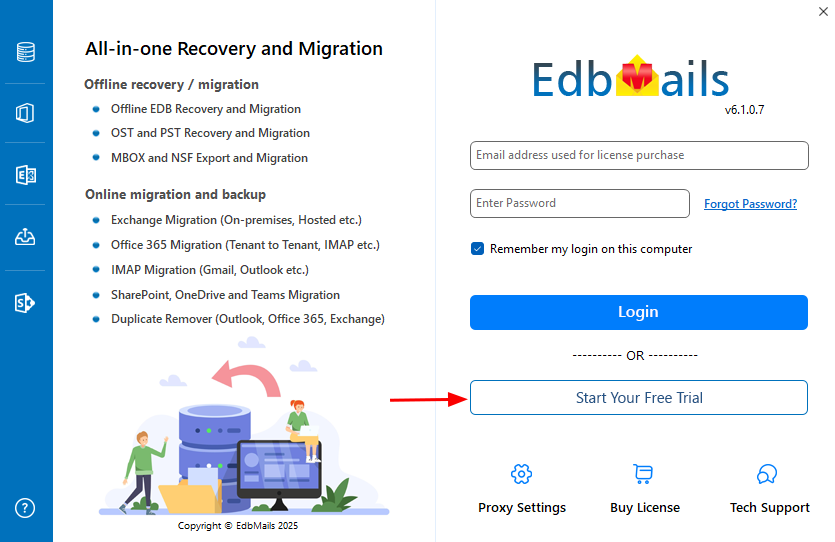
    EdbMails login screen with Start Your Free Trial button for testing EDB to Office 365 migration

  2. How do I activate my EdbMails EDB to Office 365 Migration license after purchasing?

    EdbMails does not send a separate activation key. After purchasing the appropriate EDB migration edition, sign in to the application with the same registered email address and password used for the purchase. Your account provides access to the licensed features. If the application was already open, close and reopen it, then sign in again. Review the EdbMails pricing options if you need to confirm your license edition.

  3. Can EdbMails migrate emails and other mailbox data directly from an offline EDB file to Office 365?

    Yes. EdbMails reads an offline Exchange EDB file and migrates recovered mailbox data directly to Microsoft 365 without creating an intermediate PST file. You can select emails, attachments, contacts, calendars, tasks, and other mailbox items available in the source database. Preview the recovered content before migration, and verify representative folders and items in the destination after completion. Learn more about EDB to Office 365 migration features.

  4. How do I perform EDB to Office 365 migration using EdbMails?

    Open EdbMails and select EDB Recovery (Offline) and Migration, followed by EDB to Office 365. Browse to the offline EDB file, preview its mailboxes, and select the data to migrate. Connect to Microsoft 365 using modern authentication, map each source mailbox to its intended destination, and click Start Migration. Review the report and destination mailbox after the transfer. Follow the EDB to Microsoft 365 step-by-step guide for the application screens.

  5. How can I troubleshoot Microsoft 365 connectivity during EDB to Office 365 migration?

    Confirm that the computer running EdbMails can reach Microsoft's sign-in and Microsoft 365 services over HTTPS. If the connection fails, check the selected tenant, administrator permissions, MFA or Conditional Access requirements, and Microsoft Entra application registration and consent. Retry the destination connection after correcting the identified issue. See the modern authentication troubleshooting guide for further checks.

  6. How do I handle source EDB mailbox folders that use a different language in Microsoft 365?

    If a source EDB mailbox uses localized system folder names, such as Boîte de réception for Inbox, check the destination mailbox language settings and review the source-to-target folder mapping before migration. A language mismatch can affect where standard folders appear. If necessary, update the destination regional settings and verify the mapping again. Follow the Microsoft 365 mailbox language settings guide.

  7. How do I configure modern authentication for the EdbMails EDB to Office 365 destination?

    On the EdbMails destination connection screen, choose Auto Registration or Manual Registration. Auto Registration uses the appropriate administrator permissions to register the application and obtain consent. For Manual Registration, configure the EdbMails application and required permissions in Microsoft Entra ID before connecting. Complete the Microsoft sign-in and confirm that the destination mailboxes load. See the Connect to target Office 365 guide.

  8. How do I map source EDB mailboxes to different Microsoft 365 destination mailboxes?

    EdbMails provides automatic mailbox matching and lets you change mappings manually. On the Mailbox Mapping screen, review each source EDB mailbox and select the intended Microsoft 365 destination, even when the source and target email addresses differ. You can also reuse mappings from a previous migration where available. Confirm every pairing before starting. See the EDB to Office 365 migration steps for the complete workflow.

    EdbMails EDB to Office 365 mailbox mapping screen showing separate source and target mailbox assignments

  9. Why do I receive an HTTP 407 Proxy Authentication Required error when connecting to Office 365?

    An HTTP 407 response means a proxy server between EdbMails and Microsoft 365 is asking for authentication. Ask your network administrator to check the proxy address, authentication method, required credentials, and whether Microsoft 365 endpoints are allowed through the firewall. A 407 response does not, by itself, indicate a DNS problem. Review the EdbMails system and network requirements.

  10. Do destination mailboxes need to exist before I migrate an offline EDB file to Office 365?

    Not necessarily. You can create the target mailboxes manually or use the EdbMails option to create and map new mailboxes in Microsoft 365. If a destination mailbox already exists, EdbMails can map it automatically or let you select it manually. Newly created mailboxes must be properly provisioned and licensed before their data can be migrated; allow time for mailbox provisioning when required. See the Microsoft 365 mailbox creation and mapping guide.

  11. Do I need to assign Exchange Online ApplicationImpersonation rights for EDB to Office 365 migration?

    No. EdbMails uses Microsoft 365 modern authentication and the application permissions required for its current destination connection workflow. Administrators do not need to configure the retired Exchange Online ApplicationImpersonation role for this connection. Select Auto Registration or Manual Registration and grant the documented permissions. See modern authentication in Office 365.

  12. Can I migrate multiple EDB mailboxes to separate Office 365 user mailboxes in one operation?

    Yes. Select multiple mailboxes from the offline EDB file and map each source mailbox to a separate Microsoft 365 destination on the Mailbox Mapping screen. Review the source-to-target assignments before clicking Start Migration. EdbMails processes the selected mailboxes within the migration job without combining them into a single target mailbox. See the EDB to Office 365 migration guide.

  13. Can I run an incremental EDB to Office 365 migration after the initial migration?

    Yes. EdbMails uses locally retained migration metadata to identify items already processed during repeat migration runs. Use the same computer and keep the source EDB selection and destination mailbox mapping consistent. If the source EDB has additional eligible content, a subsequent pass can process it without repeating the entire transfer. An unchanged offline EDB copy will not receive new live-server emails. Review the EdbMails incremental migration guidance.

  14. How can I verify EDB to Office 365 migration results in EdbMails?

    After migration, open the EdbMails report and review the item counts and operation status for each selected mailbox. Sign in to Microsoft 365 to check representative email folders, messages, attachments, contacts, and calendar entries. Also confirm that every source mailbox was mapped to the intended destination. If the review identifies a problem, check the relevant settings before running another pass. See the EDB to Office 365 migration guide.

  15. Can EdbMails migrate an offline EDB file to Office 365 without Exchange Server or Outlook?

    Yes. EdbMails opens offline EDB files and migrates recovered mailbox data directly to Microsoft 365 without a working original Exchange Server, Active Directory connection, or Microsoft Outlook installation. Install EdbMails on a Windows computer, browse to the EDB, connect to the target tenant, and map the mailboxes. Outlook is required for EDB to PST export, not for direct EDB to Office 365 migration. See the EDB recovery system requirements.

  16. Can EdbMails migrate mailboxes from a corrupted or Dirty Shutdown EDB file to Office 365?

    Yes. EdbMails scans offline EDB files affected by corruption, damage, dismounting, or Dirty Shutdown and can migrate the recovered mailbox data directly to Microsoft 365. Preview the available items, select the required mailboxes, and map them to the target tenant. The amount of data recovered depends on the condition of the source EDB. This extracts mailbox content; it does not repair the original database into a mountable state. See the Exchange Dirty Shutdown recovery guide.

  17. Which Exchange Server EDB versions can EdbMails migrate to Microsoft 365?

    EdbMails supports offline EDB databases from Exchange Server 2003, 2007, 2010, 2013, 2016, and 2019 for direct migration to Microsoft 365. The original server does not need to be running. Open the EDB, preview the available mailboxes, and map the selected data to Microsoft 365. For older Exchange databases, review the source files and migration prerequisites before starting. See the EDB to Office 365 Migration Tool.

  18. Can I migrate selected EDB folders or filter emails before migrating to Office 365?

    Yes. EdbMails lets you select individual mailboxes and folders from the offline EDB rather than migrating everything. You can also apply Include and Exclude filters using criteria such as date range, sender, recipient, subject, and attachment details. For example, select a department's mailboxes and migrate messages within a required date range. Review the filter settings before starting. See the EDB filter settings guide.

  19. Can EdbMails migrate EDB archive mailboxes, shared mailboxes, and public folders to Office 365?

    Yes. EdbMails offers workflows to migrate recovered archive mailbox data, shared mailbox content, and Exchange public folders from an offline EDB to Microsoft 365. Prepare the appropriate target mailbox, online archive, or public folder destination and verify the required permissions and mapping before migration. See the EDB archive mailbox migration guide and EDB public folder migration guide.

  20. Which EdbMails license is required for EDB to Office 365 migration?

    For direct EDB to Microsoft 365 migration, choose the EdbMails EDB Recovery and Migration Corporate Premium or Technical Edition. The Personal Edition covers EDB to PST export, but not direct EDB to Office 365 migration. Choose the edition based on the intended usage and migration scope. Destination Microsoft 365 licenses are separate. See the EdbMails pricing and license editions.

  21. What happens if an EDB email exceeds the Microsoft 365 message-size limit during migration?

    An email larger than the effective Microsoft 365 destination message-size limit may not transfer. Exchange Online commonly has a default receive limit of 36 MB, and administrators can configure higher limits within Microsoft's supported settings, up to 150 MB where applicable. The effective migration limit may also depend on the chosen transfer method. Check mailbox settings and review the EdbMails migration report when large attachments are involved. See the Office 365 message-size limits guide.

  22. Does EdbMails preserve email attachments, folder hierarchy, and message properties during EDB to Office 365 migration?

    EdbMails migrates recovered mailbox items while retaining their folder hierarchy, email attachments, and available message properties such as sender, recipients, subject, and timestamps. It also supports contacts, calendars, tasks, and other Exchange mailbox data. The result depends on the information present in the offline EDB and destination capabilities. After migration, compare representative items in Microsoft 365 with the source EDB preview. See the EDB to Office 365 migration features.

Need help?

24/7 Customer support

Contact us on Live chat

Personalized Demo

Book a personalized demo

Still need help?

Email us / Call us

@edbmails.com All rights are reserved Privacy Policy | Terms of Use | GDPR | Security | Press Releases

hidden msg
Live Chat

Hi, May I help you?

Hide Chat Now