EdbMails EDB Recovery and Migration software
  • Products
    EdbMails
    All-in-one Recovery and Migration
    • EDB Recovery and Migration
    • OST, PST, MBOX, NSF, EML, MSG
    • Office 365, Exchange Migration
    • SharePoint, OneDrive & Teams
    • Google Workspace Migration
    • IMAP Migration
    • Duplicate Remover
    • EdbMails Data Recovery
    • Backup Solutions
    • All ProductsAll Products

    EDB Recovery and Migration

    EdbMails lets you recover corrupted, damaged, and offline Exchange EDB files, convert EDB mailboxes to PST format, and directly migrate mailbox data to Office 365 and live Exchange Server.

    EDB to PST
    EDB to PST
    Recover corrupted, damaged, offline EDB files and convert Exchange EDB mailboxes to PST file format
    Public Folder to Exchange
    Public Folder to Exchange
    Migrate public folders from an Exchange offline EDB file to live Exchange Server
    EDB to Live Exchange Migration
    EDB to Live Exchange Migration
    Directly migrate offline Exchange database (EDB) files to live Exchange server
    Archive Mailbox to Office 365
    Archive Mailbox to Office 365
    Migrate archive mailboxes from offline EDB files directly to Office 365
    EDB to Office 365 Migration
    EDB to Office 365 Migration
    Directly migrate offline Exchange database (EDB) files to Office 365
    Public Folder to Office 365
    Public Folder to Office 365
    Migrate public folders from an offline Exchange EDB file to Office 365

    OST, PST, MBOX, NSF, EML, MSG Export and Migration

    EdbMails lets you to recover OST and PST files, export OST, PST, MBOX, NSF, EML, and MSG files to PST files, and directly migrate OST, PST, MBOX, and NSF mailbox data to Office 365 and live Exchange Server.

    OST Recovery and Migration
    OST Recovery and Migration
    Recover offline OST files, convert OST to PST, and migrate OST to Office 365 and Exchange Server
    PST Recovery and Migration
    PST Recovery and Migration
    Recover Outlook PST files , Export PST to PST, migrate PST to Office 365 and Exchange Server
    MBOX Export and Migration
    MBOX Export and Migration
    Export MBOX to PST, migrate MBOX to Office 365 and Exchange Server
    NSF Export and Migration
    NSF Export and Migration
    Export NSF to PST, migrate NSF to Office 365 and Exchange Server
    EML to PST Export
    EML to PST Export
    Convert EML files to Outlook PST files
    PST to MSG Export
    PST to MSG Export
    Convert Outlook PST file to MSG file format
    MSG to PST Export
    MSG to PST Export
    Export MSG files to Outlook PST files

    Office 365, Exchange Migration

    EdbMails lets you securely migrate mailboxes across Microsoft 365, Exchange, Google Workspace (Google Workspace Migraton), and IMAP-supported servers such as Outlook, Gmail, Zimbra, Zoho Mail, and cPanel, ensuring zero downtime.

    Office 365 Backup
    Office 365 Migration
    Migrate between Office 365 tenants, Office 365 to Exchange, Office 365 to PST, PST files to Office 365.
    Exchange Server Backup
    Exchange Migration
    Migrate between any Exchange Servers, Exchange to Office 365, Exchange to PST, PST files to Exchange.
    Tenant to Tenant Migration
    Tenant to Tenant Migration
    Migrate Mailboxes, Public Folders, Archive Mailboxes between Office 365 Tenants.
    Exchange to Office 365
    Exchange to Office 365
    Migrate Mailboxes, Public Folders, Archive Mailboxes from live Exchange server to Office 365.
    Office 365 to IMAP
    Office 365 to IMAP
    Migrate Office 365 to IMAP, Office 365 to Gmail, Office 365 to Outlook, Office 365 to Zoho etc.
    Exchange to IMAP
    Exchange to IMAP
    Migrate from live Exchange Server to IMAP servers such as Gmail, Outlook, and Zoho Mail.
    Public Folder to Office 365
    Public Folder to Office 365
    Migrate Public Folders between Office 365 tenants with complete folder hierarchy and mailbox data integrity.
    Exchange to PST
    Exchange to PST
    Export live Exchange Server mailboxes, public folders, and archive mailboxes to Outlook PST files.

    SharePoint, OneDrive & Microsoft Teams Migration

    EdbMails lets you migrate SharePoint sites, OneDrive data, Microsoft Teams, teams, channels, chats, permissions, and documents between Microsoft 365 tenants while maintaining the existing folder structure and data integrity.

    SharePoint, OneDrive & Teams Backup
    SharePoint Online Migration
    Migrate documents, lists, files and folders from SharePoint sites.
    OneDrive for Business Migration
    OneDrive for Business Migration
    Migrate documents, lists, files, folders, private chats from OneDrive.
    Microsoft Teams Migration
    Microsoft Teams Migration
    Migrate Teams, chats, channels, documents, files and folders etc.

    Google Workspace / G Suite Migration

    EdbMails offers secure Google Workspace migration to Office 365, Exchange, or IMAP, and export to PST covering emails, contacts, calendars and tasks.

    Google Workspace Migration
    Google Workspace Migration
    Migrate emails, calendars, contacts, tasks from Google workspace to Google workspace, office 365, Exchange and IMAP. Export to PST
    Google Workspace to Office 365
    Google Workspace to Office 365
    Migrate emails, calendars, contacts, tasks from Google Workspace / G Suite to Office 365
    Google Workspace to Exchange Server
    Google Workspace to Exchange Server
    Migrate emails, calendars, contacts, tasks from Google Workspace / G Suite to on-Premise Exchange Server
    Google Workspace to IMAP
    Google Workspace to IMAP
    Migrate emails, calendars, contacts, tasks from Google Workspace / G Suite to IMAP, Outlook, Zimbra, Zoho etc.
    Google Workspace to Google Workspace Migration
    Google Workspace to Google Workspace
    Migrate emails, calendars, contacts, tasks between two Google Workspace / G Suite tenants
    Google Workspace to PST
    Google Workspace to PST
    Export emails, calendars, contacts, tasks from Google Workspace / G Suite to Outlook PST files

    IMAP Migration

    EdbMails IMAP Migration tool lets you easily migrate emails from IMAP servers such as Outlook, Gmail, Zoho Mail, Zimbra, cPanel, and more. Supports IMAP to IMAP, Office 365, Exchange Server, PST, and bulk PST to IMAP migration.

    IMAP Email Backup & Migration
    IMAP Email Backup & Migration
    Backup and migrate emails from IMAP servers to PST, Office 365, and On-Premises Exchange Server
    IMAP to Office 365
    IMAP to Office 365
    Migrate emails, folders, and attachments from IMAP servers to Office 365
    IMAP to Exchange
    IMAP to Exchange
    Migrate emails, folders, and attachments from IMAP servers to on-premises Exchange Server
    IMAP to PST
    IMAP to PST
    Export emails, folders, and attachments from IMAP servers to Outlook PST files for backup
    PST to IMAP
    PST to IMAP
    Migrate emails, folders, and attachments from bulk PST files to IMAP servers

    Duplicate Remover

    EdbMails Duplicate Remover lets you easily remove duplicate items from Office 365 and Exchange Server, and from IMAP, Outlook, Gmail, Zimbra, Zoho Mail, etc., ensuring a clean and organized mailbox.

    Remove Duplicates
    Remove Duplicates
    Easily clean up your Office 365, Exchange, Outlook and IMAP accounts by removing duplicate emails.
    Remove Duplicates from Office 365
    Remove Duplicates from Office 365
    Remove duplicate emails, calendars, contacts, journal tasks, etc. from Office 365.
    Remove Duplicates from Exchange Server
    Remove Duplicates from Exchange Server
    Remove duplicate emails, calendars, contacts, journal tasks, etc. from live Exchange Server.
    Remove Duplicates from IMAP, Outlook
    Remove Duplicates from IMAP, Outlook
    Remove duplicate emails, attachments from IMAP, Outlook, Gmail, Zimbra, Zoho Mail etc.

    Exchange, SharePoint, OneDrive, Teams and Office 365 Backup

    EdbMails enables secure, automated backup and recovery for Microsoft 365 services including Exchange Online, SharePoint, OneDrive, Teams, and Live Exchange Server with complete data protection and restore flexibility.

    Office 365 Backup
    Office 365 Backup
    Incremental, Granular, Encrypted and Compressed Office 365 Mailboxes Backup
    Exchange Server Backup
    Exchange Server Backup
    Incremental, Granular, Encrypted and Compressed Exchange Mailboxes Backup
    SharePoint, OneDrive & Teams Backup
    SharePoint, OneDrive & Teams Backup
    Backup Online site collections, Team sites, Office 365 groups, all documents etc.

    EdbMails Data Recovery

    EdbMails Data Recovery Software lets you recover permanently deleted data, including photos, videos, documents, and archived files, from partitions on hard drives, SSDs, USB drives, SD cards, and external storage devices.

    EdbMails Data Recovery
    EdbMails Data Recovery
    Recover and restore permanently deleted data from hard drives, SSDs, USB drives, SD cards, and etc.
    Whitepaper Whitepaper
    Request a Demo Request a Demo
    Sign Up Sign Up
  • Features
  • FAQ
  • Offers
  • Pricing
  • Download
  • Support
  • Sign in
User’s Manual
Office 365 Migration Tool

User Manual

User Manual

  • Office 365 Migration Tool Overview
  • What is Office 365 Migration?
  • System Requirements
  • Migration Scenarios
  • Software Setup
    • EdbMails Installation Process
    • Upgrading the Software
  • Understanding the Application
    • Software's Main Components
    • Understanding the Migration
  • FAQ
    • General
    • Migration Free Trial / Demo
    • Migration License
    • Before Migration
    • Migration - Steps
    • After Migration
  • Videos
    • Office 365 to Office 365
    • Office 365 to Exchange
    • Office 365 to IMAP
    • Office 365 to PST
    • Public Folder to Office 365
    • Archive Mailbox to Office 365
    • Public Folder to Exchange
    • Archive Mailbox to Exchange
    • Restore Bulk PST files to Office 365
    • Automatically Create Office 365 Mailboxes
    • Export Office 365 user to CSV file
  • Screenshots
    • Office 365 to Office 365
    • Office 365 to Exchange
    • Office 365 to PST
  • How it works?
    • Office 365 to Office 365
    • Office 365 to Exchange
    • Office 365 to IMAP
    • Office 365 to PST
    • Public Folder to Office 365
    • Public Folder to Exchange
    • Public Folder to Shared Mailbox
    • Archive Mailbox to Office 365
    • Archive Mailbox to Exchange
    • Office 365 to Hosted Exchange
    • Multiple PST to Office 365
    • Office 365 to Gmail Migration
    • Office 365 Shared mailbox to Exchange
    • Office 365 Public folders to PST
    • Office 365 archive mailbox to PST
    • Office 365 Shared mailbox to PST
    • Office 365 shared mailbox to Public folder
    • Office 365 Archive mailbox to Shared mailbox
    • Office 365 Shared mailbox to Archive mailbox
  • Connect to source Office 365
  • Connect to target Office 365
  • Modern Authentication Using OAuth 2.0
    • Microsoft 365 modern authentication
    • Automatic Registration
    • Manual Registration
  • Connect to Exchange server
  • Knowledge Base
    • Migrate between Office 365 tenants
    • Migrate Office 365 mailbox
    • Public folder migration
    • Office 365 Migration with same Domain
    • Office 365 Group Migration
    • Selective Mailbox Migration
    • Migration to Exchange 2007, 2010, 2013, 2016 and 2019
    • User-Defined Mailbox/Folder Mapping
    • Export Office 365 users to CSV
    • GoDaddy to Microsoft 365 migration
    • Rackspace to Office 365 migration
    • Office 365 migration methods
    • Office 365 migration checklist
    • Migrate Shared mailbox to Office 365
    • Office 365 migration best practices
    • Office 365 migration challenges
    • Convert shared mailbox to regular mailbox
    • Office 365 to Exchange 2019 migration
    • Office 365 multiple mailbox migration
    • Office 365 Server to Server Migration
    • Cross-Tenant Office 365 migration
    • Office 365 to iCloud migration
    • Office 365 to Yahoo Mail migration
    • Office 365 to cPanel Migration
    • Office 365 to SmarterMail Migration
    • Office 365 to IceWarp migration
    • Create an Office 365 Migration Endpoint
    • Validate Office 365 Mailbox Migration
    • Office 365 Migration Network Requirements
    • Microsoft 365 Migration URLs & Endpoints
    • Office 365 Migration Firewall Ports
    • DNS Changes After Office 365 Migration
    • Autodiscover Troubleshooting After Migration
    • Post-Migration MX Record Validation
    • Office 365 Mail Flow Troubleshooting
    • Mailbox Permission Validation
    • EdbMails vs CodeTwo vs MigrationWiz vs Native Tools
    • Calendar Permission Migration Issues
    • Folder Permission Troubleshooting
    • Large Mailbox Migration Best Practices
    • Archive Mailbox Sync Issues
    • Office 365 Migration Coexistence
    • Cross-Tenant Mailbox Permissions
    • Cross-Tenant Calendar Migration
    • Migration Using App-Only Authentication
    • Office 365 Mailbox Mapping Errors
    • Exchange Online Migration Limits
    • Mailbox Integrity After Migration
    • Security Best Practices for Migration
    • Office 365 to cPanel Migration
    • Office 365 to SmarterMail Migration
    • Office 365 to IceWarp Migration
  • Migration Types
    • Cutover Migration
    • Staged Migration
  • Set Exchange Server Impersonation rights
  • Map the Mailboxes
  • Migration Walkthrough
    • Office 365 tenant to tenant migration
    • Office 365 to PST Export
  • Multifactor Authentication
    • Enable MFA in Office 365
    • Create App password for MFA
    • Disable Security Defaults
  1. Home
  2. Office 365 Migration Tool
  3. Office 365 Language Settings: Change Mailbox Language & Region
Download Buy Now

How to Change Language and Regional Settings in Office 365

Microsoft 365 mailbox language and regional settings control how mailbox-specific information such as language, time zone, date and time formats, and localized default folder names are presented. If you are looking for “language settings on Office 365 server,” the setting is more accurately managed at the Exchange Online mailbox level rather than as a single server-wide language setting.

This is especially important when mailboxes use different languages. For example, a French mailbox can use Boîte de réception for Inbox, Éléments envoyés for Sent Items, and Éléments supprimés for Deleted Items. During migration, source and target mailbox languages should be reviewed and folder mapping should be validated so localized default folders are handled correctly.

This guide explains how to change the mailbox language and regional settings in Outlook on the web, how administrators can verify or update the same configuration with Exchange Online PowerShell, and what to check before migrating multilingual mailboxes.

What Office 365 language and regional settings control

Mailbox regional configuration can include the mailbox language, date format, time format, time zone, and the language used for default folders. These settings affect the mailbox experience but are separate from the language settings used by desktop Office applications.

  • Mailbox language: Controls the language associated with the Exchange Online mailbox.
  • Time zone: Determines the mailbox time-zone configuration used by Outlook on the web and Exchange Online.
  • Date and time formats: Control how dates and times are displayed for the mailbox.
  • Default folder localization: Can rename standard folders such as Inbox, Sent Items, Drafts, Junk Email, and Deleted Items to the selected mailbox language.

Office 365 mailbox language vs Office app language

Changing the mailbox language is not the same as changing the display or proofing language in Word, Excel, or the Outlook desktop application. Before changing a setting, identify which layer needs to be updated.

  • Mailbox regional settings: Language, time zone, date/time formats, and default-folder localization for the Exchange Online mailbox.
  • Outlook on the web language: The web Outlook interface associated with the mailbox language setting.
  • Office display language: Menus and controls in desktop Office applications.
  • Authoring and proofing language: Writing, spelling, and proofing tools used by Office applications.

How to change language and regional settings in Outlook on the web

  1. Sign in to Microsoft 365 and open Outlook on the web.
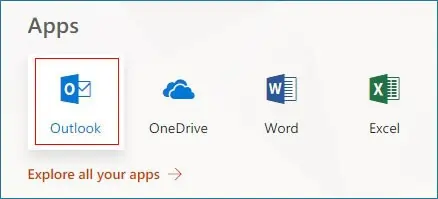
    Select Office 365 Outlook

  2. Select the Settings icon in the upper-right corner.
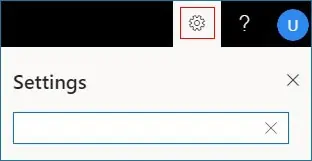
    Office 365 Outlook settings

  3. In Settings, go to General and select Language and time.
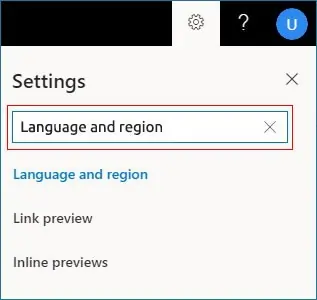
    Office 365 Outlook language

  4. Select the required language. Review the available date format, time format, and time-zone settings as needed.
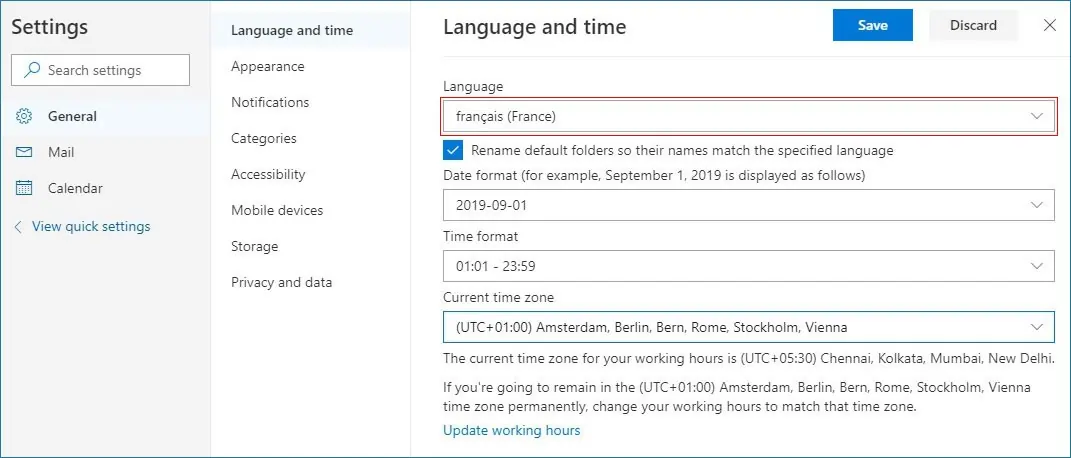
    Office 365 language select

  5. If the default mailbox folders should use the selected language, enable Rename default folders so their names match the specified language.
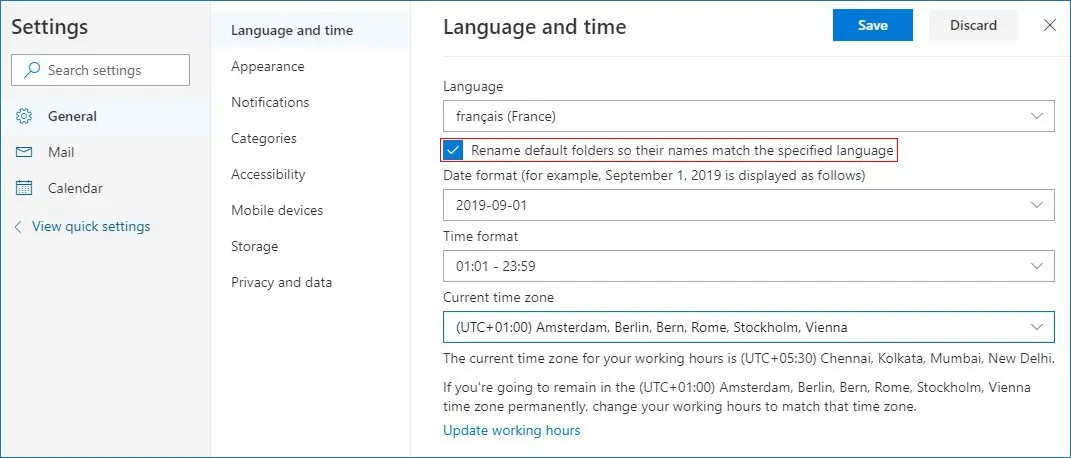
    Office 365 rename select

  6. Select Save. Refresh Outlook on the web or sign out and sign back in if the change is not immediately visible. Then verify that the language, regional formats, and default folder names match the intended configuration.

Change Office 365 mailbox language using Exchange Online PowerShell

Administrators can inspect and update mailbox regional configuration with Exchange Online PowerShell. Appropriate Exchange Online permissions are required.

1. Connect to Exchange Online

Connect-ExchangeOnline

2. Check the current mailbox regional configuration

Get-MailboxRegionalConfiguration -Identity user@domain.com

This returns mailbox regional properties such as language, date format, time format, and time zone.

3. Change the mailbox language

Set-MailboxRegionalConfiguration -Identity user@domain.com -Language en-US

Replace en-US with the required supported culture code.

4. Localize the default folder names when required

Set-MailboxRegionalConfiguration -Identity user@domain.com -Language en-US -LocalizeDefaultFolderName

Changing the language and localizing default folder names are related but distinct operations. Use folder localization only when folders such as Inbox, Sent Items, Drafts, Junk Email, and Deleted Items should be renamed to the selected mailbox language.

5. Verify the mailbox language and default folder names

Get-MailboxRegionalConfiguration -Identity user@domain.com -VerifyDefaultFolderNameLanguage | Format-List Language,DateFormat,TimeFormat,TimeZone,DefaultFolderNameMatchingUserLanguage

The DefaultFolderNameMatchingUserLanguage value helps confirm whether the default folder names are localized according to the mailbox language.

Why mailbox language matters during Office 365 migration

Localized default folder names can affect how administrators interpret source and target mailbox structures during a migration. A source mailbox and target mailbox can use different languages even when both are hosted in Microsoft 365. Matching or deliberately configuring the target mailbox regional settings, then validating folder mapping, can help prevent incorrect handling of default folders.

For example, a French source mailbox may show Boîte de réception, Éléments envoyés, and Éléments supprimés, while an English target mailbox shows Inbox, Sent Items, and Deleted Items. These are examples of localized default-folder names; changing language alone should not be treated as a guarantee that every migration workflow will map folders automatically.

When EdbMails is used for the mailbox transfer, review the source and target folder mapping before starting the migration and validate the migrated folders afterward. For the broader migration capability, see the Office 365 migration Tool.

Before migrating a mailbox with localized folders

Language and folder localization should be reviewed as part of migration preparation rather than after users report unexpected folder names. For overall project preparation, the Office 365 migration guide covers the wider migration workflow.

  • Identify the source mailbox language and regional configuration.
  • Check the source mailbox's default folder names.
  • Check the target mailbox language, time zone, and regional settings.
  • Decide whether default folders should be localized on the target.
  • Confirm how the selected migration workflow maps localized source folders to target folders.
  • Run a pilot migration when multiple mailbox languages are present.
  • Validate folder names and migrated items after the migration.
  • Use the Office 365 migration checklist to review other pre- and post-migration tasks.

Why default folder names may not change

If you change the mailbox language but the default folder names remain unchanged, check the following:

  • Folder localization was not selected: Changing the mailbox language by itself does not necessarily rename existing default folders. Enable the default-folder rename option or use the PowerShell localization parameter when appropriate.
  • A conflicting folder already exists: Localization can fail when the mailbox already contains another folder with the same name that a default folder would receive in the selected language. Rename the conflicting folder to a unique name, then repeat the localization.
  • The mailbox view has not refreshed: Refresh Outlook on the web or sign out and sign back in. Restart Outlook desktop if you are checking folder names there.
  • Administrator permissions are insufficient: Exchange Online PowerShell commands require the necessary permissions for the target mailbox.
  • Source and target settings differ: During migration, verify the regional configuration on both sides instead of assuming they use the same language.

After making changes, run Get-MailboxRegionalConfiguration again and verify the mailbox language and default-folder localization before beginning a migration or troubleshooting folder-mapping behavior.

 

 In this manual

IntroductionLanguage settings steps

Office 365 Migration

100 Mailboxes $299 Only

Buy Now

Need help?

24/7 Customer support

Contact us on Live chat

Personalized Demo

Book a personalized demo

Still need help?

Email us / Call us

@edbmails.com All rights are reserved Privacy Policy | Terms of Use | GDPR | Security | Press Releases

hidden msg
Live Chat

Hi, May I help you?

Hide Chat Now