How to Increase the Outlook PST File Size Limit
This registry method applies to classic Outlook for Windows. Microsoft documents a default Unicode PST limit of 50 GB for Outlook 2010, 2013 and 2016, and 20 GB for Outlook 2003 and 2007. Office 2019, Office LTSC 2021 and Microsoft 365 classic Outlook use the Office 16.0 registry branch.
Use this procedure when classic Outlook is approaching its Unicode PST size ceiling and you need to raise the MaxLargeFileSize and WarnLargeFileSize values. Increasing these limits does not repair a corrupted PST and does not improve Outlook performance, so review the cautions below before changing any value.
What the Outlook PST registry values control
- MaxLargeFileSize – sets the maximum size of a Unicode PST/OST file. The value is entered in megabytes (MB).
- WarnLargeFileSize – sets the maximum amount of data the Unicode file can contain before Outlook stops allowing additional data. Despite the name, Microsoft notes that this value does not display a user warning.
- Microsoft recommends keeping at least a 5% difference between the maximum and warning/data thresholds so internal Outlook processes can continue to function.
Steps to increase the Outlook PST file size limit
Step 1: Close Outlook and open Registry Editor
- Close classic Outlook. Open the Windows Run dialog, type regedit, and press Enter. Approve the Windows prompt if requested.
Step 2: Open the PST registry path for your Outlook version
- For a per-user setting, open the applicable path:
- Outlook 2016 / 2019 / LTSC 2021 / Microsoft 365 classic Outlook:
HKEY_CURRENT_USER\Software\Microsoft\Office\16.0\Outlook\PST - Outlook 2013:
HKEY_CURRENT_USER\Software\Microsoft\Office\15.0\Outlook\PST - Outlook 2010:
HKEY_CURRENT_USER\Software\Microsoft\Office\14.0\Outlook\PST - Outlook 2007:
HKEY_CURRENT_USER\Software\Microsoft\Office\12.0\Outlook\PST - Outlook 2003:
HKEY_CURRENT_USER\Software\Microsoft\Office\11.0\Outlook\PST
- Outlook 2016 / 2019 / LTSC 2021 / Microsoft 365 classic Outlook:
- For an administrator-managed policy, use the corresponding path under HKEY_CURRENT_USER\Software\Policies\Microsoft\Office\<version>\Outlook\PST.
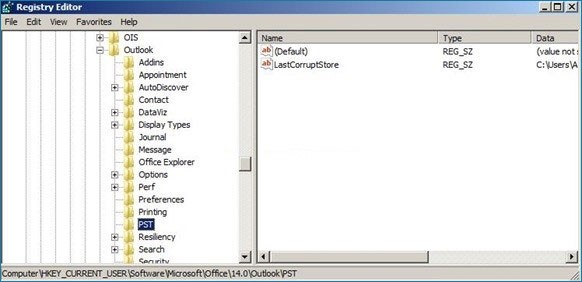
- Note: If the PST key does not exist, right-click the Outlook key, choose New > Key, and name the key PST.
- For a per-user setting, open the applicable path:
Step 3: Create or edit MaxLargeFileSize and WarnLargeFileSize
- Inside the PST key, look for the MaxLargeFileSize and WarnLargeFileSize values.
- If either value is missing, right-click the right pane and choose New > DWORD (32-bit) Value.
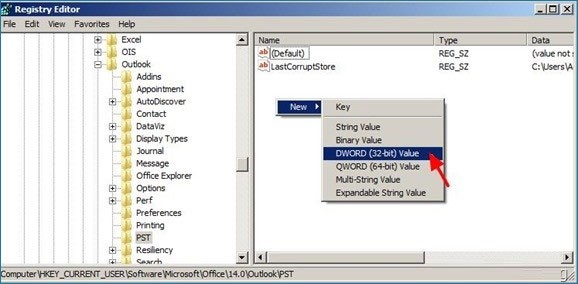
- Name the first value MaxLargeFileSize.
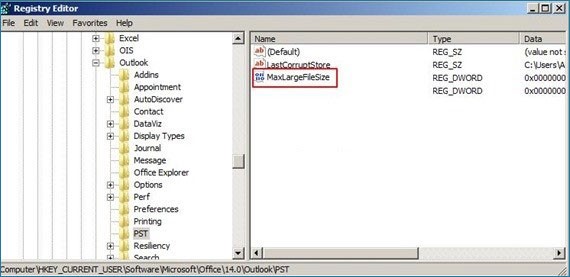
- Create the second DWORD and name it WarnLargeFileSize.
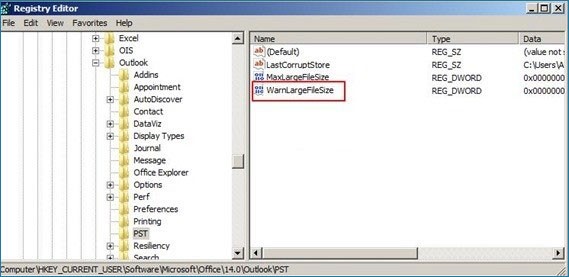
Step 4: Enter the Unicode PST size values in MB
- Double-click MaxLargeFileSize, select Decimal, and enter the required value in megabytes.
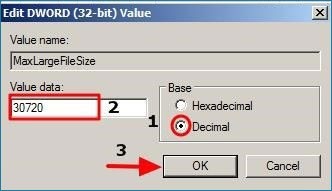
- Microsoft documents these default Unicode PST limits:
- Outlook 2010, 2013 and 2016: MaxLargeFileSize = 51,200 MB (50 GB); WarnLargeFileSize = 48,640 MB (47.5 GB).
- Outlook 2003 and 2007: MaxLargeFileSize = 20,480 MB (20 GB); WarnLargeFileSize = 19,456 MB (19 GB).
- Although custom Unicode limits can be configured beyond the documented defaults, Microsoft does not recommend increasing them without considering the performance impact. For very large archives, reducing PST size, archiving older content, or splitting/consolidating data into a more manageable structure is generally safer than continually increasing one PST.
- Double-click MaxLargeFileSize, select Decimal, and enter the required value in megabytes.
Step 5: Keep WarnLargeFileSize below MaxLargeFileSize
- Double-click WarnLargeFileSize, choose Decimal, and set it below the maximum. Microsoft recommends at least a 5% difference between the maximum and warning/data threshold.
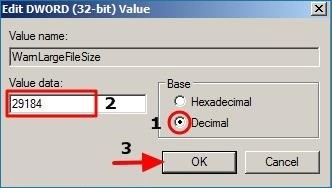
- Important: The name WarnLargeFileSize is misleading. Microsoft states that it does not produce a pop-up warning; it is the threshold at which Outlook prevents more data from being added to the file.
- Double-click WarnLargeFileSize, choose Decimal, and set it below the maximum. Microsoft recommends at least a 5% difference between the maximum and warning/data threshold.
Step 6: Close Registry Editor and restart Outlook
- Close Registry Editor and reopen classic Outlook. Monitor the PST carefully after changing its limit, especially if the file is already near or beyond the default threshold.
When increasing the PST limit is not the right fix
- If Outlook cannot open the PST or the file is corrupted, changing the registry limit does not repair the data. Use the EdbMails PST Repair Tool workflow instead. For broader recovery scenarios, see the EdbMails PST Recovery Tool.
- If you have several separate archives that should be consolidated, use the PST Merge Tool.
- If the PST is simply growing because of long-term archiving, consider reducing the data kept in one file instead of relying on an ever-larger PST.
Increase Outlook PST file size limit frequently asked questions
Does increasing the PST file size limit repair a corrupted PST?
No. The registry change only raises the Unicode size ceiling. It does not repair corruption. For a damaged file, use the EdbMails PST Repair Tool instead.
Which registry branch do Outlook 2016, 2019, LTSC 2021 and Microsoft 365 classic Outlook use?
They use the Office 16.0 branch: HKEY_CURRENT_USER\Software\Microsoft\Office\16.0\Outlook\PST.
What are the default Unicode PST size limits?
Microsoft documents 51,200 MB (50 GB) for Outlook 2010, 2013 and 2016, and 20,480 MB (20 GB) for Outlook 2003 and 2007, with WarnLargeFileSize set below each maximum.
Does WarnLargeFileSize display a warning message?
No. Despite the name, Microsoft states it does not produce a pop-up. It is the threshold at which Outlook stops allowing more data to be added to the file.
Should I keep increasing one PST indefinitely?
No. Microsoft cautions that raising Unicode limits beyond the documented values can reduce Outlook performance. Reducing, archiving, or splitting data is generally safer than continually increasing a single PST.