PST Repair Tool - Outlook PST Repair and Recovery Guide
Outlook PST files can become inaccessible or damaged after interrupted writes, abrupt system or Outlook shutdowns, storage problems, file-system errors, or other data-file issues. Symptoms can include Outlook failing to open the PST, missing or inaccessible folders, repeated data-file errors, or mailbox items that cannot be read normally.
The EdbMails PST Recovery Tool covers the broader recovery workflow. For corrupted, damaged, or inaccessible files, EdbMails PST Repair Tool scans the source PST and displays mailbox data that remains recoverable. You can preview emails, attachments, contacts, calendars, tasks, notes, journals, and folders before exporting selected data to a new, healthy PST file.
This guide focuses on using EdbMails PST Repair Tool for corruption repair, recovery, and export rather than the broader commercial evaluation of the software. It explains how to protect the source PST, decide when Microsoft ScanPST is appropriate, scan and preview the PST with EdbMails, select the required mailbox data, export it to a separate PST, and verify the recovered output. For supported Outlook and Windows combinations, refer to the PST recovery system requirements.

The following sections cover Outlook PST recovery planning, prerequisites, step-by-step recovery and export, validation after export, common limitations, and frequently asked questions.
PST Repair Tool recovery and export planning
- Check the PST file size and available disk space
- Determine the size of your PST file to understand the space requirements.
- Verify that your system has enough space for the new PST file to prevent errors.
- Large PST files can take longer to scan and export. If needed, plan to split the destination PST output into smaller files during export rather than modifying the source PST.
- Review the folders and mailbox items you need
- Identify and list the specific folders that need conversion (e.g., Inbox, Sent Items, Contacts, Calendar).
- Prioritize essential folders when you need a focused recovery or a smaller destination PST.
- Do not delete or alter data in the damaged source PST before recovery. Make selections only after the file has been scanned and previewed.
- Create an untouched backup copy of the PST
- Before running any repair or recovery operation, create a copy of the original PST and keep it unchanged.
- Work from a copy whenever possible so the original remains available if you need to retry recovery or use another method.
- Check EdbMails and Outlook requirements
- Confirm that your Windows system meets the PST recovery system requirements. Scanning and previewing the source PST does not require you to open that PST in Outlook; the current PST-to-PST export workflow requires a supported and configured classic Outlook installation.
- Try the appropriate recovery method first
- For ordinary PST structural errors, Microsoft provides the Inbox Repair Tool (SCANPST.EXE). It is a sensible first repair option when Outlook reports that a PST is damaged or cannot be opened.
- If ScanPST cannot complete the repair, the PST remains inaccessible, or important mailbox data is still unavailable, EdbMails provides a separate scan-and-export recovery workflow.
- EdbMails writes recoverable data to a separate destination PST instead of overwriting the damaged source file.
- Plan for post-recovery validation
- After export, verify important folders, item counts, attachments, contacts, calendars, and other required mailbox data in the destination PST before retiring the source file.
- Allow adequate time for scanning and export
- Recovery time varies with PST size, storage performance, number of mailbox items, degree of corruption, and the amount of data selected for export.
- Avoid interrupting the scan or export operation unless the application provides a supported pause or stop option.
- Check the PST file size and available disk space
Prerequisites for Outlook PST recovery and export
- Install a supported classic Outlook version for PST export
EdbMails can scan and preview recoverable data from the source PST without opening that PST in Outlook. For the current PST-to-PST export workflow, install a supported classic Outlook version on the computer and keep it updated. Microsoft documents different levels of PST support in classic and new Outlook.
- Configure an Outlook profile for PST export
For the PST-to-PST export operation, configure a supported Outlook profile on the computer.
- Ensure there is enough free space for the destination PST.
Check your available disk space before starting the conversion to avoid storage issues. A full or nearly full drive can lead to errors or an incomplete PST file. Free up space if needed to ensure a smooth process.
- Install a supported classic Outlook version for PST export
Steps to repair and recover an Outlook PST file
EdbMails PST Repair Tool scans the source PST, builds a preview of mailbox data it can read, and lets you select recoverable folders or items for export to a new PST. This workflow is useful when the source PST is inaccessible, structurally damaged, oversized, contains deleted items that remain recoverable, or needs to be reorganized into a healthy destination PST. Recovery results depend on the data that is still present and readable in the source file.
Step 1 : Download and Install the EdbMails application
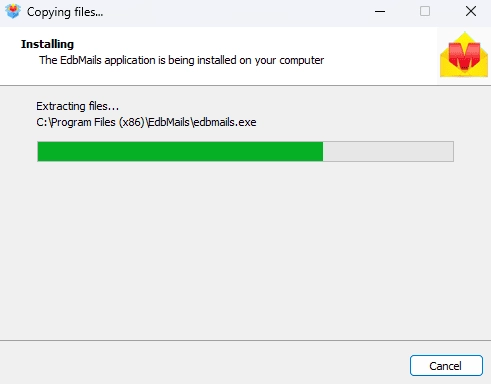
- Download and install EdbMails application on the Windows operating system.
- Follow the instructions that appear to complete the installation.
See the detailed EdbMails system requirements for Outlook PST recovery and export.
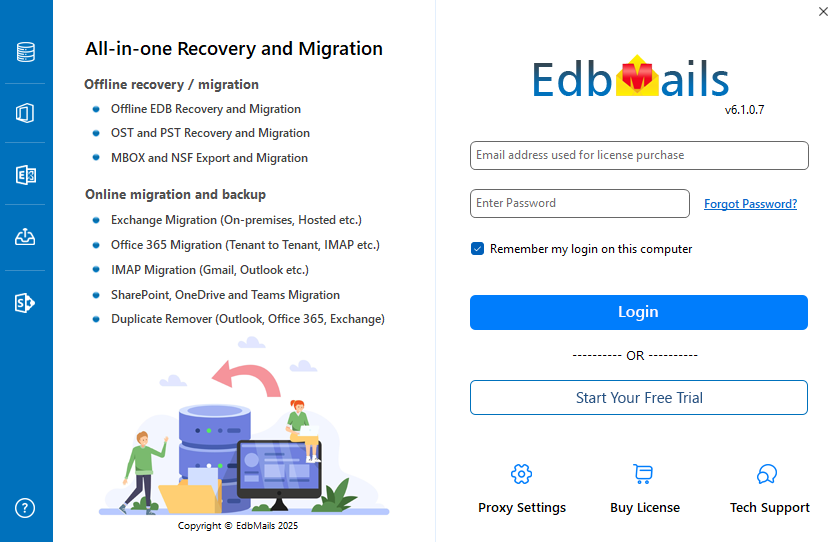
- Launch the EdbMails application
- Enter the email address & password and click ‘Login’ or ‘Start Your Free Trial’.
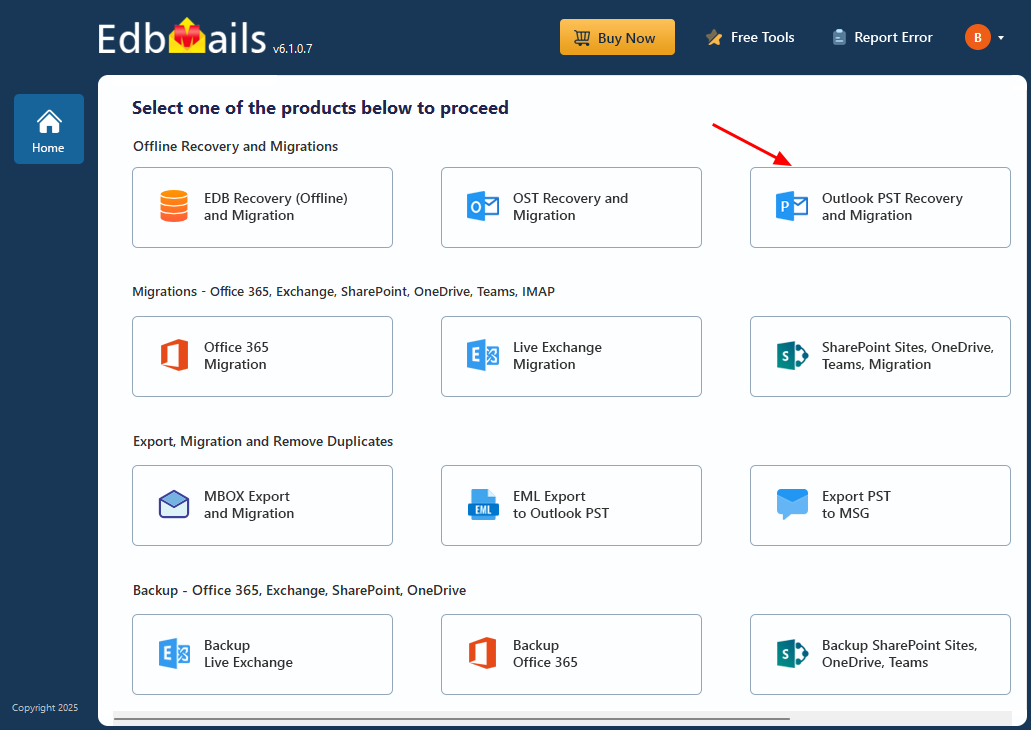
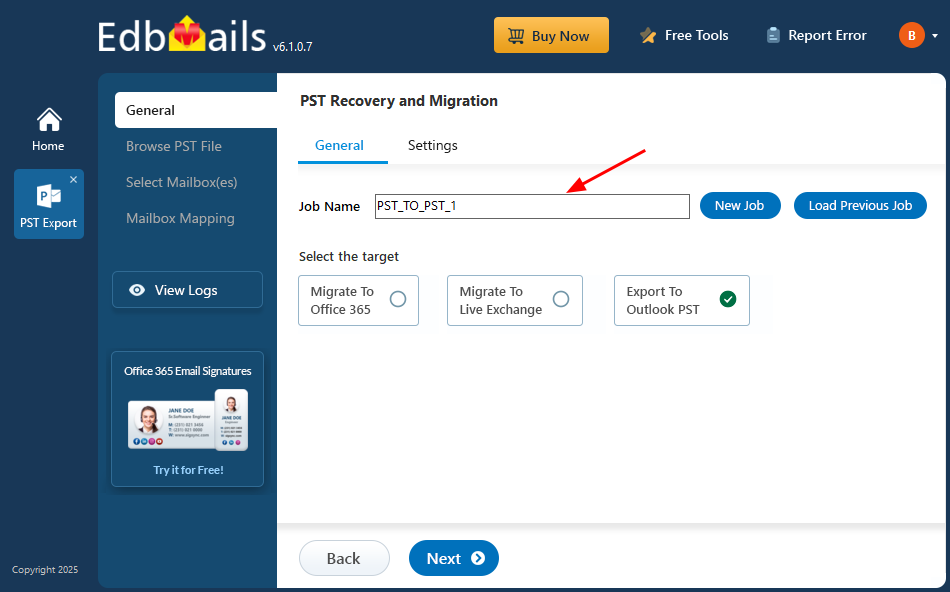
- Select ‘Outlook PST Recovery and Migration’
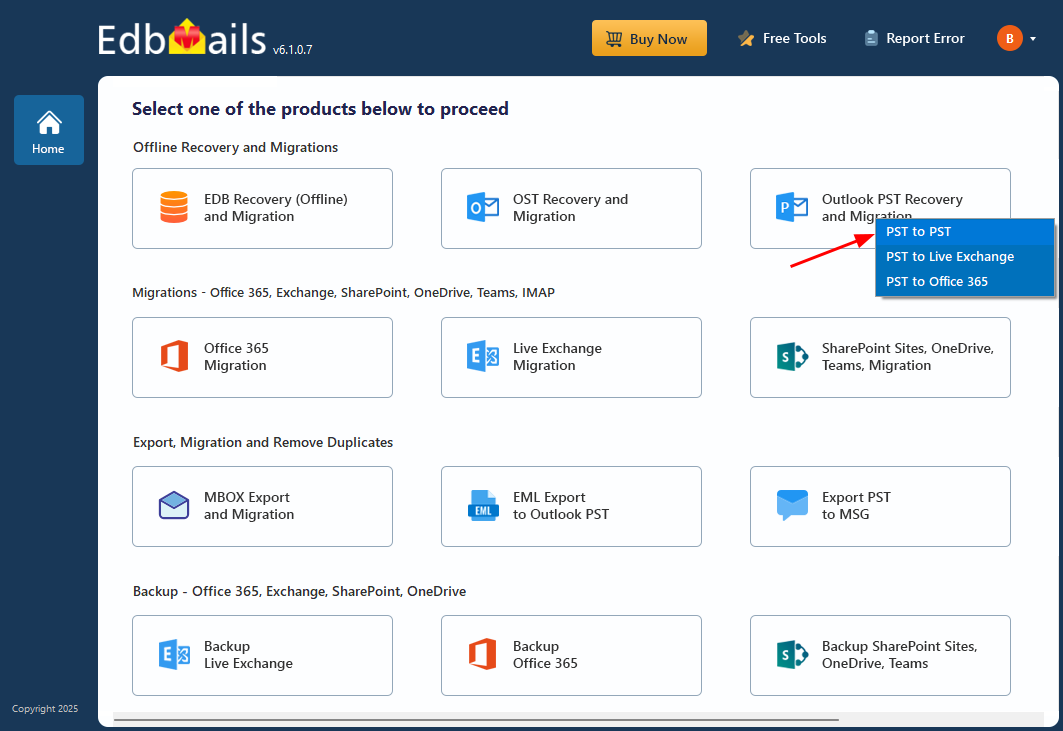
- Select ‘PST to PST’.
- You can use the default job name or click ‘New Job’ to change it.
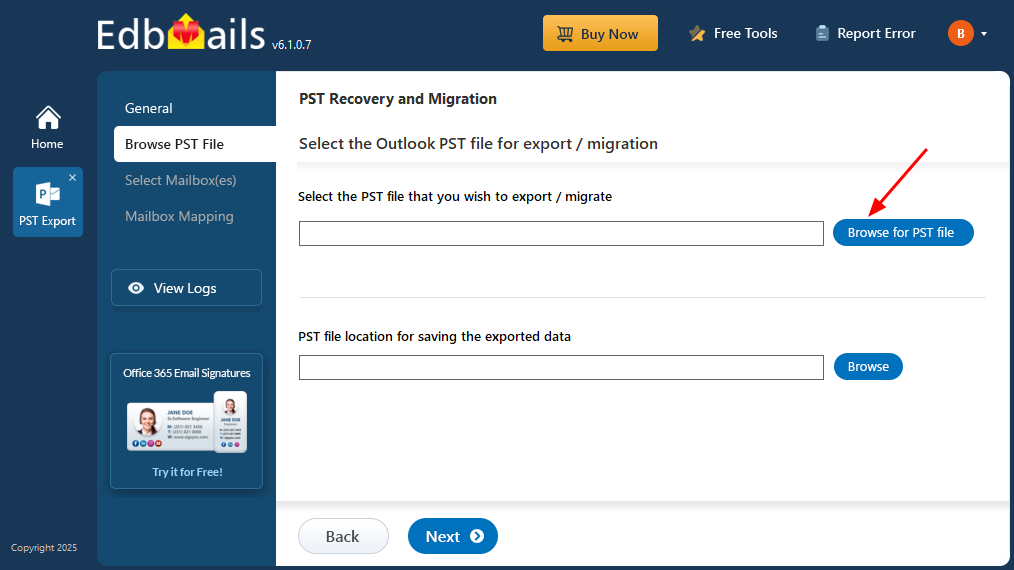
Step 2: Select the offline PST file
- Click ‘Browse for PST file'.
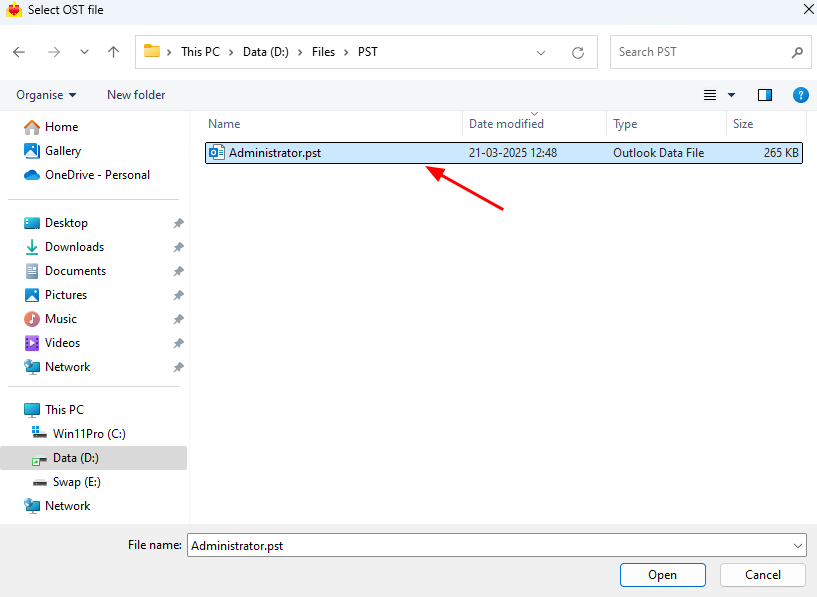
- Choose the offline PST file from your computer and click ‘Next’ to continue. If the PST is stored on a network location, make sure the computer running EdbMails can reliably access the file and that the PST is not being actively modified by Outlook or another process.
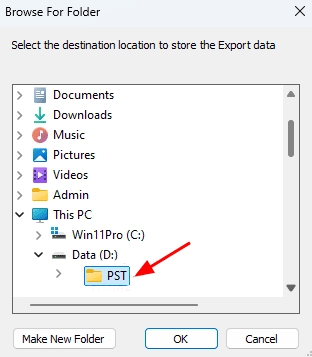
- Click ‘Browse’.

- Select the location to save the exported PST files. Ensure you have enough free disk space for storage.
- Click ‘Browse for PST file'.
Step 3: Preview and select the mailbox
- EdbMails scans the offline PST and displays mailbox data that remains recoverable, including data from a damaged or corrupted file where the underlying items can still be read.
- After scanning, the recoverable folder structure appears in the left pane. Expand folders to preview emails, contacts, calendars, tasks, notes, journals, attachments, and other supported mailbox items before selecting what to export.
- Select the required mailboxes/folders and click the ‘Next’ button.
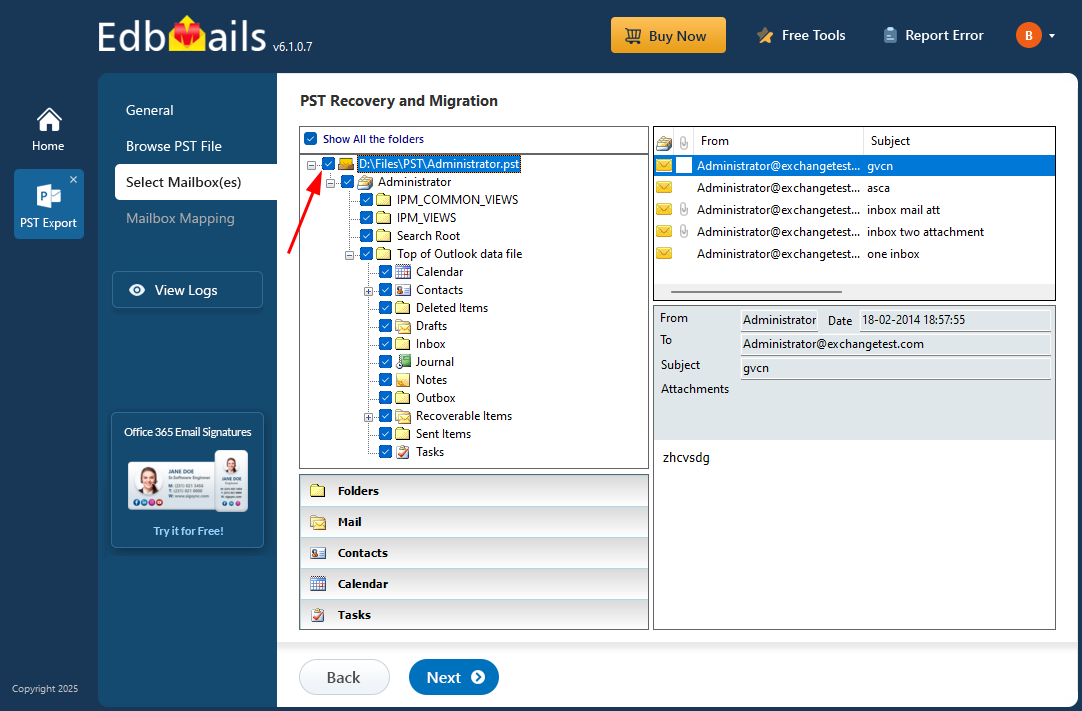
- EdbMails scans the offline PST and displays mailbox data that remains recoverable, including data from a damaged or corrupted file where the underlying items can still be read.
Step 4: Export Outlook PST files
- Verify the mailboxes and folders selected for export operation.
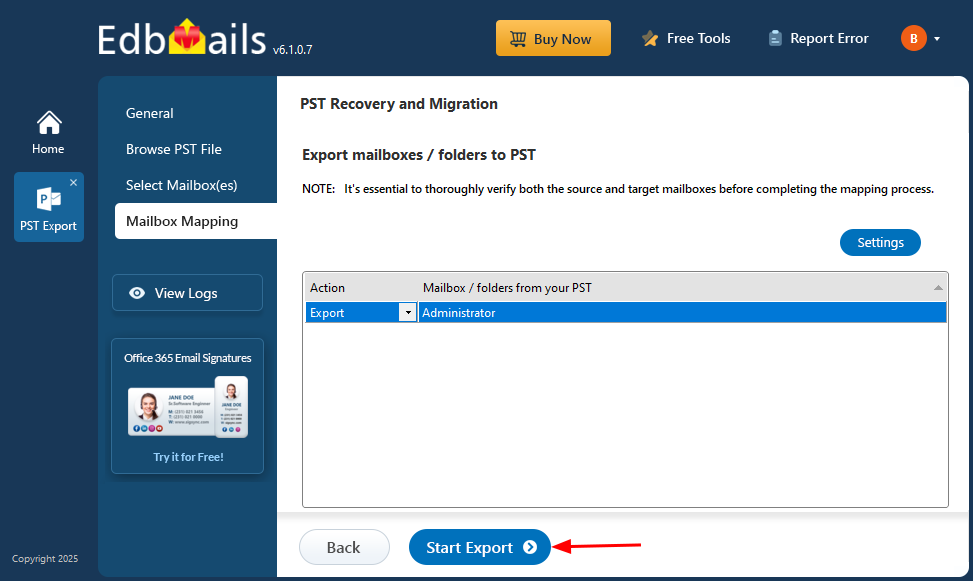
- EdbMails lets you customize your export using filters. For example, you can set a date range to export only specific items. To apply filters, just click the ‘Settings’ button.
- Make sure the ‘Action’ is set to 'Export', then click the 'Start Export' button.
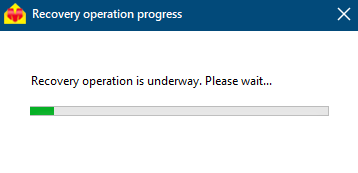
- The export operation is now initiated, and you can monitor it in the progress bar. Once the process is complete, EdbMails will display the export operation completion message.

Post-recovery and export validation
- View the export report
- Click the 'View Log' button to view the export operation report. This report provides a comprehensive overview, including:
- The total number of items exported from each folder.
- Mailbox and folder-specific details.
- A detailed record of the Outlook PST recovery and export process.
- Review the log to confirm what was exported and identify folders or items that need further attention. A successful export log does not replace validation of important mailbox data in the destination PST.
- Click the 'View Log' button to view the export operation report. This report provides a comprehensive overview, including:
- Verify the PST file in Microsoft Outlook
- Open the newly created PST in a supported Outlook environment and verify the folders and mailbox items that matter to you, including attachments, contacts, calendars, and representative messages. Keep the source PST until the recovered output is validated.
- Organize and Archive the PST File
- Once verified, organize the PST file by categorizing or archiving items based on your retention policies or organizational needs.
- You may choose to archive the PST file for future reference, backup, or compliance purposes, ensuring that your data remains accessible.
- View the export report
Benefits of EdbMails PST Repair Tool
EdbMails provides a source-preserving recovery workflow for Outlook PST files that are damaged, inaccessible, oversized, or difficult to open normally. Instead of overwriting the source PST, the application scans it, lets you preview recoverable mailbox data, and exports selected items to a separate destination PST. This is useful when you need to validate important data first, recover only selected folders, or create a clean PST output for use in Outlook.
- Recover mailbox data without requiring the original Exchange server profile that was associated with the PST.
- Preview recoverable emails, attachments, contacts, calendars, tasks, notes, journals, and folder hierarchy before export.
- Select specific folders or mailbox items instead of exporting the entire PST.
- Write recovered data to a separate destination PST so the damaged source file is not overwritten.
- Split the destination PST output into smaller files when required for easier management.
If you are comparing recovery capabilities, supported scenarios, pricing, or product features rather than following the procedure, see the EdbMails PST Recovery Tool page.
Important Outlook PST recovery considerations
- Recovery depends on what remains in the source PST.
No recovery tool can reconstruct mailbox data that has been overwritten, is no longer present in the PST, or cannot be read from the source file.
- Password protection and message encryption are different.
EdbMails can process supported password-protected PST containers as part of its recovery workflow. Message-level encrypted content, such as S/MIME-protected messages, can still require the original certificate or private key to read the message body.
- Large PST files are not automatically corrupt.
A large PST can be harder to open, copy, search, or maintain, but size alone does not prove corruption. Diagnose the actual Outlook or data-file error before choosing a recovery method.
- Keep the original PST until verification is complete.
Do not delete or replace the source PST after the first successful export. Verify important folders and representative mailbox items in the destination before archiving or retiring the source file.
Outlook PST recovery frequently asked questions
Should I try Microsoft ScanPST before using EdbMails PST Repair Tool?
For ordinary PST structural errors, Microsoft ScanPST is a reasonable first repair option. Create a backup copy of the PST before running it. If ScanPST cannot complete the repair, the PST remains inaccessible, or required mailbox data is still missing, EdbMails can scan the source PST and export recoverable data to a separate destination.
Does EdbMails modify the original PST during recovery?
No. The recovery-and-export workflow reads the source PST and writes selected recoverable mailbox data to a separate destination PST. Keep an untouched copy of the original file until you have verified the recovered output.
Do I need Outlook installed to recover a PST with EdbMails?
You can scan and preview recoverable PST mailbox data without opening the source PST in Outlook. For the current PST-to-PST export workflow, install and configure a supported classic Outlook version on the computer.
Can EdbMails recover deleted emails from a PST?
Deleted mailbox items can be recovered when their underlying data is still present and readable in the PST. Recovery is not possible when the relevant data has been overwritten or is no longer present in the source file.
Can I recover only selected folders or mailbox items?
Yes. After scanning the PST, preview the folder tree and select the folders or mailbox items required for export. You can also use available filter settings to further narrow the recovery set.
Can EdbMails handle a large PST file?
EdbMails can scan large PST files and export recoverable data to a new PST. If you need smaller output files, use the PST split option during export to divide the destination PST output; the source PST is not split.
How long does PST recovery take?
The time required depends on PST size, number of mailbox items, degree of corruption, storage performance, available system resources, and the amount of data selected for export. Large or heavily damaged files can take longer to scan.
How do I verify the recovered PST?
Review the EdbMails export log, then open the destination PST in a supported Outlook environment. Check important folders, representative messages, attachments, contacts, calendars, and item counts before you archive or retire the original PST.