


Bulk Convert Multiple OST Files to PST
Convert multiple OST files to PST in one managed batch, instead of running the export one file at a time.
Batch conversion helps when you're recovering many stranded or orphaned OST files. If the original mailboxes are still live on Exchange or Microsoft 365, migrating server-to-server is usually the better path.
When managing multiple mailboxes at once, exporting several OST files to PST quickly becomes a practical requirement. This is common during large-scale mailbox recovery, data migration projects, or when working with inactive or disconnected Outlook profiles. However, built-in Outlook export options offer limited support, particularly for large, corrupted, or orphaned OST files, making bulk exports slow and unreliable.
EdbMails bulk OST to PST Converter is designed to handle large-scale OST exports in a managed batch, without an application-imposed limit on the number of source files. It works with OST files from currently supported Outlook versions; see the current system requirements for the full list; and scans each source to recover readable emails, calendars, contacts, notes, tasks, and attachments, preserving folder structure and supported metadata for individual and organizational needs.
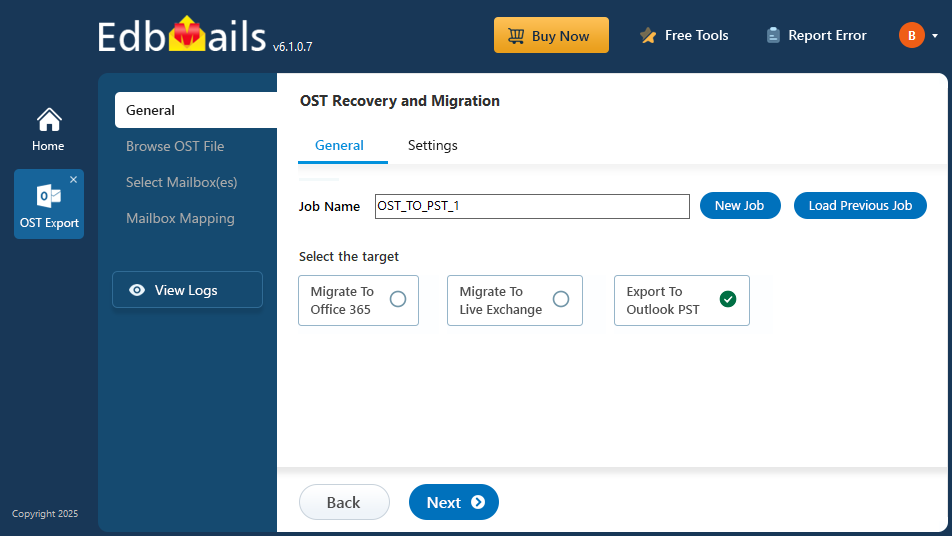
In this step-by-step guide, you’ll learn how to select OST files, configure export options, and save the data in PST format. With EdbMails, you can recover and convert Outlook data effortlessly, even from damaged OST files without relying on PowerShell scripts or manual setups.
When batch OST conversion is appropriate
- IT teams managing several inactive or ex-employee mailboxes often need to export many OST files at once rather than one at a time.
- Exchange server decommissioning or endpoint retirement, where the workstation OST is the only remaining copy of that mailbox's data.
- Large forensic or administrative mailbox recovery sets, where PST output is genuinely the required destination.
- Corrupted or orphaned OST files across multiple systems can be recovered and converted together, saving significant admin time compared to manual, one-by-one recovery.
When server-side migration is the better path
If the original Exchange or Microsoft 365 mailboxes are still live and reachable, migrating server-to-server from the authoritative source is usually preferable to exporting and re-importing workstation OST files. Batch OST conversion is best reserved for mailboxes that are stranded, orphaned, or otherwise unreachable any other way; not as a routine substitute for a healthy live mailbox and normal Outlook synchronization.
EdbMails OST to PST converter tool offers
- Lifetime licenses and free software upgrades; see current pricing and licensing for batch/multi-mailbox terms
- Free 24/7 Technical Support for lifetime
- OST to PST conversion across currently supported Outlook and Windows versions
- Opening OST files and previewing the data before export
Batch conversion workflow
| Stage | What it covers |
|---|---|
| Inventory | Note each source file's path, the mailbox owner, and its current size/status before starting. |
| Preservation | Work from copies of the source OST files where practical, so the originals stay untouched. |
| Scan/preview | Confirm each source loads and preview a representative sample of its data before committing to a full export. |
| Selection | Apply folder, date, or item-level filters per source if you don't need the entire mailbox. |
| Export | Choose output naming and, for large mailboxes, whether to split the output PST; see below. |
| Validation | Review each job's results and item counts, and check for any source or item that didn't complete before considering the batch finished. |
For many source files, deterministic output naming; by user, source file, or job; makes the resulting PST files easier to track back to their original mailbox.
If a single mailbox's export would produce a very large PST file, EdbMails can split the output into multiple smaller PST files without changing the source OST. See Split a Large OST File to Multiple PST Files for details.
Steps to export multiple OST files to PST using EdbMails
- Download and install EdbMails, then select 'OST Recovery and Migration' → 'OST to PST'.
- Browse and add your OST file(s), preview the recovered mailbox data, and start the export.
- EdbMails processes multiple source files in one batch, with no application-imposed limit on the number of sources. You can apply filters; see Date Filter / Selective Export; to each source as needed.
- For the complete step-by-step walkthrough with screenshots, see the full OST to PST conversion guide.
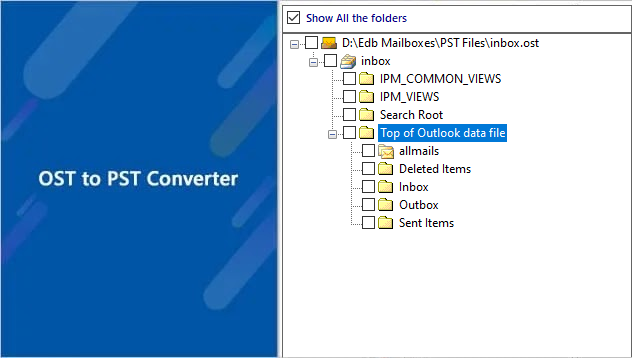
Watch the video for bulk OST file export:
Advantages of EdbMails OST to PST converter
- Bulk OST recovery and export: no application-imposed limit on the number of source files in a batch
- Customizable email export filters: export only the data you need from each source; see Date Filter / Selective Export
- Recovery from damaged sources: EdbMails scans corrupt or ransomware-affected OST files and recovers whatever data is readable; a badly damaged or unsafe file may still have unreadable or unrecoverable portions
- No data modification or deletion of source files during bulk export
PST export vs. direct migration
| Project goal | Preferred path |
|---|---|
| Portable file archive/export | Bulk OST → PST |
| Restore to Microsoft 365 | Bulk OST → Microsoft 365 |
| Restore to Exchange | Bulk OST → Exchange |
PST export is only required when a portable file is the actual deliverable. Bulk source scanning itself does not require the original Outlook profiles; Outlook is required for PST export, but direct Microsoft 365 or Exchange migration does not require Outlook.
Performance planning for large batches
- Available local SSD/disk capacity for temporary and output files
- Output PST capacity and split thresholds for large mailboxes
- Whether your build processes sources concurrently or sequentially; check current product documentation, as this affects total batch runtime
- Antivirus or backup software scanning large temporary/output files while a batch is running, which can slow the job
- Where job/report output is stored, especially across many source files
Plan a Multi-OST Conversion Before Starting the Batch
| Planning item | Recommended preparation |
|---|---|
| Source inventory | Record each OST filename, owner, approximate size, condition and last known mailbox. |
| Working copies | Keep original evidence/source files unchanged and process local working copies. |
| Output naming | Use a consistent convention that maps each PST and log back to its source OST. |
| Storage | Provide sufficient free space for source copies, generated PST files and temporary processing. |
| Validation sample | Define the folders, dates, attachments and item types that will be checked for every output. |
Recommended Batch Workflow
- Inventory and classify the source OST files.
- Run a pilot using representative small, large, healthy and damaged files.
- Confirm output naming, PST splitting and destination storage.
- Process the approved batch without modifying the source files.
- Retain an export log for each source.
- Validate representative content and investigate skipped or failed items.
- Document final source-to-output mapping for handover.
Performance Factors for Large OST Batches
Processing time depends on source-file size, number of items, file condition, storage speed, available system resources, filters and the selected output. Avoid publishing a universal conversion-speed claim unless it is supported by a reproducible EdbMails benchmark.
Batch OST-to-PST Export or Direct Migration?
| Requirement | Preferred route |
|---|---|
| Portable local files, legal handover or later Outlook access | Export the recoverable OST data to PST. |
| Final destination is Microsoft 365 or Exchange | Consider direct migration to reduce intermediate PST handling. |
| Only selected folders or dates are required | Apply supported selections and filters before export. |
| Large output must be divided | Configure PST splitting for the output; do not describe this as splitting the source OST. |
For the product overview, visit EdbMails OST to PST Converter.
Frequently Asked Questions
Can I convert multiple OST files in one project?
Yes. Add multiple OST files to a single job and EdbMails processes them as onebatch rather than repeating the workflow for each file.
Does 'unlimited' mean there is no practical file-size limit?
There's no application-imposed limit on source count. In practice, throughput is still shaped by your disk space, memory, processing time, and output PST size limits.
Can damaged OST files be processed in bulk?
Yes; EdbMails scans each damaged source and recovers what's readable. A severely damaged or ransomware-affected file may still have some data that can't be recovered.
Can I split large PST outputs automatically?
Yes. For a single mailbox that would otherwise produce a very large PST, EdbMails can split the output into multiple smaller PST files. The source OST is unchanged either way.
Can I filter different OSTs in one batch?
Yes, filters (date, sender, recipient, subject, attachment, folder) can be appliedper source within the same batch.
Can bulk OST data go directly to Microsoft 365/Exchange?
Yes; direct migration skips the intermediate PST file entirely. Outlook is not required for that path; it's only needed when the destination is a PST file.