


ANSI and Unicode OST File Support
ANSI and Unicode describe generations of Outlook data-file formats. Legacy ANSI files have a much smaller practical size limit and limited character representation, while Unicode data files support larger sizes and multilingual content. Normal export by a Unicode-capable Outlook installation is not inherently expected to corrupt Unicode text.
EdbMails OST to PST Converter supports tested ANSI and Unicode OST sources and can export readable content to a Unicode PST. Because damaged or legacy sources can contain unreadable or unrepresentable data, verify the output instead of assuming lossless conversion.
| Format | Typical context | Main consideration |
|---|---|---|
| ANSI | Legacy Outlook data files | About 2 GB format limit and limited character representation |
| Unicode | Modern Outlook data files | Larger configurable limits and broad multilingual support |
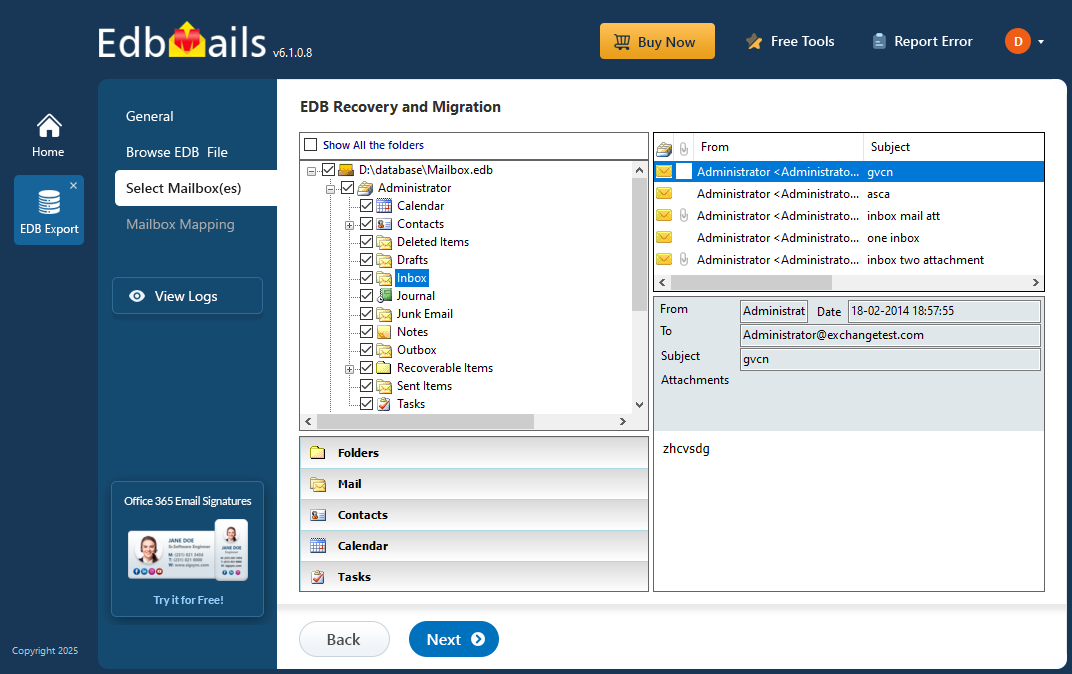
In this step-by-step guide, you’ll learn how to add your OST file to the application, let EdbMails scan and evaluate its contents, and export the data into a PST file while preserving the original language settings and folder structure. The process is simple and requires no manual folder renaming or character encoding adjustments, making it an ideal solution for language-sensitive Outlook data recovery and migration.
Practical uses of the language conversion feature of EdbMails
- Legacy-data review: Convert readable content from an older ANSI source into a Unicode PST, then validate representative folders, dates, attachments, and multilingual text.
- Multilingual email migration: Preview and export mailboxes containing right-to-left scripts, East Asian characters, and European special characters, then verify those characters in the target PST.
- Scoped review or discovery: A converted PST can support review workflows, but conversion alone does not establish legal completeness, chain of custody, or compliance.
How does EdbMails preserve language settings when converting OST to PST?
Step 1: Download and launch EdbMails OST to PST Converter.
Step 2: Browse and add the OST file - folder names and content in the original regional language display correctly during preview, with no manual renaming needed.
Step 3: Click 'Export to Outlook PST' to begin the conversion; Unicode and ANSI characters, including right-to-left scripts and European special characters, are retained automatically.
Step 4: Open or import the exported PST in a supported Unicode-capable Outlook build. Spot-check non-English subjects and bodies, folder names, attachments, dates, item counts, and any right-to-left text.
For the complete conversion walkthrough, see the full OST to PST converter guide.
EdbMails can scan and preview a supported OST without the original Outlook profile. Outlook with a configured profile is required for PST export; direct migration to Exchange or Microsoft 365 does not require Outlook.
Frequently Asked Questions
What is the difference between ANSI and Unicode Outlook data files?
ANSI is the legacy format with a small size ceiling and code-page limits. Unicode supports much larger configurable sizes and broad multilingual text.
Did Outlook 2003 support Unicode data files?
Yes. Avoid treating one Outlook version as an absolute ANSI/Unicode cutoff because profile and file creation choices also matter.
Is ANSI the same as English-only?
No. ANSI files use a particular Windows code page, which can represent languages supported by that code page but not the full Unicode range.
Can EdbMails detect ANSI or Unicode automatically?
Use the application's detected source information where available, and verify behavior against a representative file and the current supported-format documentation.
Will multilingual folder names be preserved?
Readable Unicode content should be exported to a Unicode-capable target, but validate folder names and representative items rather than relying on an absolute guarantee.
What if the ANSI source contains unsupported characters?
Characters that were never representable in the original code page may already be unavailable or substituted; conversion cannot recreate source data that was not stored correctly.