


Export Selected Emails, Folders and Mailbox Items from OST to PST
Selective export lets you pull specific emails, folders, or item types out of an OST instead of exporting the entire mailbox.
Classic Outlook already has its own search/filter tools and export wizard for a live mailbox. What EdbMails adds is applying combined filter criteria directly to an offline or orphaned OST that Outlook itself can't open — filters only reach data that's actually present and readable in that file.
When handling OST files, you don't always need to export the entire mailbox. In many cases, extracting only selected emails, folders, contacts, or calendar entries is the more efficient approach. Selective export minimizes file size, removes irrelevant data, and keeps the resulting PST file structured and easy to manage. For a complete recovery and export workflow, use the OST to PST Converter to process OST mailbox data.
Outlook's built-in search and filter tools, along with its Import/Export wizard, can already narrow down a live mailbox. EdbMails' role is different: it applies the same kind of filtering — date, subject, sender, folder, and more — directly during export or migration from an offline or orphaned OST, including cases where Outlook can't open the file at all.
When Selective Export Makes Sense
Selective OST export is useful in several real-world scenarios:
- Exporting specific emails — extract only the emails tied to a certain project, sender, or time frame using custom criteria like date range, sender name, subject line, or attachments, instead of exporting the entire OST file.
- Exporting specific folders — your OST file might include Inbox, Drafts, Sent Items, and custom folders, but you may only want to export certain ones. This is especially useful for skipping folders like Junk Email or Conversation History.
- Exporting specific item types — retrieve and export only particular mailbox item types, such as contacts, calendar entries, or tasks, without exporting emails.
- Removing unwanted items — skip junk mail or emails with oversized attachments during export, so the resulting PST file only contains what you actually need. (This is filtering by criteria, not automatic duplicate detection — EdbMails doesn't currently document a dedicated dedupe feature for this workflow.)
Available Filter Options
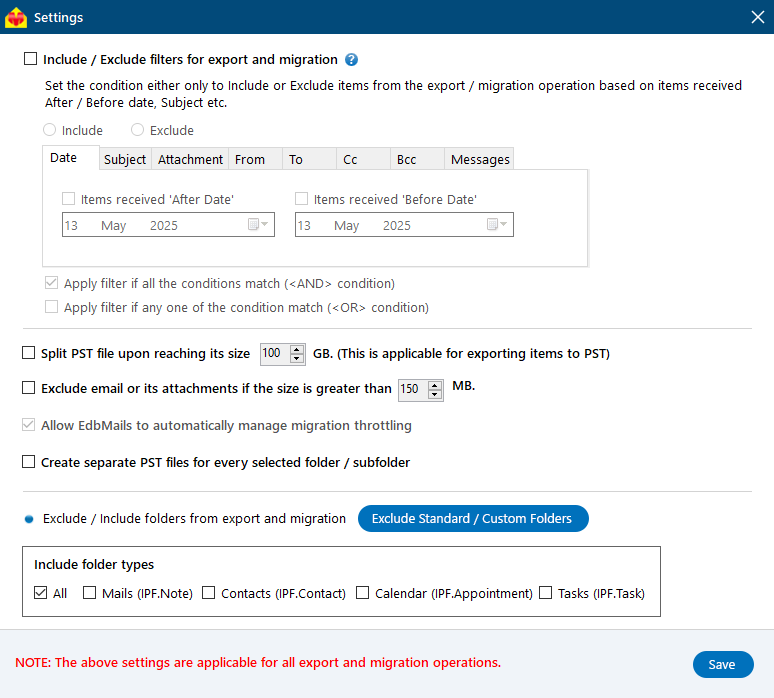
EdbMails includes a full set of include/exclude filters you can apply during OST to PST export:
- Date — include or exclude items by date range. See Export OST with Date Filter for the full field semantics and boundary behavior.
- Subject — include or exclude items based on the email or calendar subject line.
- Attachments — include or exclude items based on attachment names within the message.
- From — include or exclude emails from specific sender addresses.
- To — include or exclude emails sent to specific recipient addresses.
- Cc / Bcc — include or exclude emails based on Cc or Bcc address.
- Read/Unread status — include or exclude messages based on whether they've been read.
Filters can be combined using either an AND condition (an item must match all specified conditions to be included) or an OR condition (an item is included if it matches any one of the conditions) — giving you precise control over exactly which items get exported.
Two additional options round out the filtering toolkit:
- Export without attachments — move only the message content and skip attachments, useful for reducing PST size when attachments aren't needed.
- Split the output PST file — for large exports, EdbMails can split the resulting PST into smaller files by size. See splitting a large OST file into multiple PST files for details.
For the full breakdown of filter behavior, see the EdbMails advanced filter settings reference.
Filter Coverage at a Glance
| Filter type | Where to find the details |
|---|---|
| Date | See the dedicated date-filter page for field semantics and boundaries |
| Sender / Recipient / Cc / Bcc | Match against the specified address(es); covered above |
| Subject | Match against the subject line; covered above |
| Attachments | Match against attachment names; covered above |
| Folder include/exclude | Standard and custom folders; see below |
| Item type | Mail, calendar, contacts, tasks; covered above |
What Filters Can and Can't Reach
- Filters operate only on items that are actually present and readable in the OST you're processing. They can't select server-only items that were never cached to that file in the first place.
- A filter applied to the primary mailbox OST doesn't reach into a separate Online Archive mailbox. If the data you need lives in the Online Archive, use the archive recovery path instead.
How to Apply Include/Exclude Filters in EdbMails
- Open the include/exclude filter settings — in the EdbMails main window, check 'Include/Exclude filters for export and migration' before starting the job.
- Choose Include or Exclude — use 'Include' to migrate only items matching your criteria, or 'Exclude' to skip specific items while migrating everything else.
- Set your filter criteria — apply any combination of Date, Subject, Attachments, From, To, Cc, Bcc, and read/unread status filters covered above.
- Choose AND or OR matching — select whether an item must match all conditions or just one to be included.
- Save your settings and start the export — EdbMails applies the filters as it scans and exports the OST file to PST.
Excluding Standard and Custom Folders
Exclude Standard Folders
If you don't need to export certain standard Outlook folders, click 'Exclude Standard / Custom Folders.' You can exclude folders such as Inbox, Contacts, Calendars, Tasks, Journal, Sent Items, Outbox, Drafts, Notes, and Deleted Items. Whether any folders like Conversation History or Junk Email are excluded by default varies by build — check your current settings rather than assuming.
Exclude Custom Folders
Custom folders are the ones you've created yourself. To exclude one, type the folder name, click 'Add,' and click 'OK' to confirm.
Outlook Dependency
EdbMails can scan and preview an OST without Outlook. Outlook with a configured profile is required when exporting the filtered data to PST; direct migration to Exchange or Microsoft 365 does not require Outlook. For step-by-step export instructions, refer to the OST to PST conversion guide.
Validating a Selective Export
- If the application shows a filtered-result count before export, check it against what you expect.
- After export, verify a representative sample of included items actually matches your filter criteria.
- Spot-check that items just outside your criteria were correctly excluded.
- Save the export report or log for your records.
Plan a Selective OST Export
| Selection type | Use it for | Verification |
|---|---|---|
| Folder selection | Exporting only required mailbox areas | Confirm parent and subfolder selection before export. |
| Date range | Limiting output to a defined business or legal period | Verify time-zone context and boundary dates. |
| Item type | Separating email, contacts, calendar, tasks or notes | Check each required Outlook item type independently. |
| Individual-item selection | Recovering a small set identified during preview | Record the source folder and expected count. |
Prevent Accidental Exclusion
- Preview the complete detected folder tree before applying filters.
- Record the recovery scope and selection rules.
- Export a representative sample from every important folder.
- Review the export log for excluded, skipped and failed items.
- Open the PST and verify that the selection, not the whole source, matches the request.
Frequently Asked Questions
Do I need Outlook for selective PST export?
EdbMails can scan and preview an OST without Outlook. Outlook with a configured profile is required when you export the filtered data to PST; direct migration to Exchange or Microsoft 365 does not require Outlook.
Does selective export work with orphaned OST files?
Will selective export preserve email metadata like read/unread status and timestamps?
Is it possible to export only calendar items or contacts without exporting emails?
Can I combine multiple filters, like date range and sender, in a single export?
Does selective export reduce the risk of PST file corruption?
Can I use selective export for compliance or legal discovery purposes?
Can I exclude custom folders by name?
Can filters recover uncached server data?