How to Fix The Set of Folders Cannot Be Opened in Outlook
Check webmail and Microsoft 365 service health first. If the mailbox is available, run outlook.exe /resetnavpane, test classic Outlook in Safe Mode, and try a new profile before repairing or recovering any data file.
The error “Cannot start Microsoft Outlook. The set of folders cannot be opened” usually points to a startup or profile-loading problem in classic Outlook — most often the navigation pane configuration, a misbehaving add-in, or the Outlook profile itself. A damaged PST or OST file is only one of several possible causes, not the default explanation, so it's worth working through the checks below before assuming a data file needs repairing.
Before troubleshooting the Outlook client itself, check whether you can reach your mailbox through Outlook on the web (OWA) or your provider's webmail. If webmail works normally, the problem is local to this installation of classic Outlook. If webmail is also failing or slow, the issue may be on the server or account side, and the Microsoft 365 service-side check further down this page is the better starting point.

This error can have several different causes — a damaged PST file is only one of them:
- Navigation Pane Corruption: A damaged or customized navigation pane configuration is one of the most common causes, and the one Microsoft's own troubleshooting addresses first.
- Corrupted or Misconfigured Outlook Profile: A profile that's become damaged, or has a stale connection to the mailbox, can prevent Outlook from opening the folder list.
- Conflicting Add-ins or Antivirus Software: Third-party add-ins or overly aggressive antivirus scanning can interfere with Outlook during startup.
- Corrupted Outlook Data File (PST or OST): A damaged local data file can cause this error, but it's typically confirmed only after the checks above have been ruled out.
- Microsoft 365 or Exchange Service Issues: Microsoft has documented server-side conditions, including authentication concurrency limits on Exchange Online, that produce this exact error message independent of anything on your computer.
Common signs of the error “The set of folders cannot be opened” in Outlook
You may be experiencing this error if you notice any of the following:
- Outlook does not open: Outlook fails to start and shows the error message: “Cannot start Microsoft Outlook. The set of folders cannot be opened.”
- No access to mailbox data: You cannot access your emails, contacts, calendar, or other Outlook data.
- Outlook is very slow or freezes: Outlook may take a long time to open, become unresponsive, or stop working while loading your mailbox.
“Set of Folders Cannot Be Opened”: Isolation Checks
Use these checks to separate a server, profile, add-in or local data-file problem before attempting recovery.
| Test | What it helps isolate |
|---|---|
| Open Outlook on the web | Server mailbox availability versus a local Outlook problem. |
| Try a new profile after preserving required local data | Profile configuration versus mailbox data. |
| Check add-ins and start Outlook in Safe Mode | Extension-related startup failure. |
| Copy the OST to a working location | Storage or read issue versus profile association. |
| Preview the old OST independently | Whether required local data remains readable. |
How to fix the error “The set of folders cannot be opened” in Outlook?
Work through these methods in order — they're arranged from the quickest, least invasive checks to the ones that involve recovering data from a damaged file. These solutions apply to currently supported versions of Outlook for Windows (Microsoft 365, Outlook 2021/2019) running on Windows 10 or 11.
- Method 1: Close and relaunch Outlook
This method offers a simple and effective first step to resolve the error “The set of folders cannot be opened in Outlook.” When Outlook launches, it connects to the mail server, loads essential files and settings, and initializes the program. However, temporary network issues, corrupted data files, or outdated settings can interrupt this process and trigger the error. Restarting Outlook helps re-establish a clean connection to the server, which may resolve the issue.
- Step 1: Close Microsoft Outlook and restart your computer
- To close Microsoft Outlook, click on the ‘File’ menu in the top-left corner of the screen.
- Click ‘Exit’.
- Restart your computer, which can help to clear any temporary data that may be causing the error.
- Step 2: Reopen Microsoft Outlook and check for the error
- After restarting your computer, open Microsoft Outlook.
- Check to see if “The set of folders cannot be opened in Outlook” error has been resolved.
- You should now be able to access your email, calendar, and other important data.
- Step 1: Close Microsoft Outlook and restart your computer
- Method 2: Reset the Outlook navigation pane
Microsoft specifically documents this as a fix for the “set of folders cannot be opened” error: a damaged or customized navigation pane configuration is one of the most common causes, and resetting it restores the default folder view without affecting your mail data.
- Step 1: Close Outlook completely
- Make sure Outlook and any background Outlook processes are fully closed before continuing.
- Step 2: Run the reset command
- Press Windows key + R to open the Run dialog box.
- Type outlook.exe /resetnavpane — make sure there's a space before the slash — and press Enter or click OK.
- Let Outlook start normally. This restores the navigation pane to its default folders and removes custom Favorites or view settings; it does not delete any mail data.
- Step 3: If the command doesn't run, delete the navigation pane file directly
- Close Outlook, open File Explorer, and go to %localappdata%MicrosoftOutlook.
- Find and delete the XML file named after your profile (for example, Outlook.xml) — this is the navigation pane configuration file, not a mail data file.
- Restart Outlook; it will recreate the file with default settings.
- Step 1: Close Outlook completely
- Method 3: Start Outlook in Safe Mode
Starting Outlook in Safe Mode launches it with add-ins and custom toolbar/ribbon changes disabled, which helps you determine whether one of them is causing the error. If Outlook opens normally in Safe Mode, an add-in or customization — not a damaged data file — is the more likely cause.
- Step 1: Close Microsoft Outlook
- To close Microsoft Outlook, click on the ‘File’ menu in the top-left corner of the screen
- Click ‘Exit’ to close Microsoft Outlook and all of its associated processes.
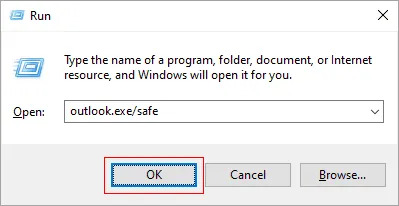
- Step 2: Start Microsoft Outlook in Safe Mode
- While holding down the Ctrl key, double-click on the Microsoft Outlook icon to open it.
- This launches a dialog box asking if you want to start Outlook in safe mode.
- Click ‘OK’ to proceed and choose the Outlook profile name.
- Step 3: Verify if the error is resolved
- After you open Microsoft Outlook in Safe mode, check to see if the error has been resolved.
- You should now be able to access your email, calendar, and other important data.
- Step 4: Exit Safe mode and restart Outlook
- After you have verified that the error has been resolved, exit Safe mode by closing Microsoft Outlook.
- Restart the application normally, without holding down the Ctrl key.
- Step 1: Close Microsoft Outlook
- Method 4: Disable conflicting Outlook Add-ins
The error message “The set of folders cannot be opened in Outlook” can also be caused by various factors including conflicting add-ins. Add-ins are third-party tools or components that extend the functionality of Outlook. However, some add-ins may cause compatibility issues or slow down the performance of the application. If an add-in is causing the error, disabling it can help resolve the issue. If the error is resolved, you can re-enable the add-ins one by one to determine which add-in is causing the problem.
Note: It's recommended to keep only essential add-ins enabled and disable all others, to maintain optimal performance and stability of Outlook.
- Step 1: Open Microsoft Outlook
- To open Microsoft Outlook, double-click on the desktop icon or you can find it in the list of installed programs.
- Step 2: Access Outlook Options and go to the Add-ins page
- To access the Outlook Options, click on the ‘File’ menu in the top-left corner of the screen.
- Click ‘Options.’
- In the Outlook Options window, click on ‘Add-ins’.
- Step 3: Disable the conflicting Add-ins
- To disable an add-in, click on the ‘COM Add-ins’ option.
- Uncheck the box next to the Add-in and click ‘OK’.
- Repeat this step for each conflicting Add-in.
- Step 4: Restart Microsoft Outlook
- After disabling the conflicting add-ins, close Microsoft Outlook
- Reopen it to see if “The set of folders cannot be opened in Outlook” error has been resolved.
- Step 1: Open Microsoft Outlook
- Method 5: Temporarily disable antivirus software
Temporarily disabling and re-enabling your antivirus software can sometimes resolve “The set of folders cannot be opened in Outlook” error. Antivirus programs may interfere with Outlook’s processes by blocking certain actions or files. Restarting the antivirus can help clear these conflicts and restore normal operation. To prevent similar issues in the future, it's recommended to add Outlook to the antivirus whitelist or exclusion list.
- Step 1: Locate the antivirus software in your computer
- Look for the antivirus software in the system tray or in the list of installed programs from the ‘Start Menu’
- Step 2: Disable the antivirus software
- Right-click on the antivirus software icon and select the option to disable or turn off the antivirus software.
- Some antivirus software may require you to enter a password or confirm that you want to disable it.
- If you are using Windows Security, go to ‘Virus and threat protection’ > ’Manage Settings’ and turn off the monitoring temporarily.
- Step 3: Restart Microsoft Outlook
- After disabling the antivirus software, close Microsoft Outlook.
- Reopen it to see if “The set of folders cannot be opened in Outlook” error has been resolved.
- If the error has been fixed, you can re-enable the antivirus software again.
- Step 1: Locate the antivirus software in your computer
- Method 6: Test with a new Outlook profile
If the checks above haven't resolved the error, the Outlook profile itself may be the problem. Microsoft recommends testing with a different profile before removing anything — if Outlook starts normally on the new profile, the old profile is confirmed as the cause.
Before you remove the old profile, keep in mind that Microsoft warns profile removal deletes its offline cached content (the local OST file). If there's any chance the old profile holds mail that isn't fully synced to the server — for example, items created while working offline — preserve a copy of its OST file first.
- Step 1: Create a new profile without removing the old one
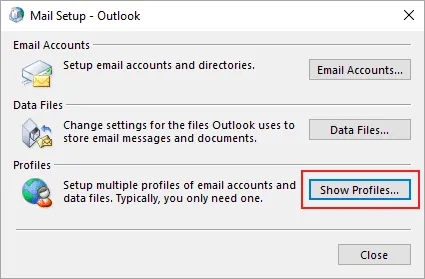
- Open Control Panel > Mail and click ‘Show Profiles’.
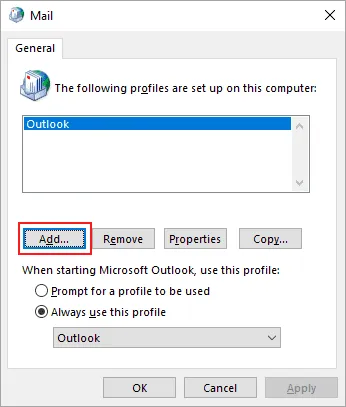
- Click ‘Add’ to create a new profile, and set up your Microsoft 365 or Exchange account in it.
- Set the new profile to ‘Prompt for a profile to be used’, or set it as the one Outlook always uses, and launch Outlook.
- Step 2: Confirm whether the new profile resolves the error
- If Outlook opens normally on the new profile, the old profile was the cause. You can continue using the new profile going forward.
- Step 3: Remove the old profile once you're sure you don't need its local data
- Back in Show Profiles, select the old profile and click ‘Remove’.
- Only do this once you've confirmed the new profile works and you've preserved any local-only data you might need from the old one.
- Step 1: Create a new profile without removing the old one
- Method 7: Repair the Outlook data file with the Inbox Repair Tool
Once the checks above haven't resolved things and you have reason to suspect the data file itself — for example, Outlook reports the file as damaged — the built-in Inbox Repair Tool (ScanPST.exe) can check and repair it. This isn't the first thing to try for this error, since navigation pane, profile, and add-in issues are more common causes.
- Step 1: Locate ScanPST.exe
- ScanPST.exe ships with Outlook and is normally found under your Office installation folder (typically under C:Program FilesMicrosoft Office or C:Program Files (x86)Microsoft Office, in the subfolder matching your installed Office version). If you can't find it, search for “scanpst” from the Windows Start menu.
- Step 2: Scan and repair the data file
- Open ScanPST.exe and browse to your PST or OST file.
- Click ‘Start’ to scan, then ‘Repair’ if errors are found.
- Step 3: Restart Outlook and verify
- Reopen Outlook and check whether the error is resolved.
- If Outlook still feels slow or the error recurs, you can also compact the data file: go to ‘File’ > ‘Account Settings’ > ‘Account Settings’ > ‘Data Files’, select the file, then click ‘Settings’ > ‘Compact Now’.
- If ScanPST can't fully repair the file, or the error returns, the file may be too damaged for this tool — see the recovery methods further down this page.
- Step 1: Locate ScanPST.exe
- Method 8: Export accessible mailbox data only when Outlook opens
This is not a startup fix. Use Outlook's native PST export only if another profile or recovery step already allows Outlook to open the healthy live mailbox. It cannot export from an orphaned OST that Outlook cannot open, and creating a PST does not repair the original startup error.
- Step 1: Launch Import and Export Wizard in Outlook
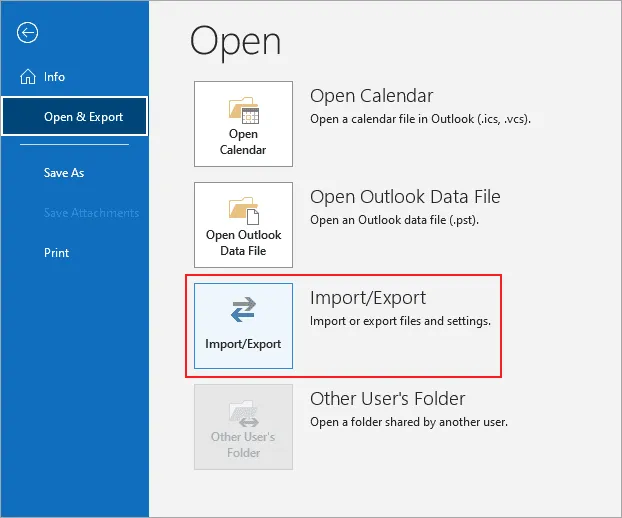
- Launch Outlook and click on the ‘File’ menu.
- Select ‘Open & Export’ and then click on ‘Import/Export’
- Step 2: Export the OST file to PST file format
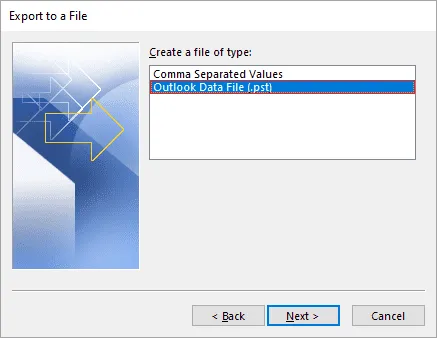
- From the Import and Export wizard, select ‘Export to a file’ and click on ‘Next’.
- Select ‘Microsoft Outlook Data File (.pst)’ as the file type and click on ‘Next’.
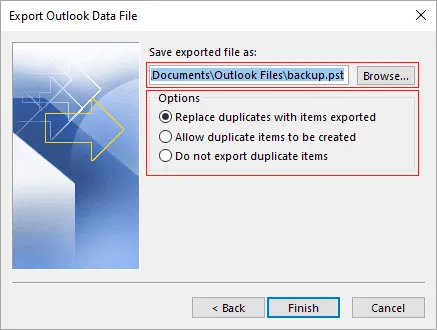
- Choose the mailbox or folder that you want to export, and click on ‘Next’.
- You will be prompted to set a password for the exported PST file (optional).
- Click ‘OK’ to start the export process.
- Step 3: Import the PST into Microsoft Outlook
- Wait until the export process is completed.
- You can view the exported PST file in the location specified.
- To retrieve all your emails, folders and mail items, open Outlook and import the PST file by following the preceding steps and selecting ‘Import from another program or file’
- Step 1: Launch Import and Export Wizard in Outlook
- Method 9: Disable Outlook compatibility mode
Running Outlook in Windows compatibility mode for an older version of Windows can interfere with its normal startup and isn't needed on any currently supported version of Windows or Outlook. Turning it off can resolve this error if it's enabled.
- Step 1: Open the Outlook executable's properties
- Right-click the Outlook shortcut, or the OUTLOOK.EXE file itself (commonly under C:Program FilesMicrosoft Office), and select ‘Properties’.
- Step 2: Check and disable compatibility mode
- Go to the ‘Compatibility’ tab.
- If ‘Run this program in compatibility mode for’ is checked, uncheck it.
- Click ‘Apply’, then ‘OK’.
- Step 3: Restart Outlook and verify
- Close and reopen Outlook, then check whether the error is resolved.
- You can also confirm from within Outlook: go to ‘File’ > ‘Office Account’ > ‘About Outlook’ — if compatibility mode is active, it's noted at the bottom of that window.
- Step 1: Open the Outlook executable's properties
- Method 10: Repair the Outlook profile and Microsoft Office installation
(i) Steps to Repair Outlook profile:
- Step 1: Open Outlook and go to File
- Open Microsoft Outlook on your computer.
- Click on the ‘File’ tab in the upper-left corner of the screen.
- Step 2: Go to Account Settings and repair the email account
- Click on the ‘Account Settings’ option, and then click on ‘Account Settings’ again in the drop-down menu.
- Select the email account that you want to repair, and click ‘Repair’.
- Step 3: Reconfigure the profile and restart Outlook
- Follow the on-screen instructions to repair your email account.
- Enter your email account credentials and configure various settings when prompted.
- Once the repair process is complete, restart Microsoft Outlook and check if the issue has been resolved.
(ii) Steps to Repair Microsoft Office:
- Step 1: Launch Control Panel in your computer
- Click on the Windows Start button in the lower-left corner of your screen.
- In the search bar, type ‘Control Panel’ and click on the result.
- In the Control Panel window, look for ‘Programs and Features’.
- Step 2: Locate Microsoft Office in the list of installed programs
- Scroll through the list of installed programs to find Microsoft Office.
- Step 3: Start the Repair wizard to repair Microsoft Office
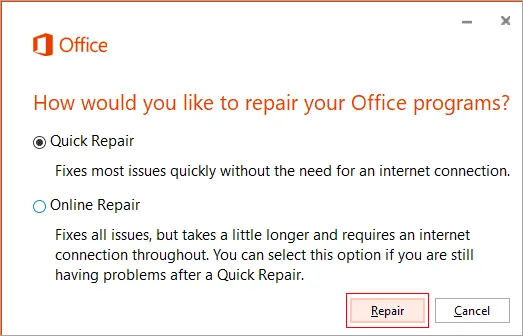
- Right-click on the Microsoft Office program and select ‘Change’.
- Click ‘Quick Repair’ to start the repair process.
- The repair process may take a few minutes to complete, depending on your system and the size of the installation.
- Step 4: Restart your computer and relaunch MS Office
- After the repair process has completed, restart your computer to ensure all changes are properly applied.
- Launch Microsoft Office again to verify that the repair was successful and use the application normally without the error.
- Step 1: Open Outlook and go to File
- Method 11: Check for a Microsoft 365 service-side issue
If none of the client-side checks above have resolved the error, it's worth confirming this isn't a server-side issue. Microsoft has documented a known Exchange Online condition that produces this exact error message — “Cannot start Microsoft Outlook. Cannot open the Outlook window. The set of folders cannot be opened. The attempt to log on to Microsoft Exchange has failed.” — caused by an authentication concurrency limit on the server, independent of anything on your computer.
- As a workaround while this is unresolved, use Outlook on the web or new Outlook for Windows to access your mailbox.
- If you're on a Microsoft 365 business account, ask your admin to open a support case from the Microsoft 365 admin center — Microsoft notes this specific condition needs a service-side change to fully resolve.
- See Microsoft's known-issue documentation for the current status.
- Method 12: Recover data from a damaged PST file
If none of the methods above resolve the error and ScanPST couldn't fully repair your PST file, EdbMails PST Repair Tool can recover data from a PST file that ScanPST can't fix.
- Select the damaged PST file, let the tool scan and repair it, preview the recovered items, then export them to a new, healthy PST file.
- Import the resulting PST back into Outlook to restore access to your mail, contacts, and calendar.
- Method 13: Recover OST Data with EdbMails OST to PST Converter
An OST file is different from a PST — it's a synchronized local cache of a server-backed mailbox, not a portable file on its own. If the OST has become orphaned or disconnected from its original mailbox (for example, after a mailbox deletion, server migration, or profile removal), the export-to-PST method in Method 8 won't work, since Outlook itself can no longer make sense of the file.
In this case, the EdbMails OST to PST Converter can scan the preserved orphaned OST and preview mailbox data that remains present and readable without requiring the original mailbox connection. Outlook is only required afterward if you want to import the exported PST into a local Outlook profile. Migrating the recovered data directly into Microsoft 365 or an Exchange Server mailbox does not require Outlook.
- Select the orphaned or damaged OST file, let the tool scan it, preview the recovered mailbox contents, then export the selected folders to PST or migrate them directly.
- For the complete walkthrough with screenshots, see the OST to PST conversion guide.
Additional Resources: