


How to Recover Deleted Items from an OST File
Efficient email management plays a vital role in day-to-day business operations, and platforms such as Outlook and Exchange Server offer quick access to emails and other data. However, accidental deletion of email items, folders, or other mailbox data can result in sudden data loss, which may interrupt communication and impact overall productivity.
In general, when emails or folders are deleted in Outlook, they are moved to the ‘Deleted Items’ folder, from where they can be restored easily. However, when these items are permanently deleted either manually or due to mailbox retention policies, recovering them is more complex. In such cases, the EdbMails OST to PST Converter can scan the OST file for recoverable deleted items, letting you preview, select, and export data that remains present and readable in the source.
This page covers recovering individual emails, folders, contacts, and calendar items from an OST file. If an entire mailbox was deleted rather than individual items, see Recover Mailbox After Exchange Mailbox Deletion or Recover Mailbox After Microsoft 365 Account Removal instead.
If the mailbox still exists, first check the Deleted Items and Recoverable Items folders using Outlook or Exchange. Use OST recovery only when the mailbox or server is unavailable, or when the source OST contains recoverable data that is no longer available in the live mailbox.
EdbMails enables recovery even when the original Outlook profile or Exchange server connection is unavailable. Through a step-by-step interface, the tool guides you through scanning the OST, previewing recoverable items, and exporting or migrating the selected data.
Reasons for OST File Data Deletion
Mailbox items can be deleted in different ways, and the available recovery method depends on how the item was removed and whether it is still retained by Exchange or Microsoft 365.
- Soft deletion: The deleted email or mailbox item is moved to the Deleted Items folder in Outlook. It can usually be restored directly from that folder while it remains available there.
- Hard deletion: An item deleted using Shift+Delete or removed from the Deleted Items folder bypasses the normal Deleted Items view. Depending on the Exchange or Microsoft 365 retention configuration, the item may still remain in the server-side Recoverable Items structure and may be recoverable during the applicable retention or hold period.
Reasons for Permanent Deletion of OST File Data
- When the Shift+Delete key is pressed for deleting an item, it leads to permanent deletion.
- When the Deleted items folder is accidentally emptied without backing up the data.
If the mailbox still exists, first check the Deleted Items and Recoverable Items folders using Outlook or Exchange. If the mailbox or server is unavailable, or the OST file cannot be opened, use OST recovery only for data that is actually recoverable from the source OST file.
Practical Situations of Deleted Email Recovery from Outlook Files
Here are some real time scenarios where recovering deleted email items from an OST file can be necessary:
- Accidental Deletion: An email can be accidentally deleted by a user, which may result in the permanent loss of important data. In such cases, EdbMails can help to recover deleted items from OST file or items from an OST file and export them to a PST file.
- Corruption: OST files may become corrupted because of unexpected system shutdowns, malware, storage errors, or other file-level issues. Corruption does not necessarily delete mailbox items, but it can make some emails, folders, attachments, or other data inaccessible or unreadable. EdbMails can scan the damaged OST file and recover mailbox data that remains readable without requiring access to the original Exchange or Microsoft 365 mailbox. If the OST came from a system affected by malware, work from a copy of the file only after the endpoint has been cleaned or remediated.
- Accidental Modification: Users may accidentally modify or overwrite an email item, losing the earlier version. Recovering that earlier version is a backup or version-history question rather than a deleted-item recovery question. If a backup of the mailbox or OST from before the change exists, that backup, not OST deleted-item recovery, is the source to check.
- Exchange Server failure: An Exchange Server crash or failure can make mailbox data temporarily or permanently unavailable, but it does not inherently mean that individual emails were deleted. If the server-side mailbox cannot be recovered and a usable local OST file remains, EdbMails can scan the OST and recover readable mailbox data. For detailed guidance, see Recover OST After Exchange Server Failure.
Outlook native deletion hierarchy
| Stage | First recovery path |
|---|---|
| Item in Deleted Items | Move/restore from Deleted Items |
| Removed from Deleted Items / Shift+Delete | Recover Deleted Items / Recoverable Items if supported |
| Retention/hold preserves item | Admin/compliance recovery where applicable |
| Mailbox unavailable, OST survives | Offline OST recovery may help if data exists in file |
Deleted-Item Recovery Source Order
Before using OST recovery, follow the appropriate recovery source based on where the deleted item may still exist. The recovery path depends on mailbox availability, retention settings, and whether the OST file contains readable cached data.
| Priority | Source | Use it when |
|---|---|---|
| 1 | Deleted Items folder | The item has not been permanently removed. |
| 2 | Recover Deleted Items / server retention | The mailbox is active and the server retention window still applies. |
| 3 | Backup, retention or eDiscovery source | Organizational retention systems contain an authoritative copy. |
| 4 | Preserved offline OST | The file may still contain readable remnants or locally cached content unavailable elsewhere. |
Factors That Affect Deleted OST Recovery
The recovery outcome depends on synchronization status, OST condition, local caching, and whether deleted data has been overwritten after removal.
- Whether the deletion synchronized with the server.
- Whether Outlook compacted or overwrote the relevant local data.
- The condition of the OST and storage device.
- Whether the requested folder was cached locally.
- How much the file was used after deletion.
Important: Do not assume every deleted item can be recovered. Preserve the source OST file, preview detected data, export a representative sample, and verify the recovered result.
Recover Deleted OST Items with EdbMails OST to PST Converter
Deleted mailbox items may remain available in the Recoverable Items structure depending on the mailbox configuration, retention settings, and what was synchronized into the local OST file. Items removed from the normal Deleted Items folder may still be recoverable while they remain retained by Exchange or Microsoft 365.
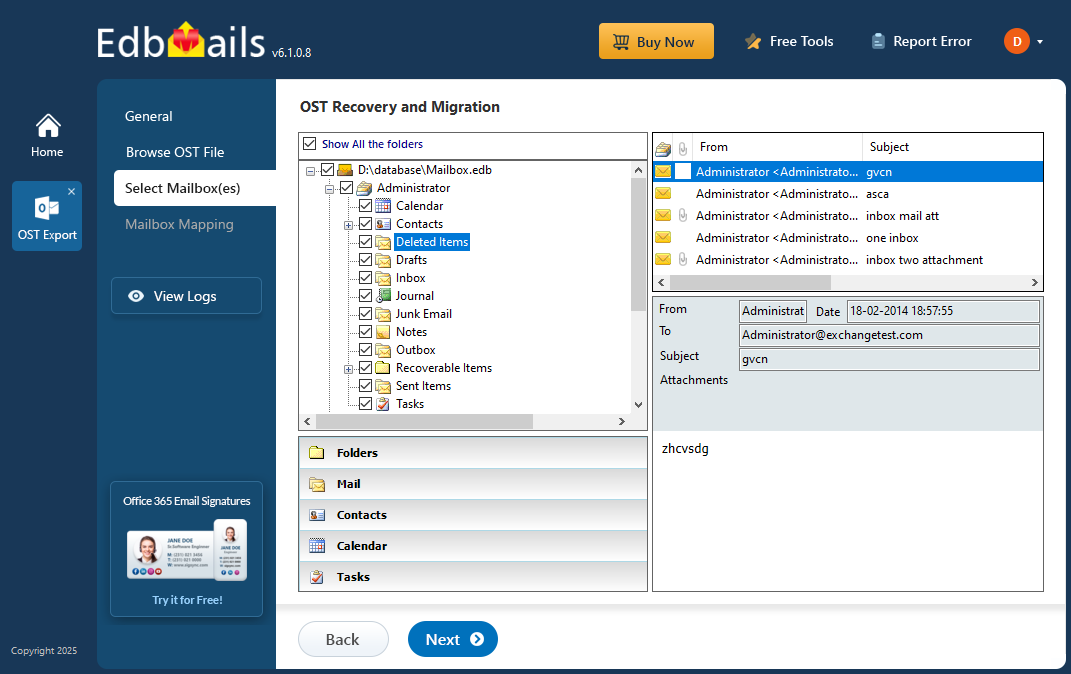
EdbMails scans the OST file and displays readable deleted mailbox items that are available in the source. You can preview recovered emails, contacts, calendar items, and other mailbox data before selecting the required items for recovery.
To recover deleted items from an OST file:
- Download and install EdbMails, then sign in or start the free trial.
- Select the offline or orphaned OST file that you want to scan.
- After the scan completes, preview the readable mailbox folders and deleted items available for recovery.
- Select the required folders or items and export them to PST or migrate the recovered data to the required destination.
For detailed export steps, see the OST to PST conversion guide. For the product overview, supported OST conditions, trial, and export options, see the EdbMails OST to PST Converter.
Deleted folder vs deleted items inside a folder
Recovering a deleted folder is not always the same as recovering individual messages that were inside it. In classic Outlook, a permanently deleted folder may not be restored as the original folder through Recover Deleted Items, even when some messages from that folder are still recoverable separately.
If the folder structure itself is no longer available, recover the individual readable items first and then recreate the required folder structure in the destination if necessary.
Live mailbox recovery vs offline OST recovery
The preferred recovery path depends on whether the Exchange or Microsoft 365 mailbox is still available. If the live mailbox can be accessed, use native Deleted Items or Recoverable Items recovery first. OST recovery is mainly a fallback when the server-side recovery path is unavailable and a usable local OST remains.
| Live mailbox available | Offline or orphaned OST |
|---|---|
| Use Deleted Items or Recoverable Items first | Scan the local OST for readable recoverable data |
| Server-side retention may preserve additional items | Only data present and readable in the OST can be recovered |
| Recovered items can be restored back into the mailbox | Recovered data can be exported to PST or migrated to a supported destination |
What EdbMails may recover from an OST file
EdbMails can scan an OST file and recover mailbox data that is still present and readable in the source. Depending on the OST contents and condition, recoverable data may include deleted emails available in recoverable structures, as well as readable contacts, calendar items, tasks, folders, attachments, and other supported mailbox properties.
During preview, active mailbox items and deleted or recoverable items should be reviewed separately so that only the required data is selected for recovery. For native recovery of an individually deleted contact, see Microsoft's guide to restoring a deleted contact in Outlook.
Granular Restore Options: Recovery does not have to mean restoring the entire mailbox. After scanning the OST, you can select specific folders, date ranges, or individual items rather than exporting everything. See Granular recovery of OST file for the full selective-export workflow.
Recovery limitation: Only data that still exists and remains readable in the source OST can be recovered. EdbMails cannot recreate mailbox items that were never cached locally or that have already been permanently purged, overwritten, or are no longer present in any available source.
OST recovery workflow
- Preserve a copy of the original OST file.
- Scan the OST.
- Review active and recoverable or deleted folders and items.
- Preview and select the required mailbox data.
- Export the recovered data to PST or migrate it directly to a supported mailbox.
- Validate the recovered items and review the result.
Choose the recovery destination
| Goal | Recovery path |
|---|---|
| Create a local or portable recovery copy | OST → PST |
| Restore data to an Exchange Server mailbox | OST → Exchange Server |
| Restore data to a Microsoft 365 mailbox | OST → Microsoft 365 |
EdbMails can scan and preview the OST without Outlook installed. Outlook, with a configured profile, is required only when exporting the recovered data to a PST file; migrating directly from OST to Microsoft 365 or Exchange does not require Outlook.
Frequently Asked Questions (FAQ)
What is the difference between Deleted Items and Recoverable Items?
Can Shift+Delete items still be recovered?
Can I recover a permanently deleted folder?
How long are Recoverable Items retained?
Can I recover deleted items if the mailbox no longer exists?
Can an OST contain deleted items?
What if the OST is corrupt?
Can I restore only selected deleted messages?