


Google Workspace Migration Settings
EdbMails lets you control exactly how your Google Workspace migration runs, from how repeat migrations are handled to how much of your data is carried over. Incremental migration is built in, so consecutive runs to the same target pick up only new or changed items, and you can add a stricter item-by-item comparison or re-migrate to an empty target when needed. You can also filter what gets migrated by received date, subject, attachment, sender, recipient, CC, BCC, or read/unread status, split large mailboxes into smaller PST files, exclude oversized emails or attachments, migrate message content without attachments, and leave out specific standard or custom folders. This gives you full control over what actually gets migrated, instead of moving everything by default.
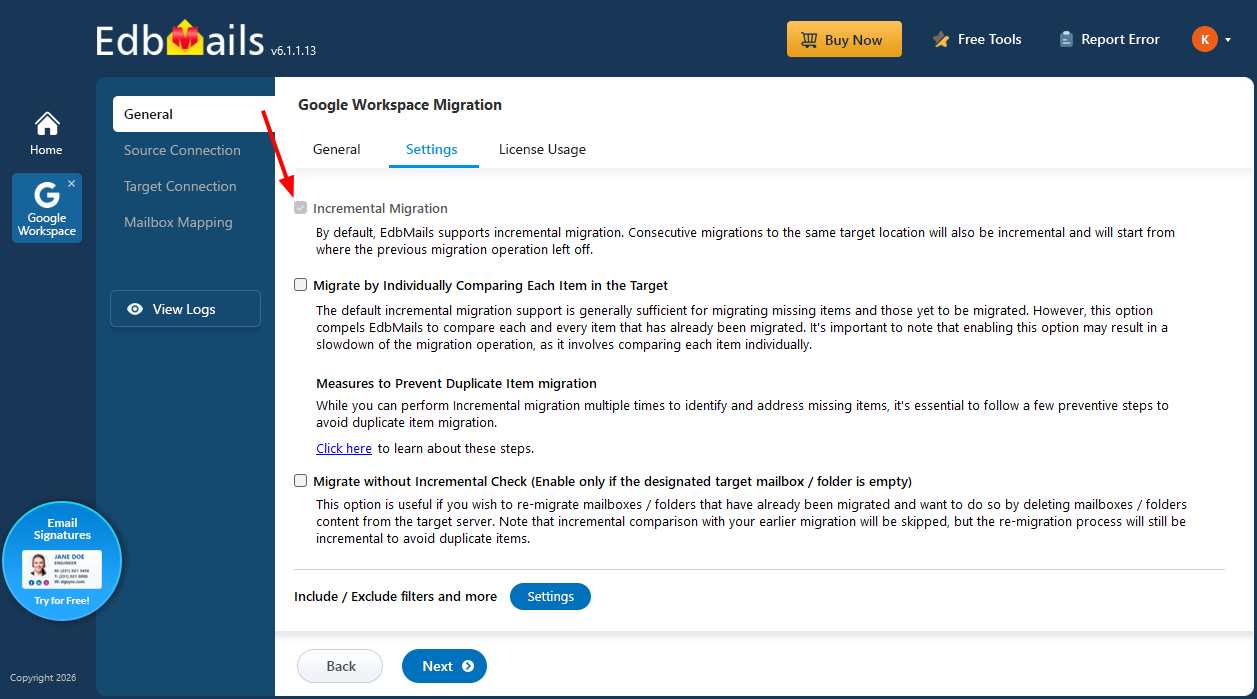
Incremental Migration
Incremental (Delta) migration is turned on by default and applies to every migration. When you run the migration more than once between the same source and target, EdbMails compares the source against what was already migrated and moves only the new or changed items since your last run. This lets you re-run the migration to catch anything that arrived or changed in the source afterward, without creating duplicate items on the target.
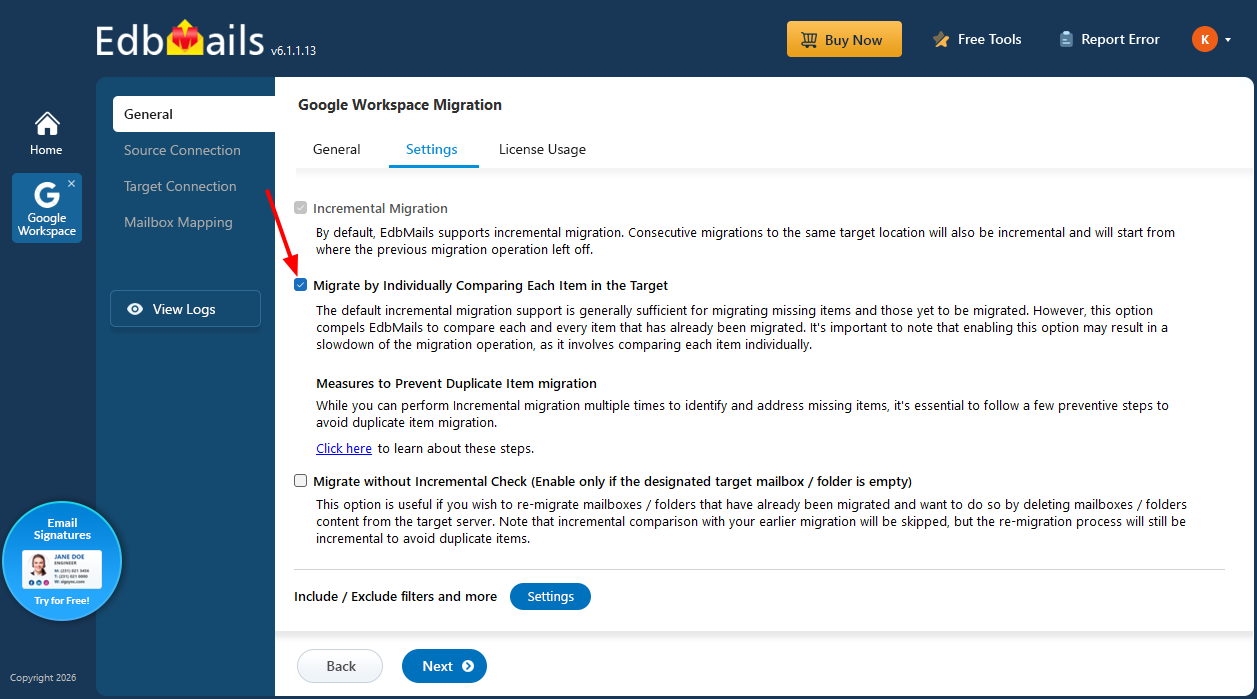
Migrate by Individually Comparing Each Item in the Target
For most migrations, the default incremental behavior is enough to bring over missing items and anything not yet migrated. This option adds a stricter level of checking, comparing every item that has already been migrated against the target rather than relying on the standard incremental check. Because EdbMails examines each item on its own, the comparison takes longer, so it suits situations where you want that extra level of verification and are comfortable with a slower migration.
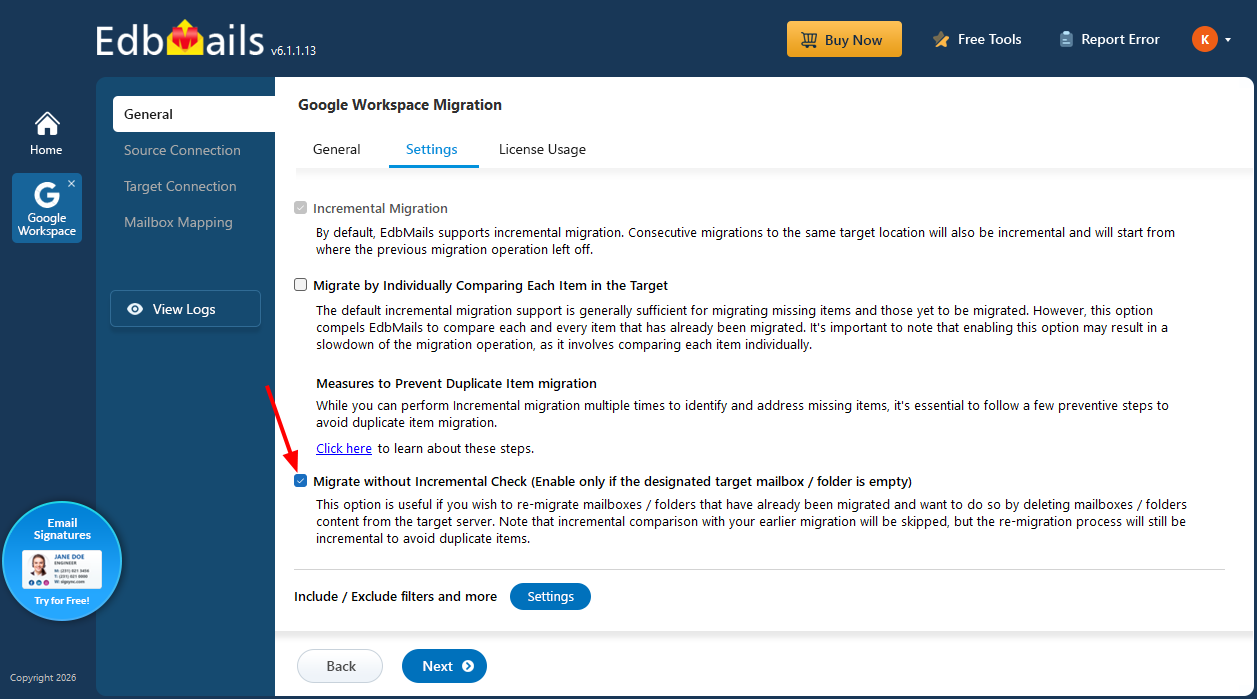
Migrate without Incremental Check
This option is useful when you want to re-migrate mailboxes or folders that were already migrated, for example after deleting their contents from the target server. The incremental comparison with your previous migration is skipped, but the re-migration still runs incrementally so that duplicate items are avoided.
Include / Exclude Filters and More
The Settings button next to this option opens a window where you can narrow down exactly what gets migrated instead of moving everything. The choices you make here apply to all export and migration operations, so they are worth a look when you only want a subset of your data carried over.
Include / Exclude Filters for Export and Migration
Select this checkbox to filter items by a condition rather than migrating the whole mailbox, then choose whether to include or exclude the matching items.
Include: Choose this to migrate only the items that match your filter criteria, so the migration carries over just the data you need.
Exclude: Choose this to skip the items that match your filter criteria, so everything except those items is migrated.
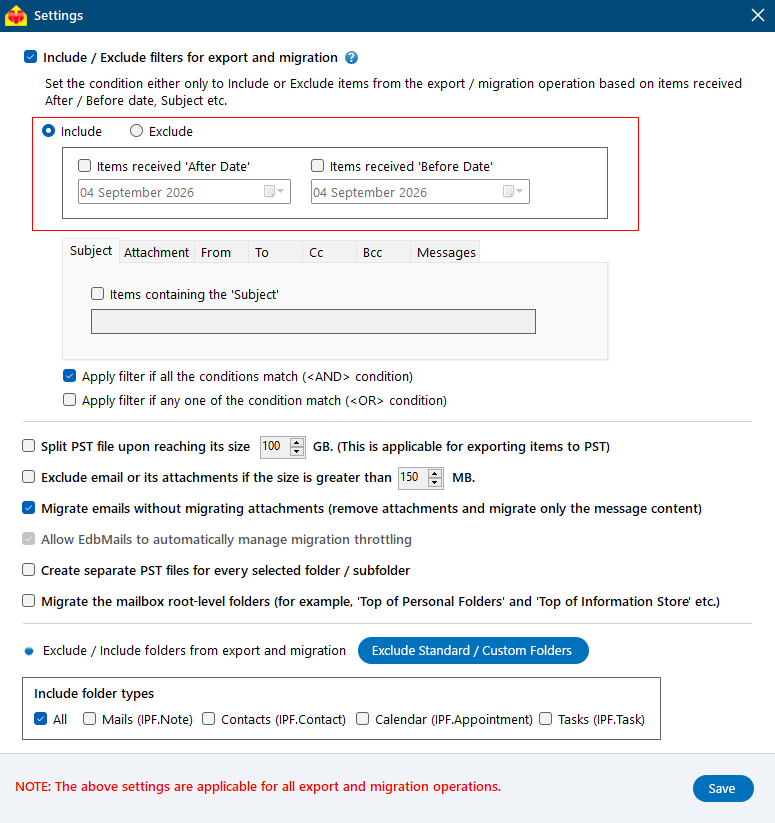
Filters: EdbMails gives you filters to customize your migration operation. The Date Filter includes or excludes items based on the date they were received, letting you define an 'After Date', a 'Before Date', or both to migrate items within a particular date range. You can also filter by Subject for the email or calendar subject, Attachments for the names of attachments contained in emails, From for emails sent by specific senders, To for emails sent to specific recipients, Cc and Bcc for specific CC and BCC addresses, and Messages for emails based on their read or unread status.
When you apply more than one filter, you control how they work together. Choose Apply filters if all the conditions match for an AND condition, where filters are applied only when all specified conditions are satisfied, or Apply filters if any one of the conditions match for an OR condition, where filters are applied when at least one of the specified conditions is met.
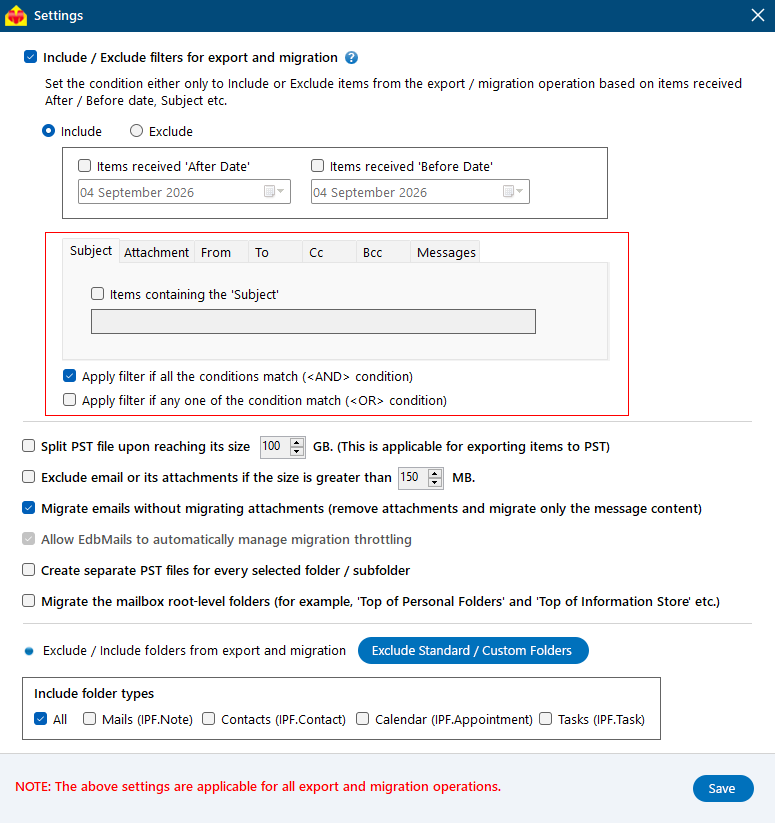
Split PST file upon reaching its size
This applies when you are exporting items to PST. Set a size in GB, and EdbMails starts a new PST file once the current one reaches that limit. It keeps individual PST files at a manageable size instead of producing one very large file. By default, a separate PST file is created for each mailbox.
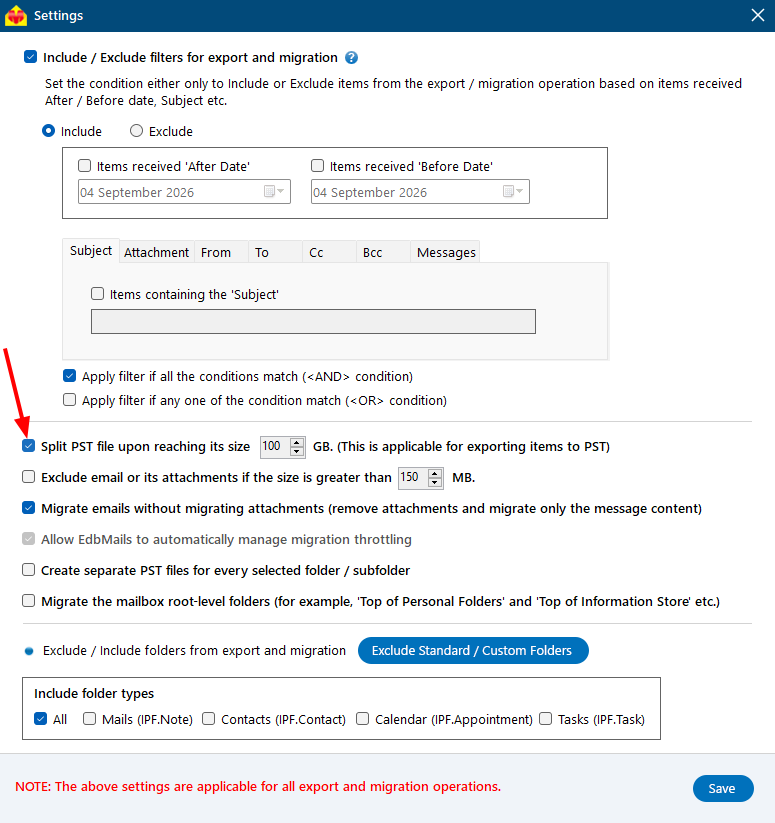
Exclude email or its attachments if the size is greater than
Set a size in MB to leave out items above that threshold. This is handy when you want to skip unusually large emails or attachments to keep the migration lighter, which helps when you are working with storage-limited target plans.
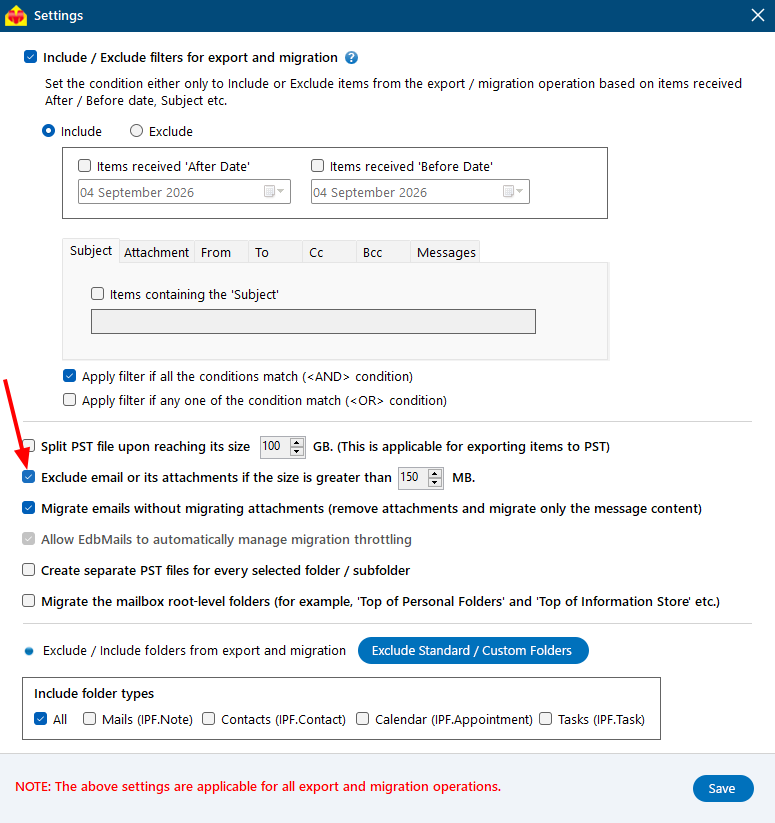
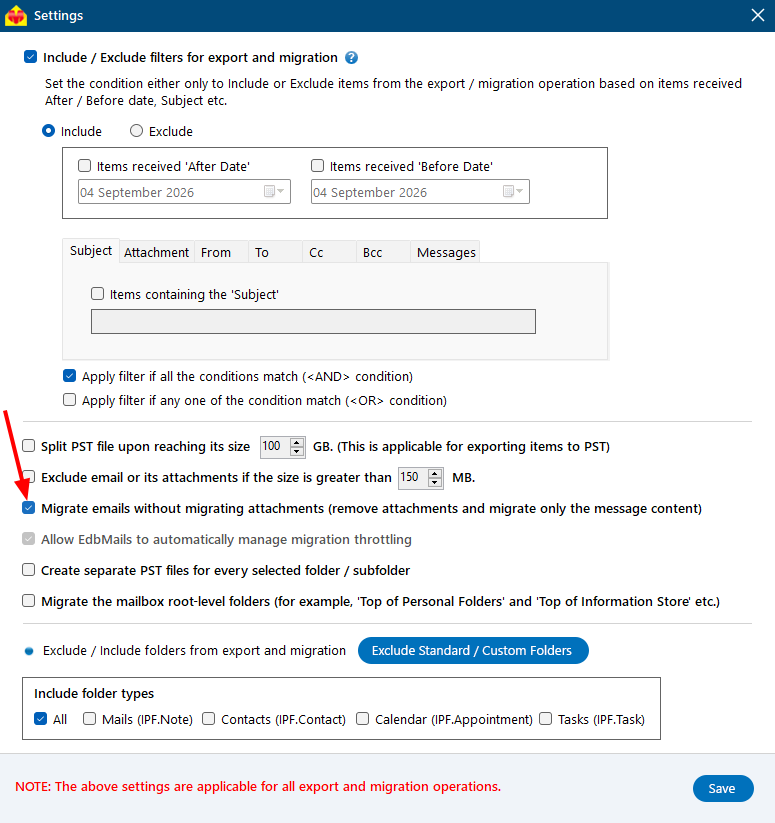
Migrate emails without migrating attachments
Turn this on to bring over only the message content and leave attachments behind. The emails still migrate, just without their attached files. This reduces the overall migration size and saves storage space when large attachments are not essential.
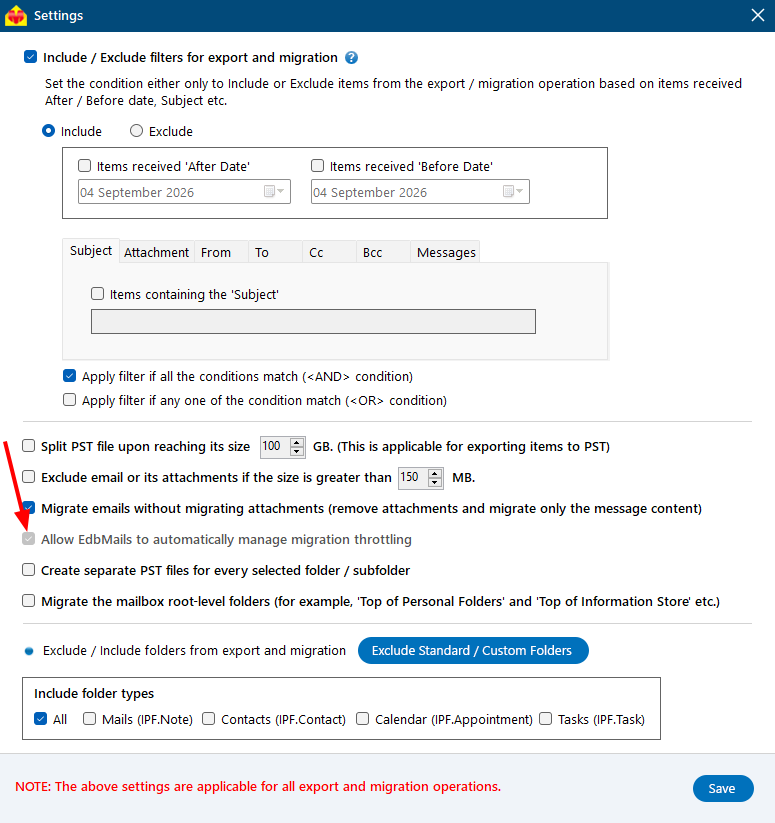
Allow EdbMails to automatically manage migration throttling
This option is enabled by default. During migration, servers such as Microsoft 365 apply throttling limits that can slow down or interrupt the transfer of data. EdbMails automatically works within these limits and adjusts its migration speed as needed, so your migration keeps running smoothly without manual intervention.
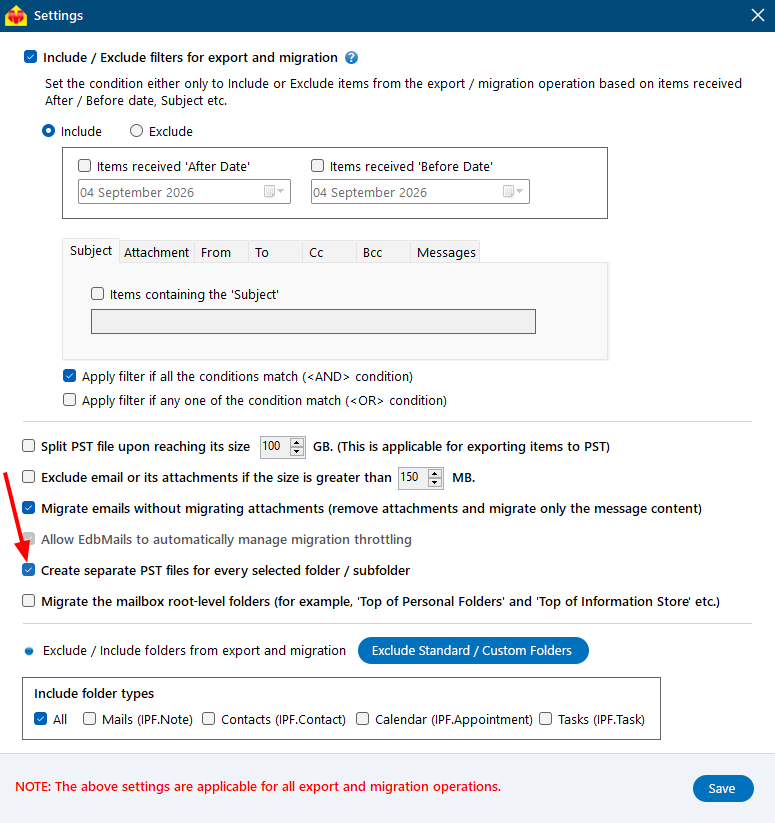
Create separate PST files for every selected folder / subfolder
When you are exporting to PST, this creates an individual PST file for each folder and subfolder you selected, rather than combining them into one. It is useful when you want your exported data organized folder by folder, making it easier to manage or review each folder separately.
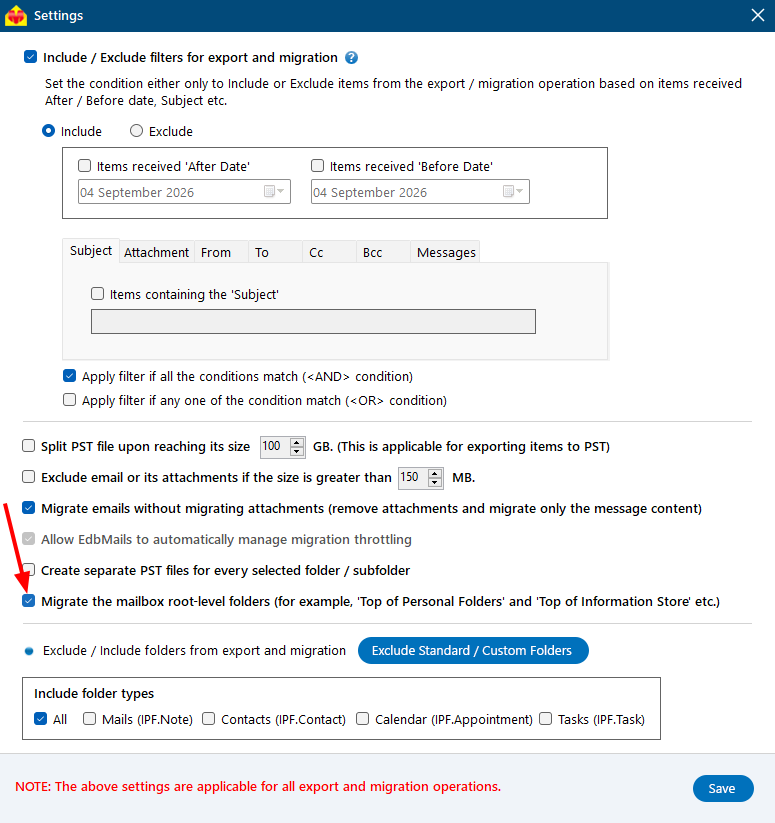
Migrate the mailbox root-level folders
Some mailbox items sit at the root level, outside the standard folder hierarchy, usually under containers such as 'Top of Personal Folders' or 'Top of Information Store'. Turn this on to include those root-level folders in the migration so that content outside the usual folder structure is not overlooked.
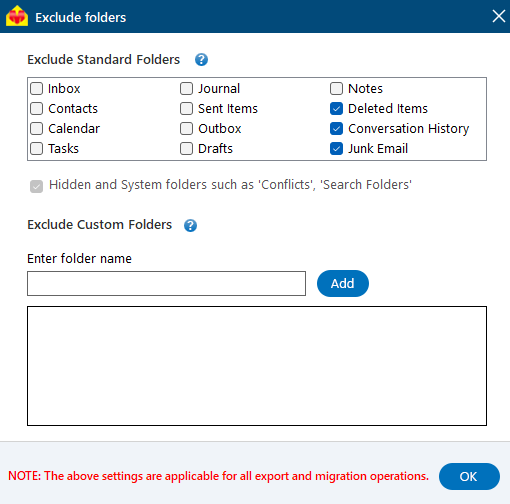
Exclude Standard / Custom Folders
The Exclude Standard / Custom Folders button lets you choose specific standard or custom folders to leave out of the migration. By default, folders such as 'Deleted Items', 'Conversation History', and 'Junk Email' are left out, and you can add more standard folders or enter custom folder names to exclude as well.
Include folder types
This is where you pick which kinds of items to migrate. All covers everything, or you can select individual types: Mail, Contacts, Calendar, and Tasks. Choose only the types you need if you want to migrate, say, mail without contacts or calendar data.
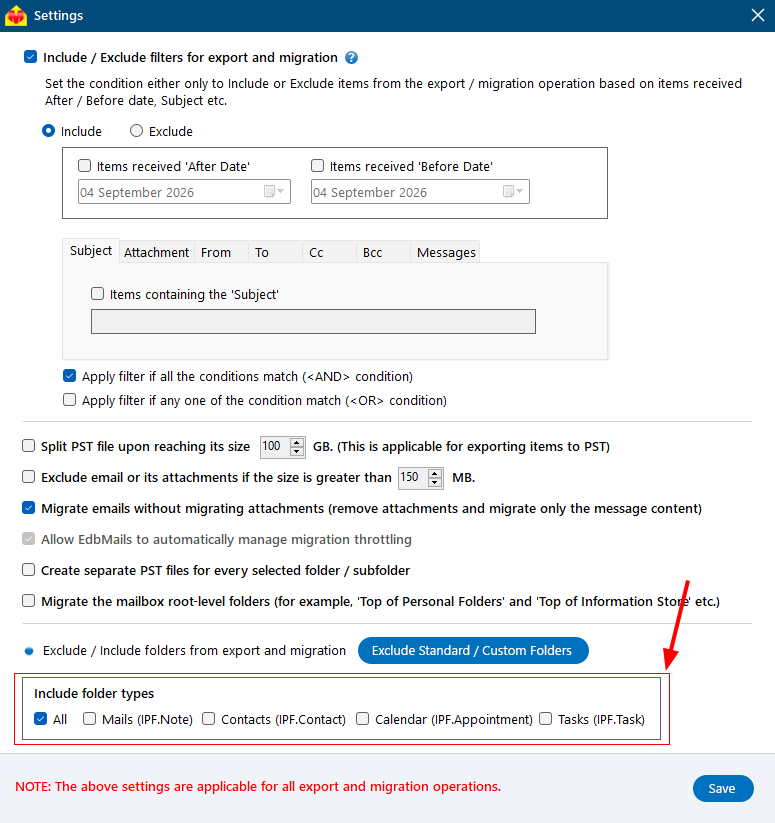
Click the 'Save' button to apply the settings.