

How to Migrate Google Workspace Mailboxes in Batches
Migrating a single Google Workspace mailbox is generally a straightforward administrative task. However, large-scale migrations involving hundreds or thousands of mailboxes introduce additional challenges such as authentication inconsistencies, Google API rate limiting, interrupted migration sessions, mailbox mapping errors, and incomplete data synchronization. Without centralized management and automated retry mechanisms, these issues can significantly increase administrative effort and delay project completion. That's the reality most IT teams run into the first time they try to move an entire domain out of Google Workspace by hand.
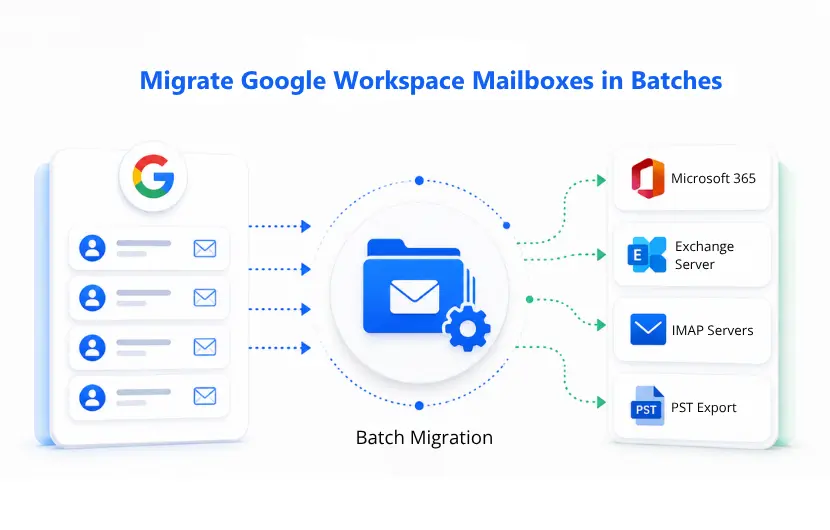
Batch mailbox migration solves this by treating the whole user base as one coordinated job instead of hundreds of separate ones. Instead of logging into each account, exporting data, and re-importing it on the other side, an admin account authorizes the transfer once, and every selected mailbox moves in parallel under the same set of rules. EdbMails simplifies batch Google Workspace migration by allowing administrators to authenticate once with administrative credentials and migrate multiple mailboxes parallely. It supports the migration of emails, contacts, calendars, and tasks to Microsoft 365, Exchange Server, and IMAP-compatible mail servers with centralized mailbox management, automated mailbox mapping, and continuous migration monitoring.
This guide walks through what batch migration actually involves, when it's the right call, and how to run one from start to finish.
What Counts as a Batch Mailbox Migration
Batch migration means moving a defined group of mailboxes together, under one job, with shared settings for mapping and filtering. It's different from a single mailbox migration, where you connect to one account and move its data on its own, and it's also different from running the same migration tool separately for every user by hand.
The distinction matters because the failure points are different. A single mailbox migration can hit per-user API limits on very large accounts, but it rarely runs into mapping conflicts since there's only one destination to configure. A domain with hundreds of mailboxes is meant to run in parallel, since migrating them one at a time would take far too long to be practical, but that parallelism draws on a shared, project-wide API quota across every concurrent job. Without a managed concurrency limit and automatic throttling, a batch job can exhaust that quota quickly, and with hundreds of source-to-destination pairings configured at once, mapping conflicts become more likely too. A batch migration tool needs to run mailboxes in parallel within a controlled concurrency limit, with rate limits and backoff handled automatically, since a single mailbox migration doesn't demand that level of coordination.