


 Cart
CartControl the repository
Administrators choose the storage location and apply their own access, redundancy and retention controls, rather than depending on a vendor's repository.
EDB Recovery and Migration
EdbMails lets you recover corrupted, damaged, and offline Exchange EDB files, convert EDB mailboxes to PST format, and directly migrate mailbox data to Office 365 and live Exchange Server.


OST, PST, MBOX, NSF, EML, MSG Export and Migration
EdbMails lets you to recover OST and PST files, export OST, PST, MBOX, NSF, EML, and MSG files to PST files, and directly migrate OST, PST, MBOX, and NSF mailbox data to Office 365 and live Exchange Server.


Office 365, Exchange Migration
EdbMails lets you securely migrate mailboxes across Microsoft 365, Exchange, Google Workspace (G Suite), and IMAP-supported servers such as Outlook, Gmail, Zimbra, Zoho Mail, and cPanel, ensuring zero downtime.


SharePoint, OneDrive & Microsoft Teams Migration
EdbMails lets you migrate SharePoint sites, OneDrive data, Microsoft Teams, teams, channels, chats, permissions, and documents between Microsoft 365 tenants while maintaining the existing folder structure and data integrity.
Google Workspace / G Suite Migration
EdbMails offers secure Google Workspace migration to Office 365, Exchange, or IMAP, and export to PST covering emails, contacts, calendars and tasks.


IMAP Migration
EdbMails IMAP Migration tool lets you easily migrate emails from IMAP servers such as Outlook, Gmail, Zoho Mail, Zimbra, cPanel, and more. Supports IMAP to IMAP, Office 365, Exchange Server, PST, and bulk PST to IMAP migration.


Duplicate Remover
EdbMails Duplicate Remover lets you easily remove duplicate items from Office 365 and Exchange Server, and from IMAP, Outlook, Gmail, Zimbra, Zoho Mail, etc., ensuring a clean and organized mailbox.


Exchange, SharePoint, OneDrive, Teams and Office 365 Backup
EdbMails enables secure, automated backup and recovery for Microsoft 365 services including Exchange Online, SharePoint, OneDrive, Teams, and Live Exchange Server with complete data protection and restore flexibility.

EdbMails Data Recovery
EdbMails Data Recovery Software lets you recover permanently deleted data, including photos, videos, documents, and archived files, from partitions on hard drives, SSDs, USB drives, SD cards, and external storage devices.
Back up supported SharePoint Online content to a local or network location chosen by your IT team. EdbMails enables organizations to maintain a separate backup repository under their own storage and access policies.
EdbMails backs up SharePoint Online to storage controlled by your organization. Instead of keeping the protected copy only in a vendor-managed cloud, EdbMails stores the SharePoint backup on a supported local disk, external drive or network/shared location you select. For the main product page, see SharePoint Online Backup.
The live SharePoint source stays in Microsoft 365. "Local" refers to where EdbMails writes the protected backup copy. The source content is still read from SharePoint Online over an authorized connection, and the resulting protected copy is placed on storage your organization owns and manages.
Administrators choose the storage location and apply their own access, redundancy and retention controls, rather than depending on a vendor's repository.
Organizations can use supported local disks, external drives or network storage already managed by IT, without purchasing separate vendor-hosted backup capacity.
A copy stored outside the live SharePoint service gives another recovery source if content is deleted, a site changes, or historical content must be retained.
A customer-controlled SharePoint backup fits the widely used 3-2-1 principle: keep at least three copies of important data, on two different types of media, with at least one copy off-site or offline. The live SharePoint content is one copy, an EdbMails backup on local or network storage is a second independently controlled copy, and a replicated or offline duplicate of that backup serves as the off-site copy. Native recycle bins and version history are convenience recovery features, not an off-site copy, so they do not by themselves satisfy the principle.
| Copy | Example in this model | Purpose |
|---|---|---|
| Copy 1 (production) | Live SharePoint Online content | Day-to-day access |
| Copy 2 (local backup) | EdbMails backup on local/network storage | Independent, organization-controlled recovery source |
| Copy 3 (off-site/offline) | Replicated or offline duplicate of the backup | Protection against site or storage failure |
A local disk is simple to deploy but concentrates the backup on one computer. External storage can provide physical separation, while network storage centralizes repository management at the cost of a network dependency. The right option depends on data volume, IT operations, availability requirements and security policy.
| Option | Best for | Main dependency |
|---|---|---|
| Local disk | Controlled environments with reliable storage on the backup computer | Local disk health and capacity |
| External drive | A physically separable copy that is securely managed | Secure handling of the drive |
| Network storage | Centralized capacity and shared administration | Network availability and permissions |
You own the repository, size the capacity, run it on your own desktop or local infrastructure, and design any secondary or offline copy yourself.
The vendor manages the repository and capacity, delivers it as a hosted service, and any secondary copy depends on the provider's own features.
| Area | Local/network (EdbMails) | Cloud/SaaS backup |
|---|---|---|
| Repository control | Customer managed | Vendor managed |
| Capacity responsibility | Customer | Provider |
| Operational model | Customer-run desktop/local | Hosted service |
| Secondary/offline copy | Organization designs its own | Depends on provider features |
Create a SharePoint backup job and choose the local or network repository.
Connect to SharePoint Online with the required administrator access.
Load and select the sites and content to protect.
Start the backup and review the logs.
Run recurring incremental backups to keep the local copy current.
Do not size the repository only for today's SharePoint volume. Capacity planning should include future growth, recurring incremental data and the number of protected jobs.
Do not assume a local repository is automatically isolated. If the storage is continuously writable from compromised systems, it can be at risk during a security incident, so access controls and a secondary copy matter.
Restrict file-system access to authorized administrators.
Use reliable storage with health monitoring and appropriate redundancy.
Keep the Windows computer running EdbMails patched and access-controlled.
Protect the account used to run backups and reach any network share.
Maintain a second or offline copy for critical data, and test restores periodically.
A backup is most useful during a destructive incident when it is not simply another writable copy exposed to the same credentials and endpoints as production. Repository access restrictions and secondary copies reduce this shared-risk problem. For ransomware-specific guidance, see SharePoint backup for ransomware recovery.
When recovery is needed, open the EdbMails backup, browse the protected SharePoint content and select the required scope. Supported restore destinations include the same or another Microsoft 365 tenant. See SharePoint Online backup and restore.
Can I use an external hard drive?
Yes, where the drive is accessible to the Windows computer and is a supported writable location. Ensure adequate capacity and secure handling.
Can I use a network or shared drive?
Yes, where the location is accessible and supported. Verify permissions, capacity and network reliability before large jobs.
Does local backup mean SharePoint is not accessed during backup?
No. The source content is still read from SharePoint Online over an authorized connection. "Local" only refers to where the protected copy is stored.
Is the local SharePoint backup kept only on one computer?
It is stored where you choose. You can keep it on one computer, on network storage, or design a secondary/offline copy under your own storage policy.
How much storage will the backup need?
Plan for current SharePoint size in scope plus growth, recurring incremental data and operational free space, and monitor capacity before recurring runs.
How does local backup fit the 3-2-1 rule?
The live SharePoint content is one copy, the EdbMails local backup is a second independently controlled copy, and a replicated or offline duplicate can serve as the off-site copy.
Should I use a local disk or a network share?
A local disk suits controlled environments with reliable storage; a network share suits centralized administration but adds a network-availability dependency.
Can the local backup be restored to another tenant?
Yes. The supported restore workflow can target the same or a different Microsoft 365 tenant.
How do I keep the local backup secure?
Restrict repository access, patch and control the backup computer, protect the running account, and keep a secondary or offline copy for critical data.
Does the backup computer need to be available for recurring runs?
Yes. Scheduled or repeated runs depend on the backup computer being available and able to reach SharePoint Online at the chosen time.
Is a local copy enough on its own?
For critical data, a single writable local copy is not ideal. Combine it with access controls and a secondary or offline copy so one incident does not affect every copy.
EdbMails Demo / Trial Version
Step 1. Download and install EdbMails
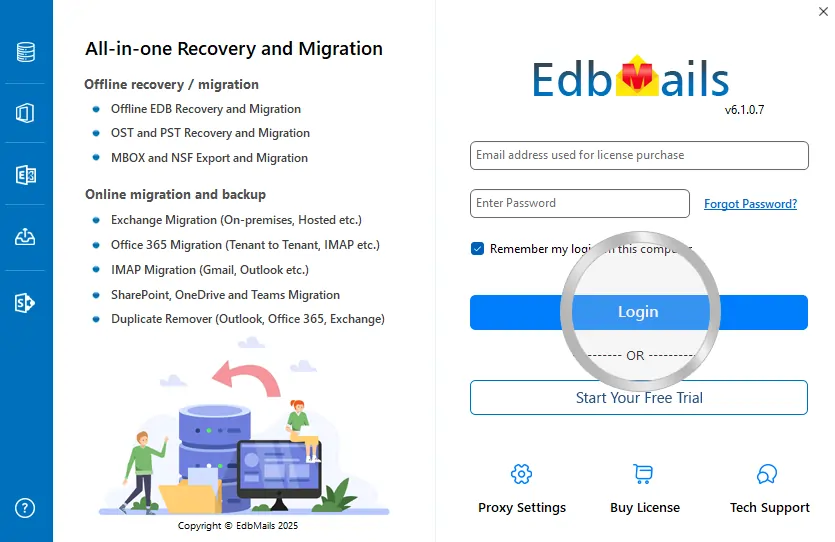
Step 2. Click the 'Start Your Free Trial' button

Hi, May I help you?
Hide Chat Now